This post was originally published on here
The next major accident involving falling space debris is not a matter of if, but when. And when it happens, the question will not be why a single satellite failed to burn up, but why no regulator was counting the cumulative risk from 70,000 of them.
For two decades, spacefaring nations have operated under a simple rule: any satellite sent into orbit must have a less than one in 10,000 chance of injuring someone on the ground. The rule was written when a few dozen objects reentered the atmosphere each year. By early 2026, with more than 9,000 Starlink satellites in orbit and filings for constellations totaling over 70,000 spacecraft, that arithmetic no longer holds.
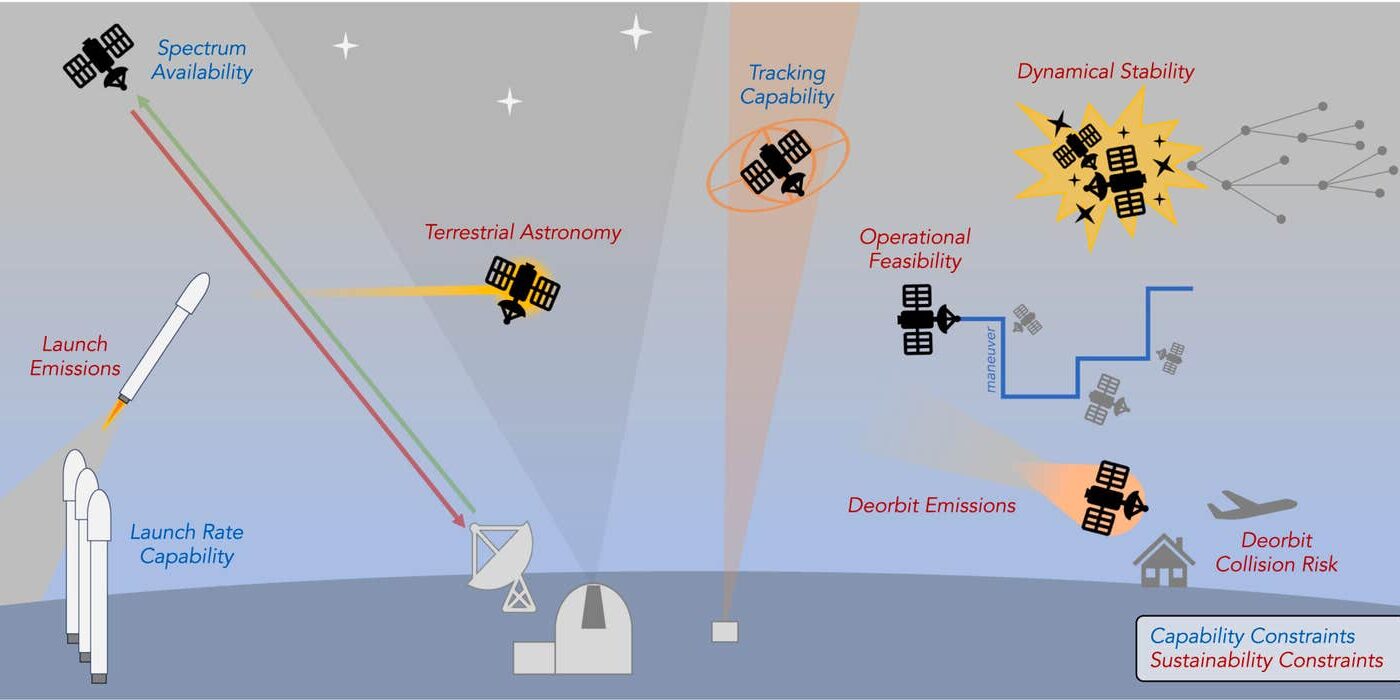
Researchers have now done the math that regulators have not. A study published in the journal Acta Astronautica calculated the collective probability that debris from eleven major megaconstellations will hit someone. The result was 40 percent. The figure represents a fundamental gap between how safety is assessed and how risk actually accumulates when tens of thousands of objects come down.
The Reentry Physics Problem
Satellites do not simply vanish when they reenter the atmosphere. They break apart at approximately 80 kilometers altitude, and most components vaporize from frictional heating. But materials with high melting points routinely survive. Stainless steel fuel tanks, titanium pressure vessels, and tungsten reaction wheels are designed to withstand extreme conditions in space, which also makes them likely to withstand partial reentry.
SpaceX designs its Starlink satellites for what the industry calls “design for demise,” meaning they should disintegrate completely. Physical evidence has repeatedly contradicted that guarantee. In 2024, a 2.5 kilogram fragment of a Starlink satellite crashed onto a farm in Saskatchewan, Canada, an incident documented by Canadian Manufacturing.
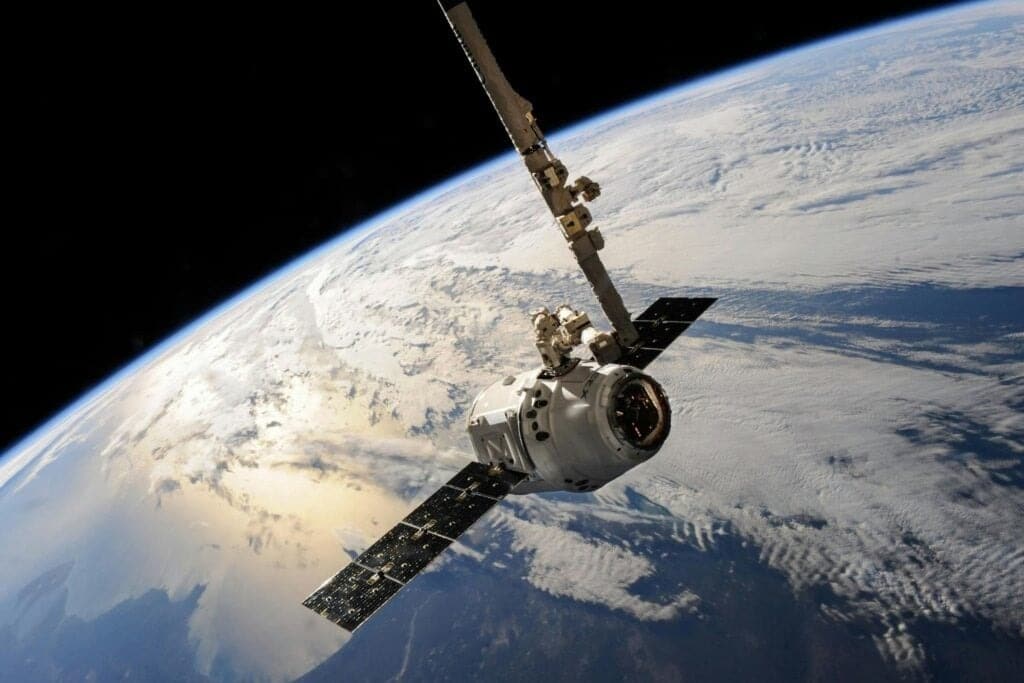
The company later acknowledged the incident and attributed the survival to an earlier than expected loss of control, which reduced atmospheric friction and allowed a piece of the spacecraft to reach the ground intact. Similar fragments have since been reported in Poland, Kenya, North Carolina, and Algeria.
The spacecraft involved in these incidents were the older 700 kilogram version of Starlink satellites. SpaceX is now launching second generation satellites with a mass of approximately 2 metric tons, more than eight times heavier than the original 250 kilogram design. Whether a spacecraft eight times larger can be engineered to burn up completely is an open question that materials science has not yet answered, and one that The Register notes has drawn increasing scrutiny from aerospace engineers.
Atmospheric Chemistry and the Ozone Layer
Debris on the ground attracts immediate attention, but atmospheric scientists are tracking a slower process with potentially larger consequences. When satellites vaporize in the mesosphere, 50 to 80 kilometers above Earth, they release clouds of vaporized metals that condense into aerosol particles. Those particles descend into the stratosphere, where Earth’s protective ozone layer resides.
Aluminum is the element of greatest concern. Upon reentry, aluminum oxidizes into aluminum oxide nanoparticles. A single 250 kilogram satellite generates roughly 30 kilograms of these particles. Unlike chlorofluorocarbons, which directly destroy ozone, aluminum oxide acts as a catalyst. One particle can facilitate chemical reactions that destroy thousands of ozone molecules over decades without being consumed.

Researchers from the University of Southern California’s Department of Astronautical Engineering documented an eightfold increase in atmospheric aluminum oxides between 2016 and 2022, directly correlating with the proliferation of satellite constellations, a finding reported in detail by CNET. In 2022 alone, reentering satellites released an estimated 41.7 metric tons of aluminum, approximately 30 percent more than the natural input from micrometeoroids.
Projections based on current deployment schedules suggest annual aluminum oxide emissions could reach 360 metric tons, a 646 percent increase over natural background levels, according to research highlighted by Popular Mechanics. Because these particles take 20 to 30 years to descend into the ozone layer, the atmospheric chemistry of today’s satellite fleet will not manifest as measurable ozone loss until the 2040s. By then, the upper atmosphere could already be saturated with catalysts.
NASA high altitude sampling flights over Alaska in 2023 detected the signature of this process. At approximately 60,000 feet, instruments found that 10 percent of stratospheric sulfuric acid particles larger than 120 nanometers contained aluminum and other metals traceable to spacecraft reentries, according to data presented at the American Astronomical Society meeting that year. The atmosphere now bears a permanent chemical marker of human activity in space.
The Regulatory Arithmetic Gap
Current orbital debris regulations were written for an environment that no longer exists. The one in 10,000 casualty risk threshold, first introduced by the United States in 1995, was designed for an era when satellite reentries numbered in the dozens per year. France, Japan, the European Space Agency, and the Inter Agency Space Debris Coordination Committee have all adopted similar standards.
But those rules evaluate satellites individually. A constellation of 30,000 satellites, each with a one in 10,000 casualty risk, yields a collective probability of approximately 95 percent that some satellite will cause a casualty. No regulator currently computes or limits that cumulative probability.
Some agencies have begun to adjust. In June 2024, France updated its Space Operations Act to limit the total collective risk from constellations of 100 or more satellites to one in 100. The European Space Agency, in an October 2023 guideline revision, recommended a stricter per satellite standard of one in 100,000 for large constellations, effectively lowering the allowable risk for each individual spacecraft.
The United States has not updated its threshold, and the Federal Communications Commission does not consider atmospheric pollution or ozone depletion in its licensing reviews, a gap noted in analysis by The Indian Express.