This post was originally published on here
 4 min read
You can leave the Backrooms, if you’re lucky, but the Backrooms may never leave you. This summer’s buzzy horror hit, Backrooms, is now playing in theaters. But while its mysteries will draw people in, it’s how it ends that might linger with audiences after the credits roll.
In Backrooms, directed by YouTube wunderkind Kane Parsons, Chiwetel Ejiofor plays a furniture salesman named Clark who discovers an endless maze of beige horrors known as “the Backrooms.” After Ejiofor convinces his employees to help him map out the place, his therapist, Dr. Mary Kline (Renate Reinsve), follows him inside and discovers the monstrous horrors that dwell inside. Meanwhile, a shady corporation called Async has also been conducting research into the ever-changing dimension.
Based on the popular Internet folklore born on 4chan, Backrooms is shaping up to be the biggest horror blockbuster of the summer after Obsession. But what to make of Backrooms’ mystifying final image? What exactly happens at the end of Backrooms, and how might it set up sequels and spin-offs? Here’s how to decode the end of Backrooms.
Warning: Spoilers for Backrooms ahead.

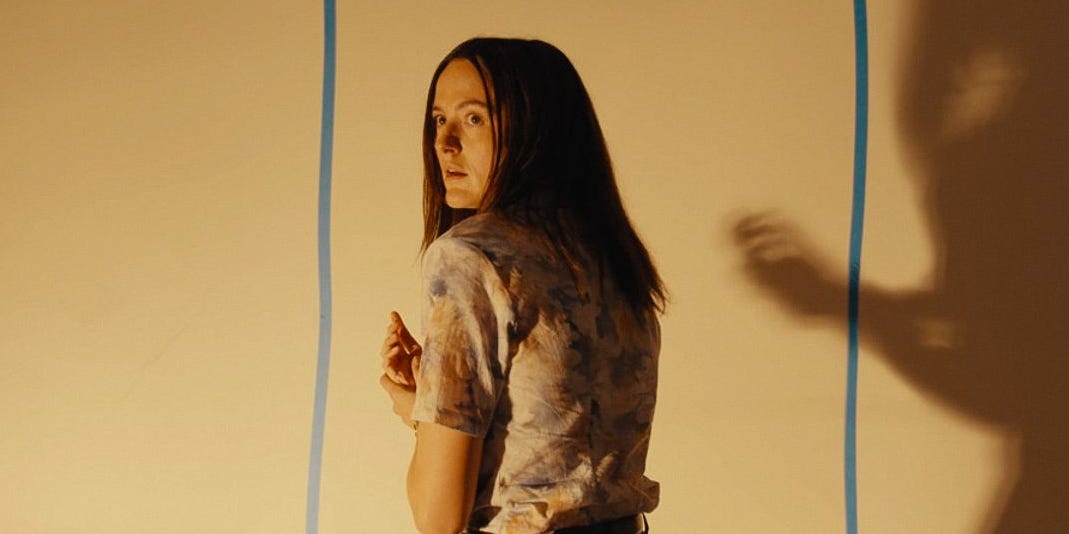
Renate Reinsve stars in Backrooms as Dr. Mary Kline, whose fate is intertwined with the movie’s enigmatic ending.
Toward the end of the movie, Mary follows Clark into the Backrooms. She finds him wallowing in his pity and riddled with guilt over his employees’ deaths. In his time away, Clark has made himself an odd home in the Backrooms with its “residents”—awkward simulacra of human beings that can be best described as poorly-rendered video game avatars.
When Clark is convinced to free Mary, a monstrous version of Clark—formally called “the Lifeform” in the script—appears, killing Clark. The Lifeform chases Mary throughout the Backrooms until she’s knocked out by Async scientists. Async takes away the Lifeform (presumably to study it) while Mary is brought to an interrogation room. She’s questioned by Phil (Mark Duplass), one of the lead researchers of the Backrooms for Async, where she learns what little the shady company knows thus far.
Originally a manufacturer of MRI machines, Async discovered the mysterious Backrooms and devoted its resources to studying it. Phil tells her the Backrooms seem to operate as a kind of echo-space for memories; it’s why many places in the Backrooms look familiar but are imperfect, as our memories can’t contain the full snapshot of the places or people we’ve seen.
This is when Backrooms ends in a silent montage of the Backrooms replicating places from Mary’s memories, such as her childhood home. We then see a Backrooms-ified version of Mary sitting by herself. It seems Mary has spent just enough time in the Backrooms for the place to absorb and create a version of her that will stay there forever.
This is just our take and perhaps not Parsons’s intended idea (more on that in a bit), but Backrooms is essentially a movie exploring how memories, feelings, and traumas can be a prison. Clark, who is hurt by his divorce and haunted by his broken dreams as an architect, is emotionally trapped by his shortcomings. It’s telling that the movie begins with Clark in therapy, doing role-playing exercises to make sense of where his life went “wrong,” from his point of view.
Dr. Mary Kline is similarly trapped. Raised in an abusive household where she was cut off from the outside world, Mary isn’t totally free from her own traumas. She has recurring dreams (or nightmares) about her childhood; even when her house is demolished, her handprint stays impressed in the driveway cement.
Our take on the Backrooms’ ending is that Mary will forever be a part of the Backrooms. She might be free of it in the end (for now, at least), but it’s not an experience that will leave her so easily. Just as Mary will likely remember and even dream about the Backrooms again, the Backrooms now remembers Mary, with its own half-remembered version of her living inside it forever.

Kane Parsons confirms one thing about Backrooms’ ending: It’s not a dream.
What Kane Parsons Says About the Ending of Backrooms
When we interviewed Kane Parsons last month, we actually asked him point blank to decode the ending. The director politely refused. “Maybe this is me butting against what is a tradition of directors explaining their work,” Parsons told us.
“I have always felt disappointed when I hear someone I look up to tell me about their work,” he said. “I don’t really care for that too much, personally, about the stuff that is meant to be narrative or not ambiguous. I could tell you exactly what it means to me and what it was meant to be, but I don’t want that information being out as fact.”
Part of the reason Parsons is keen to keep Backrooms’ biggest secrets close to his chest is to let the legions of Internet lore buffs interpret it for themselves. “I want a chance for people to go through [the movie] in an untainted way. I’ve had people take a couple things from it, and I have not decided if it’s best to dictate verbally what that thing is. It’s a classic case of, ‘What do you think it meant?’”
But Parsons was willing to confirm one thing. “It wasn’t a dream,” he says.