This post was originally published on here

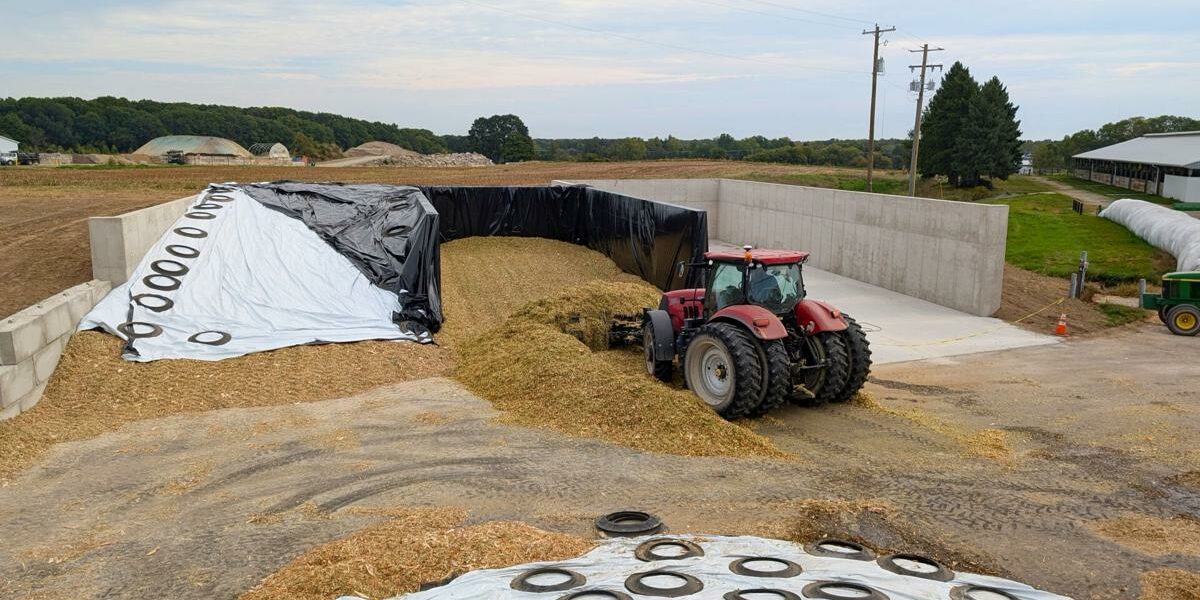
Silage bunker being filled. (Photos by Dan Buskirk.)
Silage can be created from nearly any forage crop, but corn is often used because it is so energy-dense. Putting up silage can preserve forage quality via fermentation if it has sufficient moisture and is stored anaerobically (oxygen-free), under conditions that encourage fermentation of sugars to organic acids. Acidity from organic acids and the lack of oxygen prevent the development of microbes that cause spoilage.
Dan Buskirk, Associate Professor/Beef Extension Specialist at Michigan State University, says corn silage is an excellent feed in terms of energy content for most classes of livestock except dry cows that don’t need that much energy in their diet. “Silage is usually high in energy but deficient in protein. A protein supplement is often needed when silage is fed,” he says.
In cow-calf operations some people winter their cows on silage and it can be fed in bunks or just out on the pasture. There isn’t much waste if the ground is frozen or has a sod base and cattle aren’t tramping it into the mud.
There can be some health issues if silage isn’t put up properly. “The biggest issue we have, however, is that some people don’t pack it enough to eliminate the oxygen,” says Buskirk. Many pathogens, molds, and mycotoxins can thrive in moist forage if there is oxygen present.
Some molds can produce toxins that mimic estrogen and can foul up the normal cycling of females. Many molds are relatively harmless, but some can cause abortion in pregnant cows. There may be mold on top of a silage pile, and if one cow eats more than the other cows because it wasn’t mixed and diluted, this might cause a problem. Silage can be trickier to put up correctly (with minimal health risks) than hay, but good silage will last a long time and can hold its nutrient quality longer than hay.
“With corn silage, producers may think of it as forage, but good corn silage is 50% concentrate and 50% forage. It has a lot of starch and energy but also enough fiber to keep us out of trouble with digestion; we are not as likely to accidentally overfeed starch by feeding corn silage as we are with a grain concentrate,” says Buskirk.
Traditionally it’s been a fairly safe feed, compared with grain, especially in the feedlot. “In the upper Midwest, producers have always fed a lot of silage to growing and finishing cattle. In the past decade or so we’ve been feeding higher concentrate diets in the finishing phase, but there used to be a lot of steers that were simply fed out on almost nothing but silage. It just takes a bit longer because it’s not as high in energy as a complete feed,” he says.

Silage pit
“Besides some issues with pregnant cows, it’s a pretty safe feed when put up properly, and a good feed for growing animals. It can also be limit-fed for cattle that don’t need as much energy.
Proper compaction is crucial. If you are harvesting silage and packing it in a pile, there are formulas to use—to make sure your packing density is high enough. It involves having enough weight (of tractors) on the pile at any given time in relation to how fast the feed is coming in,
A silage pile can be challenging to keep, depending on how much a person uses. Having an open face on the pile in the winter is not as big an issue, but in the summer—with warmer weather—it can spoil quickly if you are not feeding it fast enough. “In that situation, you are never feeding good feed. You are always feeding what has spoiled on that open face,” says Buskirk.
Match the silo or bunker size to the herd size you are feeding. This ensures that the daily removal of silage is faster than deterioration. An example: if you have 100 cows consuming 45 pounds of silage per day, then the face should be no more than 6 feet high and 40 feet wide.
Recommendations from experts at Great Plains Consultants (Eagle, Nebraska) include mixing in any additives first. Inoculants can’t decrease any mycotoxins that are already present in the crop, but they can help eliminate mycotoxin production during the ensiling phase.
General silage packing guidelines suggest packing densities should be at least 15 pounds of dry matter per cubic foot or 44 pounds of fresh matter per cubic foot. Packing density can be maximized by spreading the material in thin layers, about 6 inches of fresh forage from each truckload.
A cover should be applied as soon as the pile has been packed and finished. Shrink loss of an uncovered pile is about 20 to 50%, while a covered pile only has 10 to 20% shrink, which is economically significant. For example, if you reduce shrink from 25% to 15% with a cover and have $4.00 corn, you save $5.05 per ton on 1,200 tons, meaning you can save $6,060 per pile by using a $1,000 tarp.
Silage that’s been exposed to oxygen should be removed within 24 hours. The feed-out face should have a smooth surface with no cracks and be perpendicular to the floor. A smooth, perpendicular face reduces the surface area exposed to oxygen by as much as 9%, reduces the risk of avalanches, and reduces the risk of water being caught during rain. Basic recommendations are to remove 6-12 inches per day during the cold season and 18 inches per day during the warm season. Avoid leaving loose silage at the base of the face, since it is exposed to sun and oxygen and will undergo secondary fermentation. Only uncover the amount of silage that will be used in a short time–no more than three days’ feeding.