This post was originally published on here
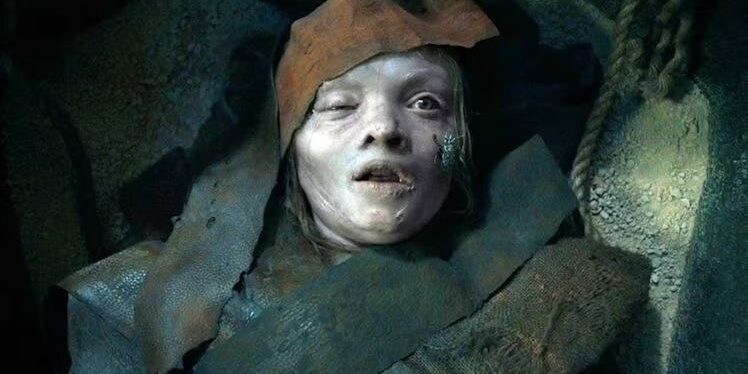
When audiences head to theaters to watch Lee Cronin’s The Mummy, they’ll be seeing a familiar story. The Evil Dead Rise director’s latest film is about a family’s young daughter who disappears in the desert, only to suddenly reappear eight years later. But “what should be a joyful reunion,” the official premise warns, “turns into a living nightmare.” One look at the movie’s poster, featuring the corpse-like girl wrapped in rune-inscribed bandages and the warning “some things are meant to stay buried,” makes the source of the problem obvious.
The film’s awkward title is a concession to the fact that Hollywood is making multiple mummy movies. A third sequel to the beloved Brendan Fraser and Rachel Weisz Mummy is slated for 2028, while Cronin’s film has been billed as a “reimagining” of the classic Universal Monster series. But those are just the tip of the pyramid. Mummies have appeared in countless films, books, and games, jumping out at everyone from Dungeons and Dragons players to Goosebumps readers. These fictional mummies are almost invariably hostile, as they seek revenge for having their eternal slumber disturbed. But … why? How did the image of a bandaged corpse doling out curses become a pop culture staple?
“The reality is that it’s a good, fun story,” Yale Egyptologist Nicholas Brown tells Inverse. “As humans, we have this fascination with horror and scary things we can’t quite explain. Ancient Egypt in general has fascinated people for centuries now. There are many ancient civilizations, and even some modern civilizations, where mummification is common, but because Egypt has the most famous mummies, that fuels the fantasy.”
Lee Cronin’s mummy is not one you want to encounter in a museum.
Warner Bros. Pictures
Mummy Madness
Some of the first mainstream mummy stories were actually romances. The hero of Théophile Gautier’s 1840 story “The Mummy’s Foot” has a dreamy fling with an ancient Egyptian princess after purchasing the title appendage in an antique store, while Arthur Conan Doyle’s “Ring of Thoth” is about an immortal Egyptian trying to go to the afterlife to join his beloved.
While ancient Egypt has fascinated humanity since the days of only slightly less ancient Egypt, a new wave of Western interest was triggered in 1798, when Napoleon seized the region from the receding Ottoman Empire and unleashed an army of scholars. The famous Rosetta Stone was discovered the next year, and while the French were soon expelled, it remained easy for colonial scientists and adventurers to explore the land and report their findings. Florence Nightingale, for example, was an amateur enthusiast, and stories like “The Mummy’s Foot” were a reflection of Europe’s romantic portrayal of colonization.
Egypt later became a British protectorate, and with all sorts of Egyptian relics — mummies included — being looted and sent to Europe, stories about the consequences of disturbing the dead were inevitable. Bram Stoker and Louise May Alcott, then better known for her tawdry thrillers, were among the many writers to churn out Egypt-tinged horror stories, with Alcott’s 1869 Lost in a Pyramid one of several to specifically posit a curse upon any who upset a mummy’s rest.
All of this kicked into overdrive in 1922, when Howard Carter became the first man in millennia known to set foot in the tomb of King Tutankhamun.
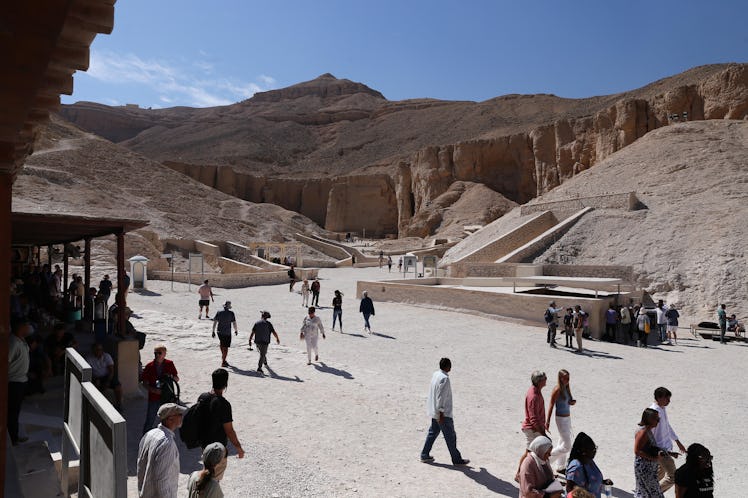
King Tutankhamun’s tomb is now a major tourist attraction.
Anadolu/Anadolu/Getty Images
“The financier, Lord Carnarvon, he actually dies in 1923 amid the excavation of the tomb,” Brown says. “Newspapers go wild with it. They say it’s a curse, Tutankhamun is coming after Lord Carnarvon. Obviously, it’s imagination and fantasy. We don’t have any inscriptions or texts from King Tutankhamun’s tomb that say ‘if you open this tomb I’ll curse you.’ I’m inclined to believe that it was fabricated to sell newspapers. And then of course there are the famous movies from the early 20th century where mummies are coming back to life.”
The scale and grandeur of Carter’s find made it a media sensation, and when several men linked to the excavation, including Carnarvon’s half-brother, later died too, their unfortunate demises were rolled into the supposed curse. Brown, however, notes the story’s obvious flaw.
“Howard Carter worked in there for 10 years, and lived a pretty good while after,” Brown says. “And he was the first person to go in. So you’d think of all the people to be cursed, he would be the one.”
“The financier, Lord Carnarvon, he actually dies amid the excavation of the tomb. Newspapers go wild with it.”
Brown himself has done work on King Tut’s tomb that re-contextualizes some of its artifacts, and he describes himself as “yet to be cursed.” Perhaps the real takeaway is that we should be grateful to live in an age of antimalarials and other medicines that might have prevented such sudden deaths. But as Brown alluded to, a fresh wave of mummy pop culture capitalized on Carter’s famous discovery.
All sorts of creators again tackled the subject matter; one of H.P. Lovecraft’s most memorable stories, 1924’s “Imprisoned with the Pharaohs,” was ghostwritten for Harry Houdini as the purportedly true story of Houdini encountering ancient mummies and pharaohs during an Egyptian vacation gone wrong. But it was Boris Karloff playing the risen Imhotep in 1932 who cemented the mummy as a monster, not a lover. The Mummy was a hit that spawned a steady stream of sequels, reboots, and knockoffs, and we’ve been wrapping our kids up in cloth for Halloween ever since.
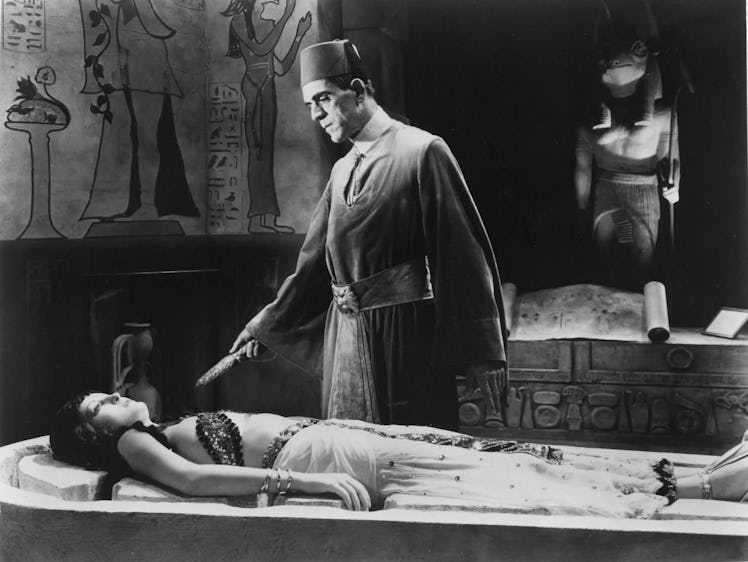
Boris Karloff’s Mummy defined a generation of Egypt-themed horror.
Universal Pictures
Beneath the Bandages
While there really were ancient Egyptian grave robbers, particularly when times were tough, those wealthy enough to enjoy extravagant tombs relied more on laws and norms than traps and supernatural threats to defend their posthumous possessions. Get caught peddling gold stolen from the dead, and you might very well be executed.
“We do have some very limited texts where the tomb owner is speaking to visitors along the lines of ‘If you cause harm to this tomb, I’ll come after you’ or ‘I’ll ensure you have a bad afterlife,’” Brown says. “Those inscriptions, or at least the ones I know of, date centuries before when King Tut’s tomb was built.”
That said, Brown doesn’t see the significant gulf between fact and fiction as a negative.
“We’re so lucky that Egyptology is such a popular topic. I’m a fan of the Fraser and Weisz Mummy movies. I’m thrilled they’re making a fourth one. I get it, it’s for entertainment, I don’t sit down to watch The Mummy and expect to learn something. If and when we can portray accurate information, I think that’s good. But it helps keep me and my colleagues in work if we’re piquing people’s interest with movies and TV shows and documentaries.”
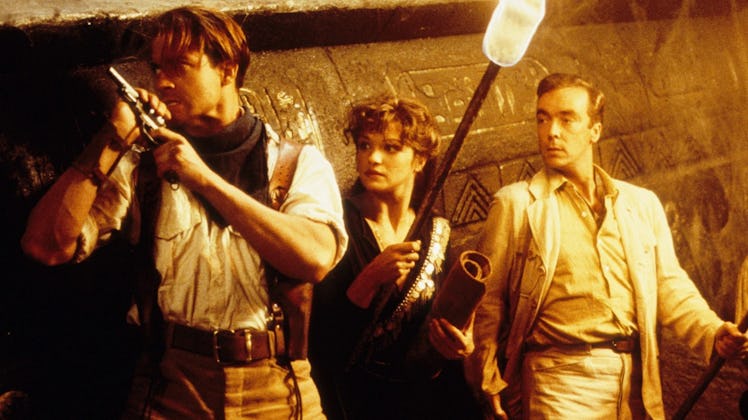
Imhotep was re-awakened in 1999, and now a fourth modern Mummy movie is coming.
Universal Pictures
Like many Egyptologists before him, Brown says he was a kid who “became obsessed with mummies and pyramids and golden treasure” before visiting Egypt in his 20s, “falling in love with the country,” and making a career out of what entranced him. If the fantasy can lead someone to reality, they may find the world beyond scary mummies just as enthralling.
“I love the human aspect of ancient Egypt,” Brown says. “The more you dive in, the more you realize that people really haven’t changed. There’s a small village of workmen called Deir el-Medina — these are the guys and their families who built tombs in the Valley of the Kings. They’re highly specialized craftsmen and artisans [who] left behind so many letters and administrative notes. And one is a court proceeding the village was holding against Paneb, who was like the town drunk. In addition to being accused of having slept with God knows how many people’s wives, there’s a line about how he got drunk, sat on the town wall, and threw beer jars at people going by. Stories like that help us build this connection between ancient people and us today.”
“I would just encourage everyone to remember that when you’re able to see a mummy, they were once a human being.”
Indeed, when a millennia-old tablet from the city of Ur complaining about the quality of a merchant’s copper became a modern meme, it was because the man’s feedback almost reads like a Yelp review. And that ability to see glimpses of humanity through vast stretches of time is what Lee Cronin thinks fascinates us too, even if he’s repurposing the feeling for horror. As he told /Film, ancient Egyptians “didn’t get buried expecting to show up in a museum. They were going there to rest for eternity. So I thought it was really interesting that we could go and dig something up that shouldn’t be found.”
Brown isn’t anticipating any rampages from the mummies we’ve actually dug up, although he suggests that enthusiasts remain respectful regardless. Millennia from now, after all, it might be your exhibited remains inspiring a terrifying tale.
“Our fascination with mummies is great,” Brown says. “I would just encourage everyone to remember that when you’re able to see a mummy in person, they were once a human being. It’s always nice to show them a little courtesy. Take a moment to reflect on the fact that they lived thousands of years ago, and say a little prayer to wish them well in their afterlife.”
The Mummy (1932) is available on YouTube. The Mummy (1999) is available on Prime Video.