
This post was originally published on here
Recently, I was driving home late when a message from one of my brothers flashed up on my phone. In the thumbnail was a picture of actor Tom Holland and my face. Looming large over both of us was Dr Mike Israetel. Given that he has built a sizeable internet following by brutally critiquing celebrity workouts, I pulled over to discover exactly how savagely I was about to be dismantled.
Thankfully, linked in the message was a video of Dr Israetel breaking down an interview I’d done with Holland, discussing the CrossFit workout Cindy. The tone was remarkably positive. My heart rate returned to normal.
Dr Israetel may be best known online as the potty-mouthed, unusually unserious face of Renaissance Periodization – whose YouTube channel reaches nearly 4 million subscribers – but the ‘science guy’ label is more than branding. He holds a PhD in sports physiology, taught exercise and sports science at multiple US universities and has spent years coaching, competing and translating research into physique advice people can actually use.
The doctor recently joined us on the Men’s Health: Built For Life podcast, following the release of his new book, The Aesthetic Revolution – a smart, thoughtful defence of vanity as a legitimate gateway into more effective training, improved health and, ultimately, a better relationship with your body. From there, we chatted about how men should approach training, nutrition strategies and Dr Israetel’s fitness red flags. It’s fair to say he lived up to his reputation.
Men’s Health: What do most men still misunderstand about building muscle?
Dr Mike: Men consistently misunderstand the idea that one new way of training or eating is finally going to cause miracle growth. That assumption may eventually be true, when muscle-building drugs become advanced enough to be a genuine revolution. But it’s not here yet.
It’s sad to see people get this glimmer in their eyes because they think, ‘Oh my god, this is it. My biceps have really been struggling, but this one exercise is going to do it.’ And you’re just like, ‘That’s never going to be the answer.’
The answer is: have you trained your biceps twice a week, with roughly eight sets per workout, for the past 16 weeks, while being in a slight calorie surplus and getting enough protein and sleep? If the answer is yes, then that level of biceps growth is dependable growth. That’s what you’re going to get.
MH: If I have only three hours a week to train, what are the big rocks I need to move?
DM: First, figure out how you can split up that time. You could do three one-hour sessions a week, or four sessions of around 40 minutes. There’s no clear right answer. It depends on your preference, your schedule and how your body responds.
Next, decide how to divide up muscle groups. Full body every day is totally fine, especially if you’re a beginner. If you’re more advanced, splitting body parts up probably makes sense – upper and lower, for example. Or, if you don’t train lower body a ton, you might do a push and pull split: all the muscles that pull on one day, all the muscles that push on another.

Then you need to decide whether you want a fixed weekly schedule or a floating split. Some people work best with Monday, Tuesday, Thursday and Friday locked in. They’re consistent because everyone knows: after a few months, people stop asking and make plans with them on other days.
For other people, work is unpredictable. Some days they work three hours; some days they work 12. For them, a floating split is better. Whenever they recover, they train again. Some weeks they train five days, some weeks two. Sometimes Sunday, sometimes Monday.
Once you’ve picked that structure, you have a proto-programme. Then you choose the exercises, pick reasonable starting weights and go. After that, you only have to do one thing: show up. Give effort. Write down your reps. Next session, the weight goes up a little or the reps go up by one. Give effort again. Produce results.
When you’re too tired to match those results, you take a week of very easy training or no training at all. Then you rebuild the plan and go again. The set-up is a 10-to 20-minute process. The execution is showing up consistently and doing the thing. It’s not rocket science.
MH: Why is tracking your reps so important?
DM: Because without tracking, you don’t really know whether you’re improving. You can train hard for a while, make good progress, then accumulate enough fatigue that your strength stops going up. But if you’re not recording anything, you may not realise that’s happened.
Then you enter this nasty grey zone. You used to train four days a week with 20 total sets per workout. Now you’re doing three days a week and 15 sets. That might be just enough to keep fatigue high, but not enough to grow as much muscle as you were growing before. You can spend weeks or months there because you’re not tracking.
If you are tracking, and you’re trying to add a little weight or one extra rep each time, you get immediate feedback. If two sessions in a row for the same muscle group go backwards, you know you’re too fatigued. You should deload.
That might mean an easy week where you train twice, each workout takes 20 minutes and you lift half the weight for half the reps and half the sets. Or you just take a week off. Your fatigue drops, you come back ready to push hard again and you get another productive run of training.
People say, ‘Training’s going great.’ But how do they know? ‘The gym feels good.’ Are you getting stronger? ‘I think so.’ That’s like looking at your stock portfolio, seeing a bit of green and deciding everything is fine.
With the human body, you can’t just assume it will correct itself. It could give you poor returns forever unless you take charge. You need to know whether you’re actually improving. Tracking is the only way to do that.
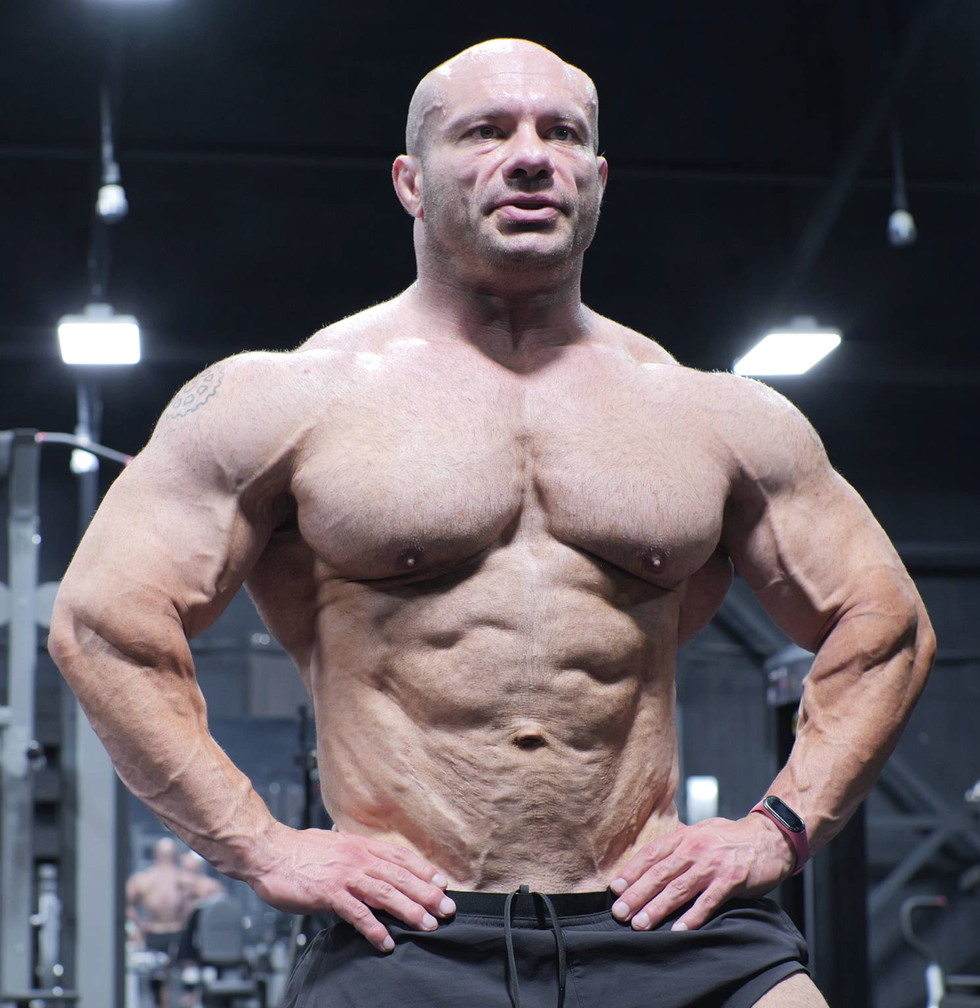
Fitness expert Dr Mike has nearly 4 million subscribers on his YouTube channel and a new book out, The Aesthetic Revolution
MH: How should people decide whether to train high volume or high intensity?
DM: A lot of people go on vibes. The Mike Mentzer, mid-80s, big-forearms-and-moustache thing is an undefeated vibe. But, do you want the vibe more, or do you want to grow more?
When people bring up Mike Mentzer, I like to bring up Lee Haney. Mentzer won zero Olympias. Haney won eight in a row. He trained with higher volume, roughly keeping two reps in reserve, and his big quote was, ‘Stimulate, don’t annihilate.’ That’s not as exciting, but Haney did it right.
That doesn’t mean you shouldn’t enjoy the vibe. Vibes are great. But if you notice that very low volumes leave you with tons of recovery capacity, do a few more sets. You can still take them to failure if you like. If your recovery starts to fall apart, back off. Explore your own boundaries.
You don’t know where that limit is unless you test it. You might get good results from one set of hack squats a week. Then you build to four sets and get even better results. Would six or eight sets be better still? Probably, yes. But for you, it might be no, because you can’t recover from it. So start with lower volumes, then build up.
MH: What does solid nutrition look like for better body composition, mood and energy?
DM: Four to five meals per day is probably the sweet spot. Six is fine if you want. Three is totally fine, too. Each meal should have plenty of protein. A good target is around 1g per pound of body weight per day. So, if you weigh 200lb (around 90kg) and eat five meals a day, that’s roughly 40g of protein per meal, mostly from lean meats, plus any supplements you want to use.
Most meals should be built from healthy foods, with a little nonsense here and there. You also want some mix of carbohydrates and fats. You don’t have to be overly precise about the split. One meal might have lots of nuts and very little carbohydrate. Another might be mostly white rice with almost no fat. That’s okay, as long as the calories are roughly consistent meal to meal.
Then you adjust calories depending on your goal. If you want to gain muscle, increase calories by 200 to 250 above maintenance and watch your body weight slowly climb – maybe 250g a week. If you want to lose fat, drop 400 to 500 calories below maintenance and track the same way.
That basic template will take care of most body composition. It also helps mood and energy because your meals are evenly spaced and built from foods that digest steadily.
A lot of people say they have low energy. Then you ask what they do in a day and it’s: breakfast, work, then by 3pm they feel destroyed. What do they eat at lunch? Nothing. So your body runs out of fuel, you do nothing about it and you have no energy. Or they’ll eat no whole grains, no protein, just a high-carb snack, and wonder why they don’t feel a consistent level of energy. If you don’t consistently give your body food that digests slowly, you can’t expect consistent energy.
If someone tells me they eat four meals a day, get enough protein, keep calories where they need to be, eat mostly whole foods, include healthy fats, fruit and veg, space meals out well, and they’re still not gaining muscle or strength, then it’s almost certainly not their diet.
MH: Which exercise do people defend with almost religious fervour that you secretly think is a bit rubbish?
DM: Rack deadlifts. People defend those like crazy. They mostly do it because their favourite pro does it. They want to cosplay. And also it’s their only time in the gym they’re going to put five plates on to something and get all the attention when they scream and drop the weight really hard on the racks. And the reality is that, like, it just compresses your spinal column. A lot.
MH: What’s your least favourite fitness trend?
DM: Trying to ‘over-scientise’ fitness without doing the proper science. The real science of training is hierarchical. You need to get the basics right first, then the details. If you actually read the research, the things that matter are pretty clear: getting a deep stretch in your lifts, training close to failure, targeting the muscle accurately and doing enough volume and frequency.
That means training a muscle two, three or four times per week, with five to 10 – sometimes even 12 – hard sets per session. That’s the stuff that’s genuinely science based.
One thing science has shown is that the upper limit for growth with volume is way higher than many people thought. It’s not necessarily 20 sets per muscle per week. It’s not 25. For many people, it’s probably over 30. In a specialisation programme, it can be over 40 sets per muscle per week.
But there’s a side of the internet that seems to think the only science of training is biomechanics. So people hyper-optimise some tiny angle to target one weird part of the triceps. The exercise might technically do that, but it takes forever to set up, then they do three sets of six and say, ‘I targeted my triceps.’ Sure. But you barely created any stimulus.
There’s nothing wrong with optimising angles or setting up clever exercises, as long as you’re also putting in real effort, enough volume and enough frequency. But if you build some weird contraption, train for three sets once a week and call it science, you’re not doing science. You’re doing a fun clown show.
MH: What’s your most boomer opinion on modern fitness?
DM: Barbell lifts are great. They work for a lot of people. Progressing steadily through full-range-of-motion barbell lifts is awesome. All the angles and machines in the world are great, too, but the classic barbell basics are still very good.
I posted a workout once that was weighted pull-ups, unweighted pull-ups and barbell bent-over rows. Some kid commented, ‘This is ridiculous. I can’t believe you think you’re an authority. This is the most boomer workout I’ve ever seen.’
But we don’t judge exercises by what era they’re from. We judge them by their effect. Pull-ups are amazing. Bent-over rows are amazing. Not the best for everyone, but they’re great.
Of course, I clicked on his profile to see what non-boomer training looked like. It was all one-arm cable contraptions, again for a few sets and with seemingly no results.
I think some people don’t want to stare reality in the face. They don’t want to realise they can only do five good pull-ups. There’s nothing wrong with that – you just have to put in the time to get stronger at effective exercises, so you get bigger. Or you can do fancy stuff and tell yourself strength doesn’t matter, it’s about hitting the angles.
My boomer opinion is that classic sets and rep schemes still work very well. Some people say that’s outdated. It isn’t. It’s effective, and it always will be.
MH: If you could delete one phrase from gym culture, what would it be?
DM: ‘No days off.’ It’s the opposite of helpful. It creates this illusory idea that if you train seven days a week, it doesn’t matter how good the training is, how much effort you put in or whether the volume makes sense. It’s just about being there every day.
That distracts you from the real thing you need to do, which is train productively and recover properly. There is no Team No Days Off. You’re just gripping on to the only thing you can be consistent with and misprioritising it.
MH: What’s the biggest red flag in online fitness influencers?
DM: Being anti-science is a big red flag. Not anti-fake science or anti-trendy nonsense – that’s fine. But there are people now who are against science-based lifting altogether. They have this idea that being anti-intellectual is a badge of honour.
You see people posting pictures of jacked guys with captions such as, ‘No science-based lifters here, brother.’ And it’s like, ‘Okay, so you’re stupid and you’re leaning into it. Maybe school didn’t make sense to you. That’s fine.’ But instead of hiring a coach who understands the science and can steer you right, they go the other way and decide science-based lifting is dumb.
They oversimplify everything: ‘Just lift heavy and eat.’ Meanwhile, some of them are taking huge amounts of steroids. That’s not wisdom or a system. That’s drugs, genetics and bravado.