This post was originally published on here
SARASOTA, Fla. (WWSB) – Scientists have discovered six different sugars in samples collected from asteroid Bennu by NASA’s OSIRIS-REx mission, including glucose and ribose that are fundamental for life as we know it.
An international group of scientists led by Tohoku University analyzed the asteroid samples and found the bioessential sugars, which are commonplace on Earth but remarkable when found on an asteroid.
“We actually found six different sugars, including two, ribose and glucose, that are fundamental for life as we know it,” said Dr. Danny Glavin, a co-investigator for the mission.
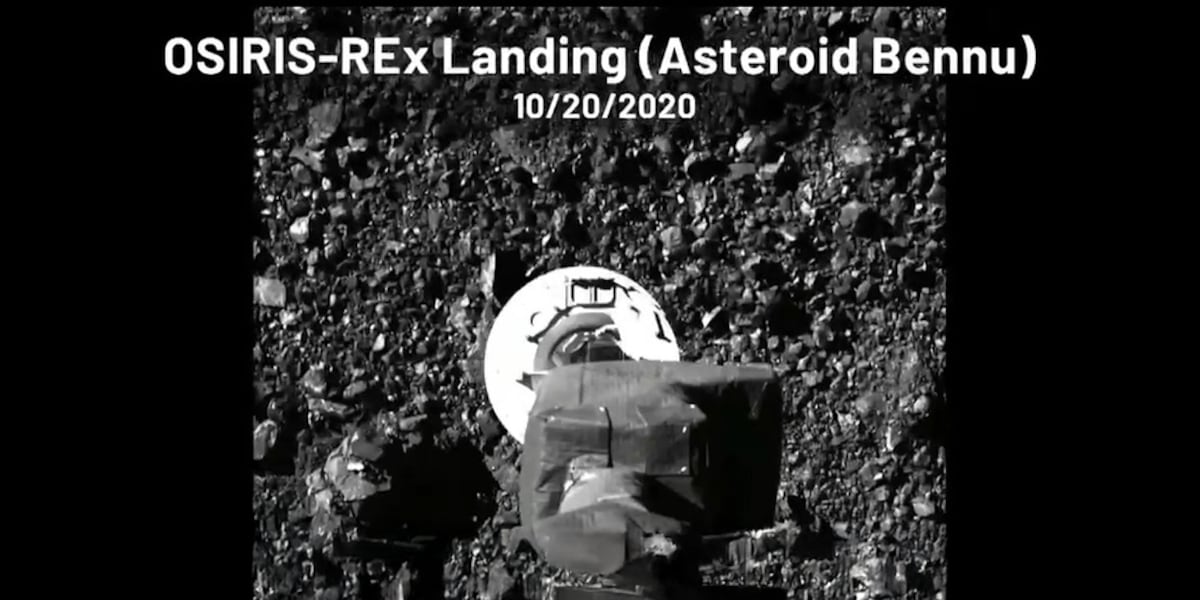
The OSIRIS-REx mission launched in 2016, rendezvoused with asteroid Bennu in 2018, collected a sample from the surface of the asteroid in 2020, and brought it back to Earth where it landed in Utah in 2023.
Ribose helps provide the backbone for ribonucleic acid, and glucose is an important source of energy for all living things. The team expected to find ribose, though the glucose discovery raised eyebrows.
“And this is the first discovery of glucose in any astromaterial, so this is truly exciting,” Glavin said.
The discovery process was rigorous after OSIRIS-REx’s seven-year journey ended. Samples were chipped off and crushed into a powder, about 600 milligrams in all.
“And then we basically extracted it in water, at cool temperatures, kind of like making a cold brew, a cold tea,” Glavin said. “And then extracted those sugars into that water.”
Mass spectrometry allowed scientists to separate and identify the six individual sugars.
The team noted what they didn’t find: deoxyribose, or the backbone for DNA. The asteroid may lend more credence to the RNA world theory, which suggests early RNA on Earth could have been sustained in fluid droplets before DNA appeared.
The ribose discovery fills in a gap of knowledge building on previous findings from the same samples.
“When we first started the sample analysis, we discovered amino acids,” Glavin said. “In fact, 14 of the 20 protein amino acids found in life. And we also found the nucleobases. These are the components of the genetic code in DNA and RNA. All five, in fact.”
The fact this asteroid still harbors ingredients for life, billions of years after its formation, gives hope that scientists could find more molecular evidence closer to home.
“These building blocks of life were distributed from the outer solar system all the way into the inner solar system,” Glavin said. “They were everywhere, ubiquitous.”
Not only could these building blocks have enabled life on Earth, but potentially elsewhere, including Mars, Europa and the outer solar system.
“I’m becoming much more optimistic that we may be able to find life beyond Earth, even in our own solar system,” Glavin said.
Copyright 2025 WWSB. All rights reserved.