


This post was originally published on here
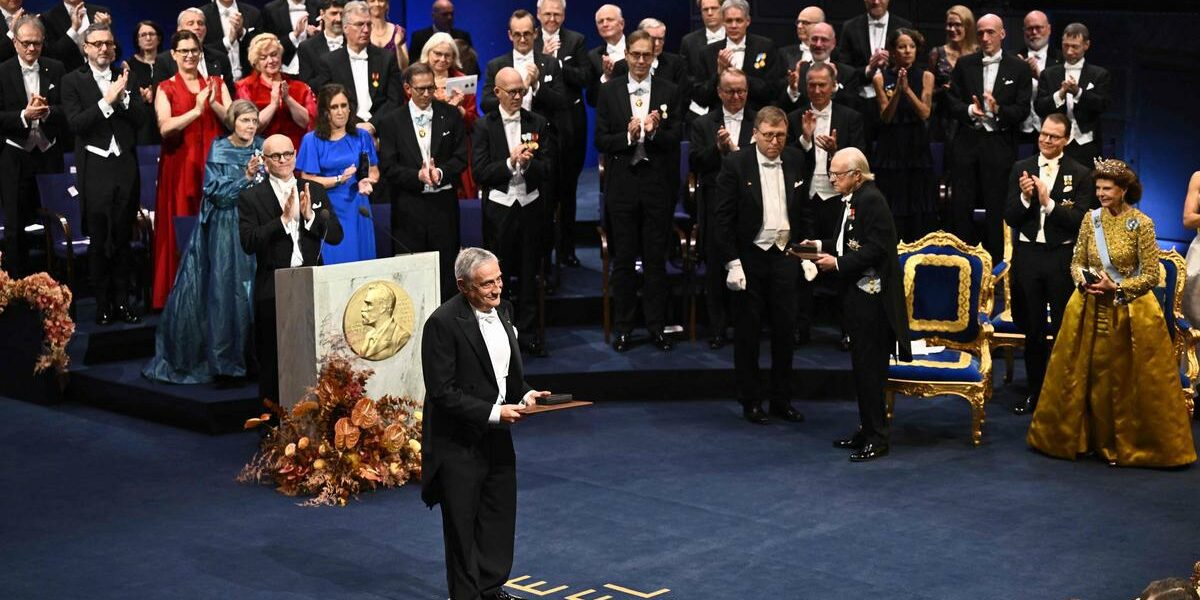
On December 8, economic historian Joel Mokyr delivered his lecture in Stockholm as part of the ceremony in which he received his share of the special Nobel Prize for economics, for “having identified the prerequisites for sustained growth through technological progress”.
His talk recapitulated his long-standing argument that a self-reinforcing relationship between science and technology has sustained modern economic growth, with the support of particular institutions and of a small intellectual elite. As he put it, “Scientific and technological advances are not made by the population at large. They are made by what I have called the upper tail of the human capital distribution. These are the smartest, most creative people in society, who come up with these ideas, and the vast bulk of people just watch this and maybe they carry out the ideas, but the actual insights come from very few people and they have to be incentivised.”
Many economic historians and historians of science have accepted parts of this picture but they’ve also questioned the way he has assembled these elements into a virtuous cycle.
Innovation through negotiation
First, consider what Mokyr called the “curse of concavity”. In standard economics, each extra unit of capital or labour yields smaller gains, so growth should eventually slow down. Mokyr has argued that knowledge can escape this curse because more science produces better tools, which enables more science. Scholars such as Robert Gordon and Tyler Cowen have however pointed out that the great “general-purpose technologies” of 1870-1970 produced a singularly exceptional jump in productivity that recent information and communication technologies haven’t matched, and that the U.S. may already have harvested its “low-hanging fruits”. That is to say: a knowledge system can be highly dynamic even as its benefits are increasingly hard to turn into broad-based growth.
The second issue concerns the role of instruments. In his talk Mokyr narrated a sanitised story about how new tools — including telescopes, microscopes, barometers, vacuum pumps, steam engines, and X-ray crystallography — unlocked new scientific knowledge with which scientists developed yet more tools, in an accelerating positive loop. But the limits of this picture are clearer when we zoom out.
In his 1997 book Image and Logic, for instance, Peter Galison studied the large detectors scientists use in particle physics experiments (for example, the CMS detector at the then-futuristic Large Hadron Collider). In particular Galison attempted to trace how the apparatuses emerged from negotiations between engineers, theorists, funding agencies, and existing experimental traditions rather than simply appearing as “better tools” that stood ready to answer old questions.
In The Shock of the Old (2006), British historian David Edgerton has argued that histories of technology have focused too much on spectacular new inventions and too little on maintenance, repair, incremental modification, and the long life of supposedly obsolete technologies — like cycle rickshaws and water handpumps in India. Mokyr spoke about how Joseph Lister’s microscope led to the germ theory of disease by revealing the existence of bacteria to scientists. He then called germ theory “the greatest welfare enhancing discovery in history until then”, treating it as an instance of how frontier science generates welfare gains. Edgerton and other historians have however stressed that its consequences for public health depended on sewers, clean water, vaccination campaigns, organised healthcare, and state capacity.
In The Pasteurization of France (1984), the French philosopher Bruno Latour made a similar point by studying how alliances between farmers, bureaucrats, veterinarians, and public health officials helped spread the virtues of the theory.
‘Enlightenment without empire’
The third point of contention is his story about the institutions of early modern Europe. Mokyr asked, “What kind of institutional environment supports innovation?”, then said institutions have to meet four conditions to this end: (i) strong incentives for an innovator elite, (ii) a competitive “market for ideas”, (iii) freedom of movement for talent, and (iv) a moderately activist state.
The California School of historians, including Kenneth Pomeranz, has complicated this picture by showing that until the late 18th century, some parts of China and India were also commercially sophisticated and had complex markets and their own knowledge elites. Instead, according to this School, Britain was special because it was endowed with coal and imperial trade.
Historian of the Industrial Revolution Robert C. Allen developed this idea further in his “high wage, cheap coal” thesis: he said the British Industrial Revolution was profitable because high wages and cheap energy led to inventions that saved labour, e.g. the steam engine, and that the price environment induced both invention and diffusion. Jan de Vries’s The Industrious Revolution (2008) has likewise stressed household labour and changing consumption as having enlarged the markets for new products.
Read these histories together with Mokyr’s and it should be clear that technological progress as we know it happened is already more than a matter of a society cleanly adapting ideas conceived by an intellectual elite. In fact this is the principal issue with Mokyr’s work: it reprises a Eurocentric and supply-side narrative that marginalises imperialism and everyday labour as important engines of progress.
More broadly even, Mokyr’s story is problematic because it is too coherent to resemble European history as it happened. The continent lurched through coercion, dispossession, war, guild conflicts, state monopolies, and several episodes of political and religious repression before it had its “market for ideas”.
As Jindal School of International Affairs assistant professor Rohith Jyothish wrote in The India Forum: “The world Mokyr reconstructs is an idealised Europe, a republic of reason unshadowed by the colonial and extractive circuits that sustained it — the Atlantic slave economies, the plunder of Asian trade, the appropriation of raw materials and labour from distant colonies that fed the very industries he celebrates. His ‘useful knowledge’ is an Enlightenment without empire.”
Not just the ‘upper tail’
The question of the elite also raises a fourth issue. In his lecture Mokyr used the label “upper tail” to refer to a thin stratum at the very top of the distribution of skills and knowledge in society and he placed most of the weight of innovation on this group. In his books however he has long argued that major “macro-inventions” are ineffectual without a broad stream of “micro-inventions” and skilled artisans who can develop and implement them. Historians such as Alessandro Nuvolari and Allen have gone further to stress the importance of “collective invention” and the adoption of new tools by industry. In their account, innovation is socially embedded and distributed and forms the substrate for the “upper tail” itself.
Fifth, and finally: the role of the state. To quote Mokyr, “… the government should not be too controlling, as it is for instance in China and certainly as it was in the Soviet Union, but also not too absent, which is the direction in which the U.S. is moving, but a government that sort of sits in the middle and it guides and it advises and it regulates a little bit, but it still lets the forces of free markets operate.”
While he’s right to beware churches or autocracies that monopolise thought, Mokyr gives less weight than he ought to to the idea that knowledge and social order are really “co-produced”. Why Trust Science? (2019) by Naomi Oreskes is for instance a book-length argument that science is trustworthy because of institutional practices like peer review and organised criticism rather than because of the brilliance of individuals. Sheila Jasanoff has described how the ways in which states fund, administer, regulate, and use science shape what counts as a legitimate idea in the first place and how scientific claims in turn stabilise particular political arrangements. In India itself, the Green Revolution had the state’s backing to deploy seeds with high yield and fertilizer subsidies as “scientific farming”, eventually entrenching an inefficient agrarian order.
Mariana Mazzucato has also applied the label “entrepreneurial state” to governments that actively shape markets by funding high-risk research and long-term missions such as lunar exploration and decarbonising the economy. If the state is simply a referee, per Mazzucato, we wouldn’t have the Internet, several life-saving drugs or spaceflight.
In the final analysis, Joel Mokyr has done well to force economists to take technology and culture seriously as historical forces, yet the picture he offers of protected incentives and a competitive market for knowledge yielding sustained improvements in welfare isn’t borne out by the facts of history. Innovation can’t be narrated only from the vantage point of the “upper tail” if it needs to explain modern growth. Instead we need to piece it together as a social process in which labour, infrastructure, administration, and imperial power ‘apply’ ideas but also shape what counts as an idea and who can benefit from it.
The author thanks Jahnavi Phalkey for her inputs.
Published – December 16, 2025 07:40 am IST






Email
SEE ALL
Remove