This post was originally published on here
Ten Ohio colleges and universities’s educator preparation programs were found to not be in alignment with the science of reading, according to an audit from the Ohio Department of Higher Education.
Five colleges and universities were found to be partially in alignment and 33 higher education institutions were found to be in alignment, according to the audit.
The science of reading is based on decades of research that shows how the human brain learns to read and incorporates phonemic awareness, phonics, fluency, vocabulary, and comprehension.
“We have an obligation to act with great urgency to make sure every future teacher is taught by our colleges and universities the best way to teach reading,” Ohio Gov. Mike DeWine said during a press conference.
The science of reading was signed into law by DeWine in 2023 through the state’s two-year operating budget, which gave $86 million for educator professional development, $64 million for curriculum and instructional materials, and $18 million for literacy coaches.
Colleges and universities teacher preparation programs were required to be fully aligned with teaching the science of reading by Jan. 1, 2025.
The Ohio Department of Higher Education Chancellor Mike Duffey created an audit process that demonstrates how each educator training program aligns with teaching the science of reading instruction.
The formal audits started in January 2025 and took place during the spring semester. The colleges submitted syllabi, materials, and assignments in addition to reviewers visiting campuses, observing classes, and interviewing staff.
Any college or university that does not become fully aligned by next December will have their approval revoked by Chancellor Duffey. All programs will be reviewed every four years.
“For the students who are becoming teachers, it will improve their job prospects,” DeWine said. “It will make future generations of children also better readers. Teacher prep programs at our colleges and universities need to be using only the science of reading.”
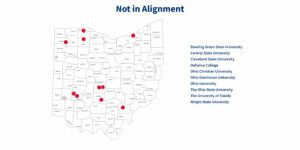
Bowling Green State University, Central State University, Cleveland State University, Defiance College, Ohio Christian University, Ohio Dominican University, Ohio University, Ohio State University, University of Toledo, and Wright State University were not in alignment — meaning they had at least one violation for teaching the three-cueing approach, which is a banned teaching practice in Ohio.
The “three-cueing approach” is any model of teaching students to read based on meaning, structure and syntax and visual cues. It often encourages children to read words by asking three questions: Does it make sense? Does it sound right? Does it look right?
Ohio’s law bans school districts from using the “three-cueing approach” in lessons unless a district or a school gets a waiver from the Ohio Department of Education and Workforce or a student has an individualized education program that specifically includes the “three-cueing approach.”
“Many of these 10 colleges are actually teaching the science of reading very well,” DeWine said. “All 10 of these colleges were found to have at least one instance of using the banned training in their material.”
All of these schools say they are now in compliance and ODHE is verifying they are now fully aligned with the science of reading, DeWine said.
Ohio State University had 17 noncompliant course sections, the most of any university, according to the audit.
“The audit … identified a limited number of cases where outdated curricular materials do not fully align with (science of reading) standards,” said Ohio State University spokesperson Chris Booker. “Those materials are being updated to fully comply with the new standards.”
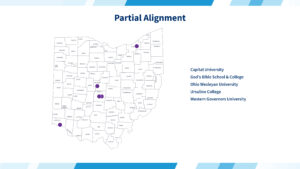
Capital University, God’s Bible School & College, Ohio Wesleyan University, Ursuline College, and Western Governors University had partial alignment, meaning they met between 50-70 audit metrics and had zero violations for banned teaching practices.
“For some universities, it’s cultural set in,” DeWine said. “They’ve taught another way for a long, long period of time. It’s tough to change. … But it’s also tough for teachers who are out in the classroom, who now have to switch over and so it’s just a moral imperative that we get this right.”
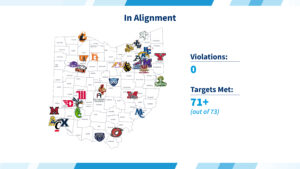
These colleges and universities were in alignment, meaning they met at least 71 out of 73 audit metrics and had no violations for banned teaching practices:
- Ashland University
- Baldwin Wallace University
- Bluffton University
- Cedarville University
- College of Wooster
- Franciscan University of Steubenville
- Franklin University
- Heidelberg University
- Hiram College
- John Carroll University
- Kent State University
- Lake Erie College
- Lourdes University
- Malone University
- Marietta College
- Miami University
- Mount St. Joseph University
- Mount Vernon Nazarene University
- Muskingum University
- Ohio Northern University
- Otterbein University
- Shawnee State University
- The University of Akron
- University of Cincinnati
- University of Dayton
- University of Findlay
- University of Mount Union
- University of Rio Grande
- Walsh University
- Wilmington College
- Wittenberg University
- Xavier University
- Youngstown State University
“We have a lot of schools that are doing a great job,” DeWine said. “… Many schools are excelling with their implementation of the science of reading and their students are better off.”
DeWine said he’s heard from principals and superintendents that some of their new teachers are coming out of college with a good foundation in the science of reading.
“Sadly, some of the principals and the teachers pointed out that they are still receiving new teachers coming out from Ohio universities that do not have that good preparation,” DeWine said. “That creates a huge problem.
This is the second academic year Ohio school districts are required to teach the science of reading curriculum.
“We’ve watched some amazing teachers use the science of reading to help their students,” he said. “Every single child is engaged in what they’re learning. … We’re making great strides in our K-12 schools.”
Forty percent of Ohio’s third-graders were not proficient in reading in 2023 and 33% of third graders were not proficient in reading before COVID-19.
Literacy scores were up slightly from last year, with 64.5% of third graders reading at or above grade level compared to 62.3% from the previous year, according to this year’s state report cards that were released in September.
The Ohio Department of Education and Workforce was required to come up with a list of curriculum and instructional materials that align with the science of reading.
Follow Capital Journal Reporter Megan Henry on Bluesky.
YOU MAKE OUR WORK POSSIBLE.