This post was originally published on here
This story appears in the December 2025 issue of Utah Business. Subscribe.
Peter Turner has a reputation in ski circles as a mad scientist — an outside-the-box engineer with a genius for crafting unusual shapes using unorthodox materials to invent skis that generate fanatical loyalty.
But spend an afternoon with Turner at the factory he designed in the Granary District of Salt Lake City, and it quickly becomes apparent that Turner is not a mad scientist at all. He is a genial visionary who delights in putting smiles on the faces of skiers.
Sitting in a conference room just upstairs from the factory floor where three dozen workers are handcrafting DPS skis, the 72-year-old co-founder laughs at a faded memory: A winter storm in Squaw Valley in 1998 with legendary extreme skier Shane McConkey.
McConkey’s job at Volant skis was to dream big dreams, and Turner’s job was to engineer those dreams into existence. On that day at Squaw Valley, McConkey wanted to show Turner how he rigged up an old set of skis to work in deep powder.
McConkey pulled his tricked-up skis from the car and said, “I take them out to the parking lot, and I run over them until I get the tips and tails up like this.”
Turner couldn’t believe it.
“And then I skied on a pair of his skis, and they skied like a dream in powder,” Turner recalls. “We had really heavy Sierra snow that week, probably five [feet] deep, and they skied like a dream. They were bent up, so you floated over the snow.”
McConkey would stop by Turner’s office at Volant with pages torn out of surfing magazines.
“Shane’s idea was that powder is a fluid,” Turner says. “Look at everything that planes in fluid – water skis, boats, wind surfers, surfboards. They’re all reverse camber, they’re all wider where the mass is. So Shane says, ‘Make a ski like that.’”
Turner made a ski like that: the iconic Volant Spatula, the first rockered ski ever brought to market. That innovation, combined with a sidecut Turner later pioneered with the DPS Lotus 138, makes it easier for beginning skiers to carve their first turns, for intermediate skiers to navigate bumps and crud, and for expert skiers to ride steeps and deeps.
A ski company with a cult following
“Peter built the perfect powder ski 20 years ago,” says Thomas Laakso, SVP of product and operations at DPS. “Are we done yet? No.”
That’s why Ted Ligety, two-time Olympic alpine gold medalist, is sitting in a cubicle just outside the conference room. Ligety joined DPS in October 2024 as head of product performance.
Turner and Ligety had just returned from Chile, where they tested DPS’s new Pisteworks line of carving skis. Turner had been noodling for years on ways to apply the playfulness of carbon fiber — which injects the rebound that energizes turns —to a resort ski. Ligety, a self-proclaimed “ski nerd” who geeks out on the mechanics of skiing, says the Salt Lake City location enabled him to test 15 iterations of the Pisteworks 79 in a couple of months.
“I can be in our conference room here whiteboarding on a Monday, then with our factory right here downstairs, it’s such a tight cycle — I can be out skiing it on a Wednesday,” says Ligety, leaning over an office cubicle. He says that same testing process would have taken three or four years at a European ski company.
DPS skis are the most expensive on the market. Ligety’s new carving ski, for example, launched with a hefty $1,995 price tag, while the company’s beloved Wailer line runs $1,299. DPS’s revolutionary use of carbon fiber is expensive, but because carbon fiber doesn’t fatigue like metal or fiberglass, the skis come with not only a lifetime warranty but a “will and testament” that allows owners to pass on the warranty to their heirs.
Custom-made spools of space-age carbon fiber, shipped here from an Ohio aeronautics supplier, cost $50 a pound, compared to $3 a pound for the fiberglass most competitors use. DPS’s decision to manufacture in Utah only adds to the cost.
The economics of ski manufacturing can be brutal, and that means DPS teeters on a financial edge from season to season. Seattle-based K2 produces lower-cost skis by mass manufacturing in Guangzhou, China, and Amer Sports, the Finnish company behind the popular Salomon, Atomic and Armada brands, is owned by a consortium of primarily Chinese investors, and the same factory in Austria manufactures their skis.
Ask Turner what he’s most proud of, and he says, “For me, it’s as simple as we survived in the ski industry for over 20 years.”
Laakso says a lot of ski companies have been born and shuttered over those two decades.
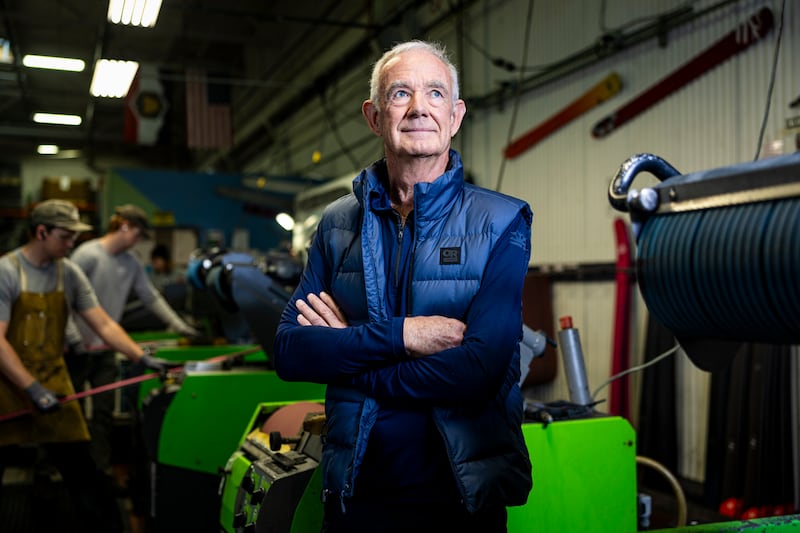
“Surviving isn’t a good sign of winning, but it shows some tenacity and the value of being unique,” Laakso says. “It could have been a better decision to say we’re going to start a brand and someone else is going to make the skis, but we decided we’re going to do it in carbon fiber and we’re going to do it in Salt Lake City.”
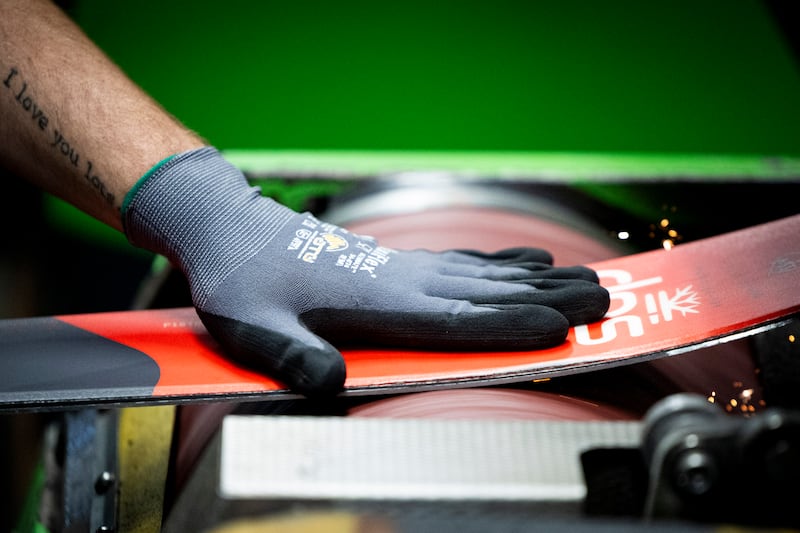
The decision to manufacture in the U.S. has its business benefits. While walking the factory floor, Turner challenges a visitor to guess what kinds of skis we’re watching workers build.
“These are military skis,” Laakso says. “We’re in the middle of a run to make skis basically for Arctic events. It’s something we haven’t talked about much in public. … We’re a significant supplier for the Armed Forces, for special operations, for NATO.”
These are the engineering problems Turner loves tackling. In 2013, the military asked Turner to adapt touring skis for alpine operations. The most recent challenge: How do you design a ski that enables troops to march across tundra?
“They really appreciate the carbon fiber,” says Turner. “We can keep them lightweight and still give them power. … These are not Deer Valley alpine skis; they’re more like gliding snowshoes.”
How Turner shaped the DPS brand
Unlike McConkey and Ligety, Turner didn’t grow up skiing. He skied occasionally but didn’t buy his first skis until he left Northern California to study engineering at the University of Washington.
“Then I got hooked pretty quick,” Turner says. “I remember finding my old mechanics materials book, and I had a sketch in there of the cross-section of a ski.”
One summer, he wrote letters to every product company he could find that was even vaguely related to the ski industry. He scored a summer internship with Hanson Industries, a Colorado ski boot manufacturer, and when they offered him a full-time job, he jumped at it and transferred to the University of Colorado Boulder.
Like many entrepreneurs, Turner worked other jobs after DPS Skis started up in 2005. His wife had pre-existing medical conditions, he says, so he worked for the health insurance and designed skis on weekends and at night. Those jobs at Sandy-based Reynolds Cycling, which made carbon fiber bicycle wheels, and Clearfield-based ATK, which used carbon fiber in military aircraft design, contributed to his pioneering use of carbon fiber in ski design.

“Sometimes, I’d take a week of vacation and fly to China because back then, our factory was there,” Turner remembers.
In 2009, Turner found out that DPS’s Chinese manufacturing facility was stealing its design ideas and selling knockoff skis in Japan. That’s when DPS scaled up its small Ogden design facility, moved manufacturing to Utah and never looked back.
“Then we started to grow and grow and grow,” Turner says.
It was in his garage in Eden that Turner molded his next masterpiece, The Spoon, a norm-busting DPS ski that fixed the flaws in the Spatula and burnished Turner’s mad scientist reputation. With its absurd convex shape and even more absurd price tag between $1,400 and $1,700, The Spoon caused a sensation in the ski world when it was previewed to the public in 2011.
Outside Magazine gave the ski its inaugural “Radical Design Award,” and one reviewer proclaimed that “it will forever change the way you ride deep powder.” The Spoon quickly became the ski of choice for backcountry skiers, heli-skiers and snowcat skiers.
Other reviewers found the ski, with almost no edge grip, almost useless on groomed runs. Defiantly unapologetic, DPS issued a press release: “The DPS Spoon defies convention. It’s singularly meant for deep powder — and nothing else.”
It was only in 2012, seven years after Turner co-founded DPS, that the passage of the Affordable Care Act enabled him to secure healthcare insurance for his wife, quit his day job and devote all of his time to DPS. A year later, DPS moved its headquarters and manufacturing to Salt Lake City.
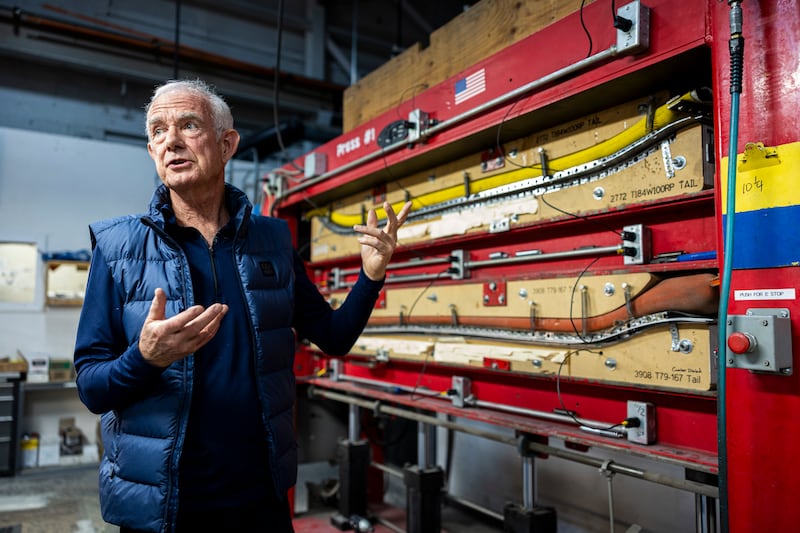
Laakso joined the company in 2018 to run operations and quality control, and Turner’s co-founder, Stephan Drake, left in 2019. Rumors swirled at the time that DPS was going out of business, and Turner acknowledges that the company survived a near-death experience.
“Our seasonal cash flow has always been a struggle and a source of stress,” Turner says. “That stress almost took me out a few years ago. A whole bunch of people stuck with us through our darkest days.”
Making skis is a perilous business. DPS buys millions of dollars of raw materials in the spring, makes as many skis as it can every day (60 to 70 sets is a good day) and books orders in the fall. The cash trickles in anywhere from six to 18 months later.
“This is a seasonal, cyclical business, which means you have growth spurts, you have declines, you have droughts that drive you to have excess inventory, and that hurts you,” Turner says. “We’re building skis now [in September] for this winter, and we don’t have any idea how much it’s going to snow. The real problem is cash flow.”
Laakso, the company’s business guy, listens from across the table and nods his head.
“We’re high-tech farmers,” he says, adding, “We don’t always ask what is the best business decision. We ask what’s best for the skier. And maybe that’s why we’re here 20 years later. … We don’t have focus groups. We are the focus group. We are skiers. We live and breathe skiing. We’re making skis for ourselves and hoping other people like them.”
These days, Turner goes into the office every couple of weeks. He enjoys connecting with the team on the factory floor but worries about getting in the way.
“My wife says I’m too picky,” Turner laughs. “And I say, if I wasn’t, we’d be making [crappy] skis. It’s the way I am.”
Laakso agrees: “You can be an engineer, but without passion — I mean, this guy breathes passion, and that’s reflected in these skis on the wall.”
Passion keeps Turner creating
Our interview has concluded, and squinting into the late-afternoon sunshine, Turner mulls taking the scenic route on his motorcycle back home to Eden, through Emigration Canyon and East Canyon. But before he kickstarts the engine, there’s one more story to tell.
“I just saw my dentist this morning,” Turner says. During his last visit, his dentist, Joy, shared that her husband had just bought her a new set of skis, and Turner asked how she liked them.
She hesitated: “Well, I’m still trying to figure them out.”
“I’m thinking, ‘You hate the skis,’” Turner says. “She couldn’t admit it. With our skis, you get on them the first time and bam, it’s like, ‘Hallelujah!’”
Turner went back to his garage, pulled out a pair of DPS skis, and delivered them to the office. A week later, Turner says, he ran into some of Joy’s skiing buddies.
“What did you do to Joy?” one of them asked. “All of a sudden, she’s skiing in the powder. She was always afraid of the powder.”
Turner breaks into a broad grin.
“She’s out there skiing and having the time of her life,” Turner says. “That, to me, is the real benefit of our skis.”