This post was originally published on here
Scientists based at Heriot-Watt University have launched a £4m project to create the world’s first 3D videos of black holes using complex artificial intelligence (AI) systems.
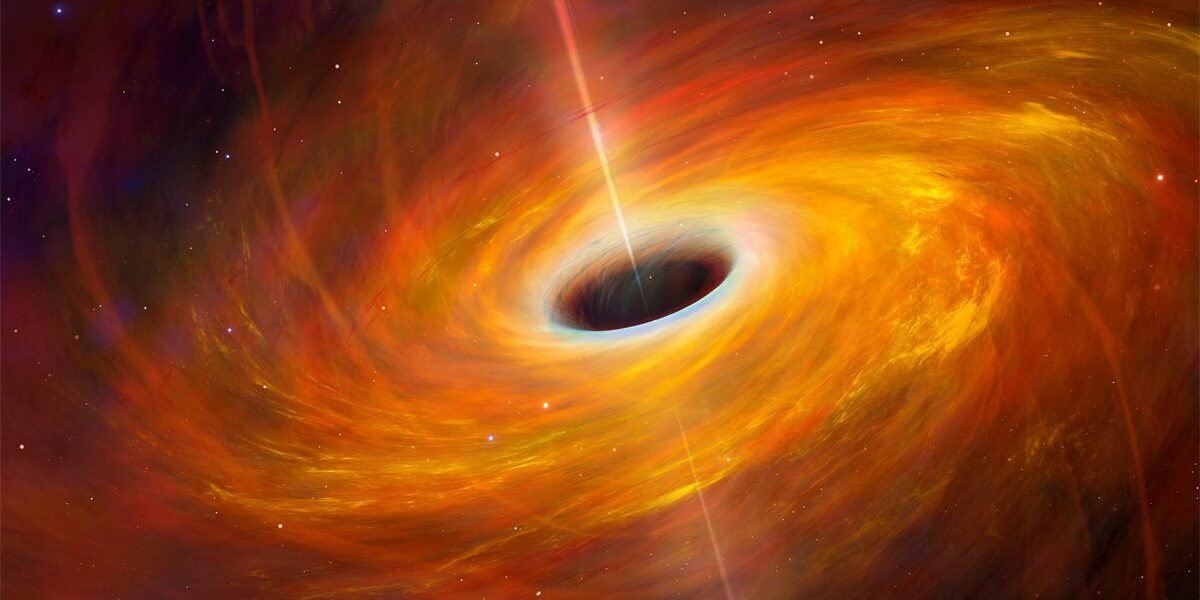
Black holes are regions in space with incredibly strong gravitational forces, so powerful that nothing can escape them once it crosses a boundary called the event horizon. Black holes generally form from the collapsed cores of massive stars, with some supermassive black holes existing at the centres of galaxies, including our own galaxy, the Milky Way.
The project will be run by Dr Kazunori Akiyama and Professor Yves Wiaux, who will work with 10 partners around the world to develop the videos from a base in Edinburgh. Funding for the project will come from the Faraday Discovery Fellowship.
By creating these videos using cutting-edge imaging technology and telescopic data, the scientists hope to transform the understanding of the universe’s most extreme environments by revealing how black holes behave and evolve across time.
Describing the potential of the project, Akiyama said: “By combining world-leading telescope capabilities with Heriot-Watt’s strengths in computational imaging, we will be able to follow the dynamics around black holes in a way that has never been possible before.
“Instead of a single blurred frame, we will see how plasma moves, how magnetic fields evolve and how gravity shapes everything around the event horizon. That shift, from still images to time-resolved structure, will fundamentally change the scientific questions we can ask and change our understanding of the universe.”
The project aims to reveal how black holes spin, how they warp spacetime under extreme conditions, and how they generate powerful jets of magnetised plasma through the use of a method called dynamic gravitational tomography.
This means that instead of creating flat images, like the 2019 and 2022 photographs of two supermassive black holes, M87* and Sagittarius A*, the AI systems will create 3D models that can show how plasma flows and evolves around black holes while revealing how energy is channelled and how spacetime is bent by extreme gravity.
The scientists claim this work, which they have titled the “TomoGrav project”, will provide the most stringent tests yet of Einstein’s theory of general relativity.
The AI technology developed to create these 3D videos could also be used in certain medical or geological settings on earth, where limited information is provided but complex answers are required.
Describing the further use cases of the technology developed in the project, Wiaux said: “Beyond black holes, this project is driven by a shared technical challenge. Imaging the universe from telescope data and imaging the human body with medical scanners both require turning very limited information into accurate, reliable images. Techniques developed to map plasma around black holes can also accelerate MRI scans or, in fact, improve measurements of the Earth’s rotation and sea level.”