This post was originally published on here
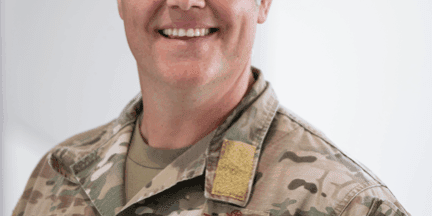
Newswise — When U.S. Air Force Lt. Col. Chris Dauer talks about why he chose a military fellowship with the Wireless Communications Research Division at the Idaho National Laboratory, he doesn’t start with the job. He starts with people.
In an INL conference room, Dauer leans back in his chair and reflects on how two decades of Air Force service led him to INL and a fellowship that’s helping him redefine what service means beyond the uniform. Dauer speaks about antennas, radios and the technical aspects of his work, but his real focus is the people that made him realize why communications research and technology matter.
For example, Dauer talked about a conversation with U.S. Air Force Staff Sgt. Kyle Fulton, a recipient of the Bronze Star Medal following a harrowing 2012 mission in Afghanistan where Fulton and his teammates prevented insurgent forces from storming a U.S. military base. The ordeal resulted in lives lost and saved.
“Kyle sat down with me after it all happened and said, ‘Hey man, I just wanted to tell you, the most important piece of gear I had that day wasn’t my M4, it wasn’t a weapon,” Dauer said. “The most important thing I had was my radio. So, I just want to say thanks for what you do.’”
Dauer said the exchange is one of his most humbling experiences. “I was like, you’re the hero here but hearing that made me realize what I wanted to do — support people like Kyle and make them more effective,” he said.
That mission-first mindset now guides his fellowship year at INL where he’s working with the Wireless Communications Research Division pairing operational needs from the field with science and engineering. The goal is to accelerate practical solutions for national security in a way that circumvents some of the innovation gaps or conflicts of interest that emerge when U.S. national security agencies and departments partner with the defense industry.
Dauer is one of two military fellows embedded within INL’s National and Homeland Security mission space this year. The other fellow is U.S. Space Force Maj. Sam Jolley, who is working within INL’s Cybercore division. The two officers collaborate informally and plug into multi-domain projects where communications and cyber systems intersect.
“INL shocked me,” Dauer said. “I thought it would be niche. Then you arrive here and it’s like walking into a Walmart or Costco — with a RadioShack in the back. The capabilities are broad, the teams are collaborative and they let us chase real problems here.”
Why INL — and why now
Dauer began his career in Air Force communications, where he found his calling as an expeditionary communications officer, a job that involves building communications connectivity in environments where none exist. He deployed to Iraq in 2007 and later supported operations across Afghanistan. His experiences in the Middle East reaffirmed the notion that reliable communications save lives.
Years later, while searching for a realistic range to test joint, coalition and vendor systems in tough terrain, he crossed paths with INL’s vast test beds and interdisciplinary teams. The relationship deepened through multi-year exercises and eventually led to his selection as an INL military fellow.
INL’s communications capabilities allow Dauer and his teammates to test concepts and technologies that they could never test in other environments.
“The problem with communications is we’re never really allowed to completely bring communications down because it’s too disruptive,” Dauer said. “We needed a place where communications can fail and fail fast, because failing is how you learn and fix things. It’s what makes you better. INL gave us space to break, retool, test across the joint force, prove what works and ensure we’re interoperable.”
What the fellowship does
INL’s fellowship model lets active-duty officers spend a year inside the lab ecosystem pairing operational gaps with lab capabilities. These capabilities allow officers to pressure-test concepts in realistic and at-scale conditions and environments.
“It’s about pairing real operational problems with the right science,” he said. “If we can shorten the path from idea to impact — that’s a win for the people who need it most.”
Further, it helps them learn how federal research and development, and acquisition and mission partners fit together. For Dauer, this means advancing resilient, long-range communications concepts, helping plan exercise activities on INL ranges and applying those lessons in his next military assignment and leadership role.
“I’ve just loved working here,” he said. Pulling me out of the Air Force box for a year means I can be the dissenting voice later on — in a good way. I’ll bring back a wider picture of what’s possible.”
SkillBridge: ‘Try it before you buy it’
In addition to its military fellowship program, INL participates in the Department of War SkillBridge program — an initiative that allows service members to work with industry, nonprofit and public-sector organizations for up to 180 days prior to separation. SkillBridge helps service members build experience while they continue to receive military pay and benefits. The partnership at INL helps transitioning service members who want a shorter on-ramp to civilian research and development missions. SkillBridge provides a practical way to explore roles, grow skills and translate military experience into civilian impact.
Veterans at INL
SkillBridge isn’t the only veteran workforce pipeline INL relies on. Mission continuity is part of INL’s culture. Veterans make up more than 9% of INL’s total workforce and 41% of the lab’s senior leadership roles.
INL draws on the skills, discipline and experience veterans bring to the table and gives veterans a way to continue serving by combining their mission mindset with its research capabilities and expertise. The result is effective and field-ready solutions for those still on the front lines of national security.
“What scares me about leaving the military is losing a sense of mission,” Dauer said. “But at INL, you can feed your family and feed your soul. What you do here still matters — it saves lives.”
Learn more about INL’s Wireless Communications Research programs and visit our career’s page to find out how you can support our national security efforts.
About Idaho National Laboratory
Battelle Energy Alliance manages INL for the U.S. Department of Energy’s Office of Nuclear Energy. INL is the nation’s center for nuclear energy research and development, and also performs research in each of DOE’s strategic goal areas: energy, national security, science and the environment. For more information, visit www.inl.gov.
Follow us on social media: Facebook, Instagram, LinkedIn and X.