This post was originally published on here
By Merilyne Ojong
Scientists, policymakers and development partners gathered in Libreville, Gabon, in November 2025 for a major International Scientific Symposium and a high-level science–policy forum that marked a milestone in efforts to strengthen evidence-based forest governance in Central Africa.
The two monumental events were organized under the EU-funded RESSAC programme that seeks to amplify the impact of research on the sustainable management of Central African forest ecosystems.
The two-day International Scientific Symposium (25–26 November 2025) showcased cutting-edge research on the Congo Basin’s forests and the people who depend on them. It brought together researchers, practitioners and decision makers to examine policy-relevant findings on forest governance, agroforestry systems, ecosystem services, and the rights and knowledge of Indigenous Peoples and local communities.
Structured around three core dimensions (environmental sustainability, economic viability and social equity), the symposium created space not only to share results, but also to interrogate how science can better inform policy and development action in the region.
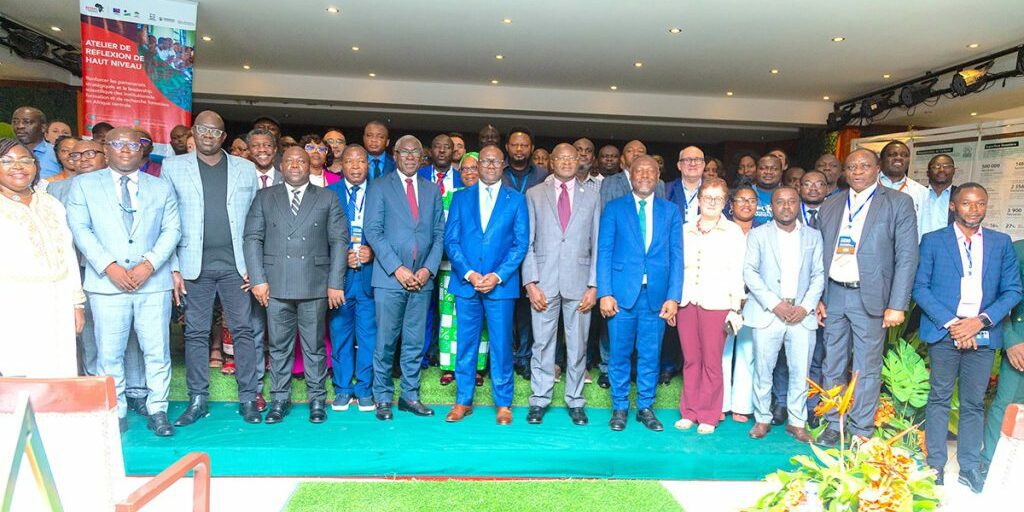
Building directly on these scientific exchanges, the high-level science–policy forum was convened at the same venue on 27 November 2025. It focused on strengthening strategic partnerships and institutionalizing post-doctoral programmes within Central African universities and research institutions.
It brought together representatives from government ministries, university leadership, international cooperation agencies, private sector actors and regional networks, including REESIRAC, CAMES, RIFFEAC and the Congo Basin Forest Partnership.
Participants reviewed good practices, assessed institutional capacities and outlined elements of a shared roadmap to support the long-term integration of post-doctoral programmes into national and regional research ecosystems. This is a critical step towards sustaining scientific excellence beyond project cycles.
The two events also highlighted the broader achievements of the RESSAC programme. Over the past four years, it has demonstrated how applied research, grounded in local realities and strong partnerships, can contribute to more sustainable forest management across the Congo Basin.
A central pillar of the programme has been investment in people and scientific leadership. Indeed, RESSAC has supported 27 post-doctoral researchers through North–South research consortia, alongside targeted mentoring in scientific writing, project design and resource mobilization.
This approach has helped build a new generation of Central African researchers who can produce policy-relevant evidence and engage effectively with decision makers.
During the Libreville meetings, the European Union underscored the importance of such investments.
“Investing in applied research and people is essential for evidence-based policymaking and sustainable development,” said Cecile Abadie, European Union Ambassador to Gabon, Sao Tome-and-Principe and the Economic Community of Central African States.
Richard Sufo, RESSAC Programme Coordinator, added that two events demonstrate the value of sustained investment in science that is rooted in regional realities.
“By bringing researchers and policymakers into the same space, we are strengthening the links between evidence and decision making, while building the next generation of scientific leadership needed to sustain Central Africa’s forests,” he said.
The extensive data generated through RESSAC will be hosted by the Central African Forest Observatory (OFAC), which is COMIFAC’s technical unit. This will strengthen regional institutions and improve access to reliable scientific evidence. It will also help close the gap between science, policy and practice.
By linking rigorous science with high-level policy dialogue – and by placing Central African researchers at the centre of knowledge production – the symposium and science–policy forum underscored how regional expertise can shape more inclusive, resilient and sustainable forest management for the benefit of people, economies and ecosystems.