This post was originally published on here
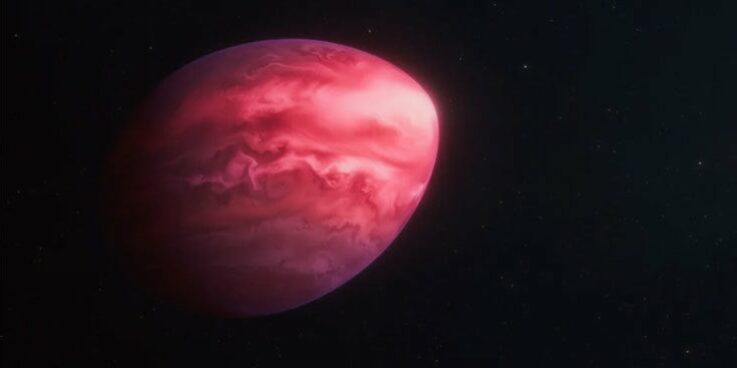
Scientists have discovered a peculiar, lemon-shaped exoplanet, PSR J2322-2650b, that is challenging current understanding of how planets form.
The planet has extreme physical and atmospheric properties unlike anything seen before.
Researchers believe the planet’s atmosphere may be filled with soot-like clouds, and deep within its interior, carbon could clump into solid crystals—possibly even forming diamonds.
PSR J2322-2650b orbits a pulsar, a rapidly spinning neutron star left behind after a massive star explodes. This pulsar, PSR J2322-2650, packs roughly the mass of the Sun into a space about the size of a city and emits steady beams of energy as it spins.
The planet’s orbit is extremely tight—only about one million miles from the pulsar—causing a full year on PSR J2322-2650b to last less than eight hours.
Powerful gravitational forces stretch the planet into its distinctive lemon-like shape. Temperatures on the planet range from approximately 1,200°F to 3,700°F, making it one of the most extreme environments ever observed.
Observations were made using NASA’s James Webb Space Telescope. Scientists expected to detect common atmospheric gases such as water vapor or methane.
Instead, they found helium and simple forms of carbon. According to researchers, this type of carbon should not exist on its own at such high temperatures unless almost all oxygen and nitrogen are absent—something not seen on any other known planet.
“Our collective reaction was, ‘What the heck is this?’” said Peter Gao, a co-author of the study at the Carnegie Earth and Planets Laboratory.
The system also resembles a rare configuration known as a “black widow”, in which a pulsar slowly strips material from a nearby companion. In this case, however, the companion is a planet rather than another star.
The findings, published in The Astrophysical Journal Letters, suggest that planetary systems can exist under far more extreme conditions than previously thought. However, no known process currently explains how such a carbon-heavy planet could form, raising new questions about planetary formation theories.