This post was originally published on here
As Delaware Currents prepares to shut down, many of us who work in and care for the Delaware River Watershed feel the loss personally.
For years, editor Meg McGuire and her team offered something rare: journalism that listened to the river, explained its science, held institutions accountable, and connected people to the water that sustains them. DC’s departure is more than the end of a publication: It is a warning.
Because at the very same moment that DC’s doors are closing, the science that protects the Delaware River is facing an existential threat.
Across the country, federal funding for scientific research — especially environmental, water quality, and climate-related work — is being reduced or redirected at a scale that has stunned even seasoned policy analysts. Many of these cuts affect fields that rely on long-term, nonpartisan data collection. In the Delaware River Watershed, this means fewer stream monitors, fewer research technicians, fewer trained scientists, and more gaps in the record that tells us whether our rivers are getting cleaner or more polluted.
Science and Journalism: Twin Guardians of the Public Interest
Remember the Flint water crisis? It became a national reckoning because researchers refused to let data be dismissed, and local reporters refused to let residents’ concerns be ignored. Their work forced accountability, policy change and the protection of human health.
This is the power of science and journalism working together: They hold those in power to account and inform the public with facts rather than speculation.
Yet both fields face a crisis of trust and political polarization. NSF’s Science and Engineering Indicators 2024 highlights a public that values research, but a Pew Research Center survey shows declining trust in scientists.
Journalism faces similar challenges. Research from Press Forward shows local newsrooms aren’t failing because people don’t care; they’re failing because people don’t fully understand the cost, labor and civic importance of the work.
Both science and journalism suffer from a kind of mystique: When done well, they appear effortless because most of the effort happens out of sight. But it is precisely this unseen work — this daily, careful, rigorous labor — that keeps our communities safe.
A River Protected by Both Science and Storytelling
Here in the Delaware River Watershed, we have witnessed how journalism and science can illuminate each other. When Chris Mele and Lauren Yates, reporting for DC, covered Stroud Water Research Center’s Cut the Salt campaign last winter, they helped thousands understand a growing crisis: road salt infiltrating our streams, threatening ecosystems, and corroding infrastructure.
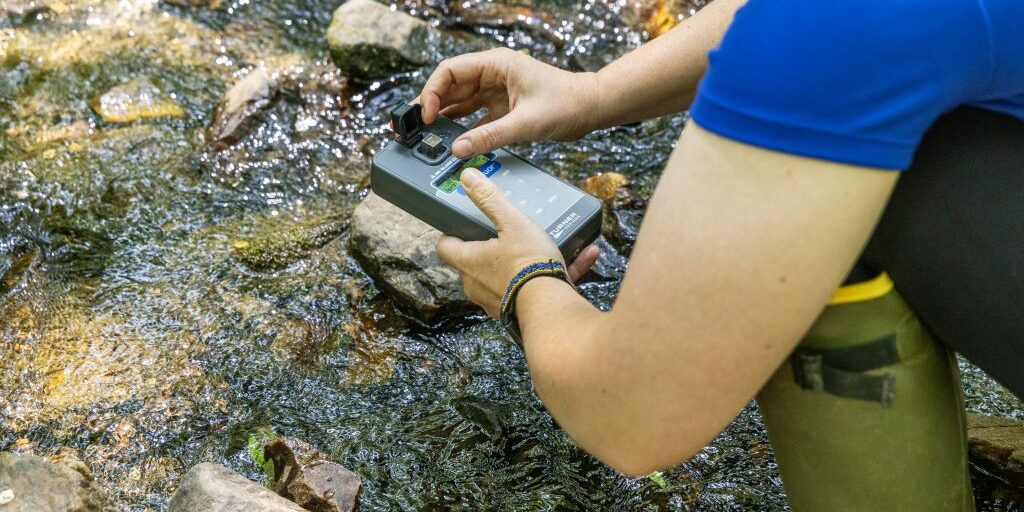
Dozens of groups and hundreds of local residents waded into streams to collect chloride data last January during Winter Salt Week and again in October. They weren’t just participating in science; they were demonstrating something more profound: Even as national funding shrinks, local communities can still rise to meet an urgent challenge.
It is a hopeful story. And yet volunteer energy and grassroots collaboration cannot replace sustained, long-term scientific investment. Nor can they replace a professional newsroom whose full-time mission is to shine light on public issues.
The Gravity of This Moment
The Delaware River supplies drinking water to 15 million people. It supports economies, ecosystems, and communities across four states. But we can’t protect what we can’t measure, and we can’t act on dangers we can’t see.
Right now, we are at risk of losing both the measurements and the messengers.
If long-term scientific monitoring is halted or reduced, we might not detect contamination until it is too late. If local journalism fades, communities might not know when policies or decisions put their water at risk. And when misinformation fills the silence left by both, the public loses its ability to hold anyone accountable.
Where We Go From Here
The solution will not come solely from Washington or major philanthropies. It will come from the communities who depend on the Delaware River and the institutions that serve them.
Supporting local journalism and local science is not charity. It is an investment in our own protection — in the data, transparency, and accountability that keep our freshwater resources safe.
As DC closes, we should honor its work by refusing to let silence replace it. Support the newsrooms that keep the public informed. Support the research organizations that monitor our rivers. Join community science efforts like Cut the Salt. Ask local leaders what they are doing to safeguard long-term water quality data.
Because the river will remain. The question is whether we will still hear what it’s telling us.