This post was originally published on here
GUANGZHOU: Chinese scientists have made a significant discovery regarding Earth’s early evolution, proposing a new mechanism explaining how the planet stored vast amounts of water during its infancy.
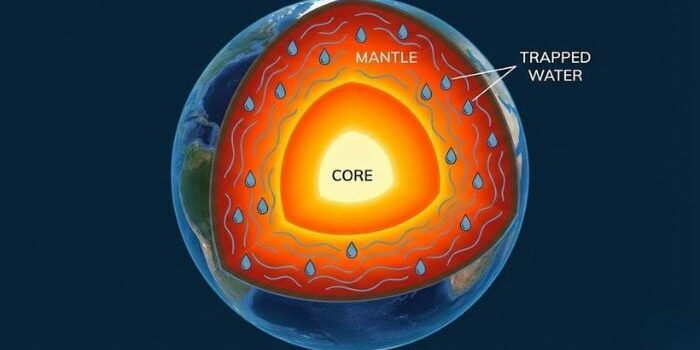
A study published on Friday in the journal Science, conducted by researchers at the Guangzhou Institute of Geochemistry (part of the Chinese Academy of Sciences), provides experimental evidence that Earth’s deep mantle may have functioned as a massive water reservoir more than four billion years ago.
This finding sheds new light on the dramatic transformation of the planet from a molten body of magma to the life-supporting world it is today. As an editorial summary in Science noted: “Where did the water go when Earth’s early magma oceans crystallized? For the deepest mantle, the answer has been elusive.”
The Role of Bridgmanite
The key lies in bridgmanite, the dominant mineral in the lower mantle.
While previously thought to have limited water storage capacity, the Chinese team discovered that the mineral actually exhibits a powerful, temperature-dependent ability to trap water.
They recreated the harsh conditions of the lower mantle—high pressure and scorching temperatures reaching approximately 4,100 degrees Celsius—using a sophisticated diamond anvil cell apparatus coupled with laser heating.
A Paradoxical Finding
A paradoxical discovery emerged from their data: Bridgmanite’s ability to capture and store water molecules when forming from cooling magma increases in efficiency as the surrounding environment becomes hotter.
According to the study, this process could have locked away an amount of water equivalent to between 0.08 and 1 times the volume of all modern oceans within the solid mantle. This primordial “water stockpile” has been gradually cycled back to the surface through volcanic activity over billions of years, contributing to the formation of a blue, habitable planet.