This post was originally published on here
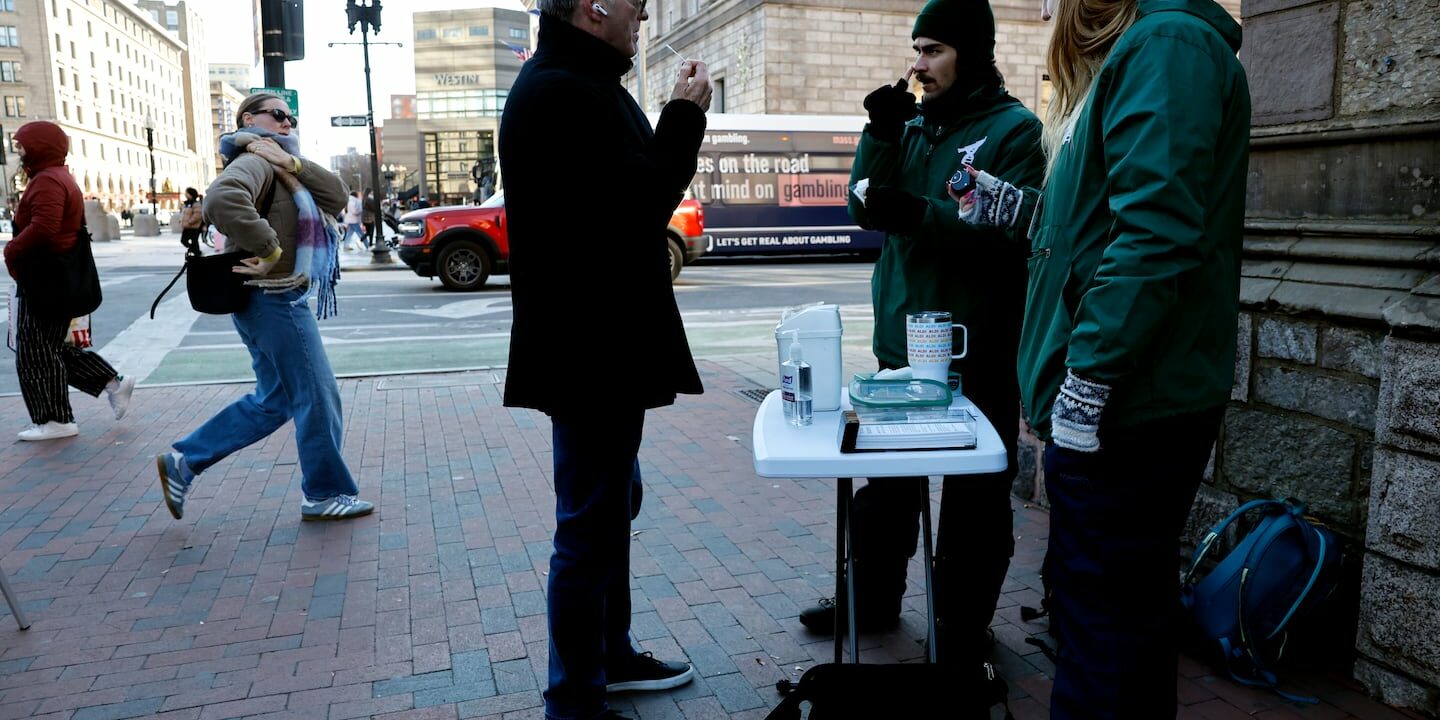
On a bright, brisk December day, two people stood in front of Boston’s Old South Church, asking passersby to shove cotton swabs up their noses, for science — and for two bucks.
And despite the aching cold, quite a few said “yes.” Dozens by early afternoon, hundreds on a typical day. and with each swabbed-out nostril, Simon Grimm gets a little closer to his goal — a reliable method for early detection of the next major pandemic.
“We want to understand what pathogens are circulating in the population,” said Grimm. “To do that, you need samples from many different people, and one straightforward way to collect them at scale is recruiting volunteers on the street.”
Grimm, a physician born and educated in Switzerland, is a technical program manager at SecureBio, a non-profit spun out from the Massachusetts Institute of Technology in the wake of the COVID pandemic. Now an independent nonprofit, SecureBio has launched the Nucleic Acid Observatory, a team of scientists working on new ways to monitor the spread of diseases.
They’re best known for searching through sewage. In cooperation with the University of Missouri, the observatory regularly tests for viruses in the sewer water of 20 US cities ranging from Boston, New York and Chicago, to Milan, Mo. and Ottumwa, Iowa. They’ve also tried sampling toilet waste from international airplane flights landing at Logan Airport to see if anything unpleasant is coming in from abroad.
But COVID, like many other pathogens, is an airborne virus, so testing sewer water only gets the scientists so far. That’s why the observatory last year launched Zephyr, a program that uses nasal swabs to monitor the viruses people are carrying. Even if a person isn’t infected, the viruses tend to stick around inside their nostrils. Test enough people, Grimm believes, and you’ll get a good idea of the ebb and flow of viruses in the local population.
All Grimm had to do was find a few thousand people willing to poke around in their own noses for a few seconds.
Turns out, this isn’t so hard, if you give people a financial incentive.
Grimm figured that every nasal passage has its price, but how much? When the program started a year ago, he experimented. A dollar was too little, while five dollars would quickly drain his funds. They hit the sweet spot about six months ago, when they hit upon the idea of a two-dollar payment, in the form of a brand-new $2 bill. Since then, SecureBio has paid out about $20,000 in swab money and collected 10,000 swabs.
Genevieve Speedy and Liam Nokes oversee the nose swabbing and dole out the cash. Speedy is a student at Boston University, majoring in genetics. She took the swab job hoping it’ll impress future employers.
“It’s like how our parents say they walk to school uphill both ways,” she said. “I can say I stood out in the cold for science.”
Her teammate Nokes signed on after speaking with members of a swab team working the T station in Harvard Square.
“I’m really interested in microbial ecology,” said Nokes, who recently graduated from Dartmouth College with a degree in mathematics, and who’s planning to pursue either a medical degree or a Ph.D.
Did he expect an Ivy League education to prepare him for a future in nose-swabbing? Well, sort of.
“I expected to end up somewhere where I was happy and doing something I thought was interesting,” Nokes replied. “And here I am.”
The swab donors had a variety of motives.
Brittany Bernie was doing her bit to protect public health. “I did this to stop the germs and the whole spread of everything and make sure we’re all safe,” she said. The money played no part in her decision.
The same went for another woman, Alex Million. ” I think it’s important to detect the next pandemic,” she said. “To protect people and get the vaccine.”
But for Eric Saarinen, the price was right. “I was walking by and they asked, …you need a $2 bill?” Saarinen said.
It’s not much money, but it’s hard to resist a brand-new $2 bill. It’s a denomination you don’t often see in the real world, making the gift something of a collector’s item.
The experiment poses no threat to privacy, the researchers say. All donations are anonymous. Volunteers swab out their own nostrils, then dunk the swab into a communal test tube partly filled with liquid. The collected material all sloshes together, which is fine because Grimm’s team isn’t interested in individuals. They’re trying to track viruses spreading through the population at large.
The samples are taken to a laboratory where human DNA is filtered out and discarded. Technicians home in on RNA, the genetic material found in many infectious viruses, including influenza, polio, West Nile fever and of course COVID. They use gene sequencing machines to identify these RNA samples, then match them with known viruses.
Over time, this method can measure how many people have come in contact with these viruses. In addition, the tests can spot viruses that aren’t identical to known pathogens, but are genetically close enough to merit a closer look. If these new viruses begin to show up frequently in the swab tests, it’s a clear signal that they’re spreading through the population.
For now, the swabs are being collected only in the Boston area. But if the method proves its worth, it could become part of a nationwide early warning system for the pandemics of the future.
Hiawatha Bray can be reached at [email protected]. Follow him @GlobeTechLab.