
This post was originally published on here
We have mapped the farthest corners of the Earth, but now we are facing a cosmic intruder. Interstellar object 3I/ATLAS didn’t just float through the Sun’s area like a normal comet. It tore through our neighbourhood like a bullet fired from the deep dark.
Since it was found in July 2025, it has gone against all expectations for solar system debris, making it something completely different. The NASA-funded Asteroid Terrestrial-impact Last Alert System (ATLAS) in Chile first saw the object on July 1, 2025. At first, it was thought to be a faint speck in the constellation Sagittarius that was already moving at an incredible 137,000 miles per hour.
3I/ATLAS came to us on a hyperbolic path, which is a mathematical sign that it came from outside of our solar system. This is different from the ‘native’ comets that belong to our Sun. What really scared scientists wasn’t where it came from, but how it acted when it got to the inner solar system. Observations showed that there was always activity facing the sun, such as a rare anti-tail and highly structured jets that seemed to pulse on a regular schedule.
These are not the signs of a frozen traveler who isn’t moving. On October 30, 2025, it reached its perihelion, which is the point in its orbit that is closest to the Sun. At that point, it was moving at 153,000 miles per hour, which is about the same distance as Mars’s orbit.
Pexels
Decoding The Mystery Of The 3I/ATLAS Anti-Tail
The chemical signatures found in the object’s coma only made the mystery deeper. The emissions were consistent with volatile compounds, some of which are rarely seen at such high concentrations. This suggested that the body formed in a very different stellar environment than our own. This visitor from another star system was active at distances where solar heating alone usually can’t explain such dramatic outgassing.
The James Webb Space Telescope (JWST) found that 3I/ATLAS has a lot of carbon dioxide and only a little bit of water ice. This chemical fingerprint sets it apart from our local comets. Researchers are now racing to figure out what it’s made of, how it behaves differently when it’s hot, and what might be causing its strange behaviour.
Timing has also played a critical role in the 3I/ATLAS saga. The object passed through the inner solar system during a brief window when humanity has only just begun to systematically monitor interstellar space. Its discovery was by no means a certainty; a decade ago, it would likely have passed completely unseen.
This reality has exposed a chilling vulnerability. Had the object been slightly smaller, faster, or less reflective, it could have slipped through our local space unnoticed until it was already racing back out into the void. In fact, Hubble Space Telescope observations from 20 August 2025 placed the nucleus size at anywhere between 1,400 feet and 3.5 miles, a range that suggests we are still grappling with the sheer scale of these interstellar voyagers.
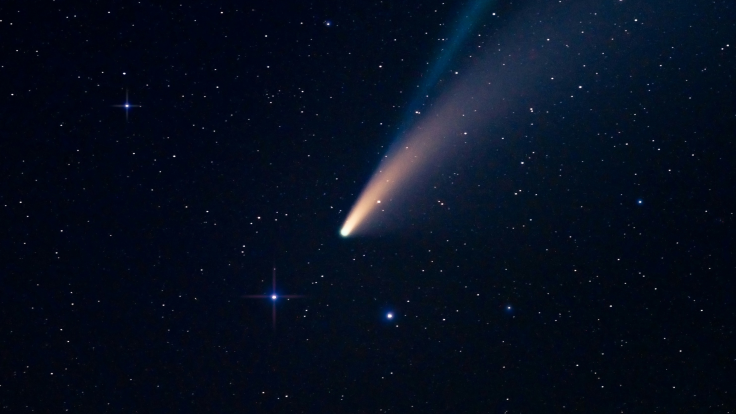
Justin Wolff/Unsplash
3I/ATLAS: A Cosmic Warning Shot For Planetary Defence
To describe 3I/ATLAS as a ‘warning shot’ is not to imply a hostile intent from some far-flung civilization, but rather to recognise the massive implications of its existence. The galaxy is not a quiet, empty vacuum. Objects from other star systems enter ours with regularity, carrying unfamiliar chemistry, physics, and—most importantly—unfamiliar risks.
While a lot of these interlopers might just be harmless scientific curiosities, some of them might have the mass and speed to really threaten Earth. 3I/ATLAS passed safely 1.8 astronomical units from Earth on December 19, 2025, but the fact that it was so close to being detected should wake up space agencies around the world.
The arrival of 3I/ATLAS served as a definitive notice. It proved that our solar system is not an isolated island and that our detection capabilities are still desperately catching up to the reality of an active, dynamic galaxy. The lesson is as clear as it is sobering: interstellar space is reaching out to us.
This time, the object was just a messenger, a quiet witness to how little we could see of the deep dark. Recent radio signal analysis from South Africa’s MeerKAT telescope has confirmed that the object is a natural comet, putting an end to theories that it is an alien probe and showing that we need better ways to monitor interstellar space.
3I/ATLAS is now heading back to the interstellar medium, and it leaves behind more than just a trail of dust and rare gases. It leaves us with questions about how ready we are for the next visitor. We can only watch as it fades away for now, knowing that the next ‘warning shot’ is already on its way.