This post was originally published on here
Here’s what you’ll learn when you read this story:
- New research published in the Journal of the British Astronomical Association adds credence to a theory that the Biblical Star of Bethlehem was a real-life astronomical phenomenon.
- The research points to a Chinese history test, which describes a comet that appeared to stand still for 70 days in 5 B.C.E.—a date which likely coincides with the birth of Jesus.
- The new research subjects this comet theory to mathematical calculations regarding its potential trajectory, and even pinpoints what day it would have appeared in the sky along the path from Jerusalem to Bethlehem.
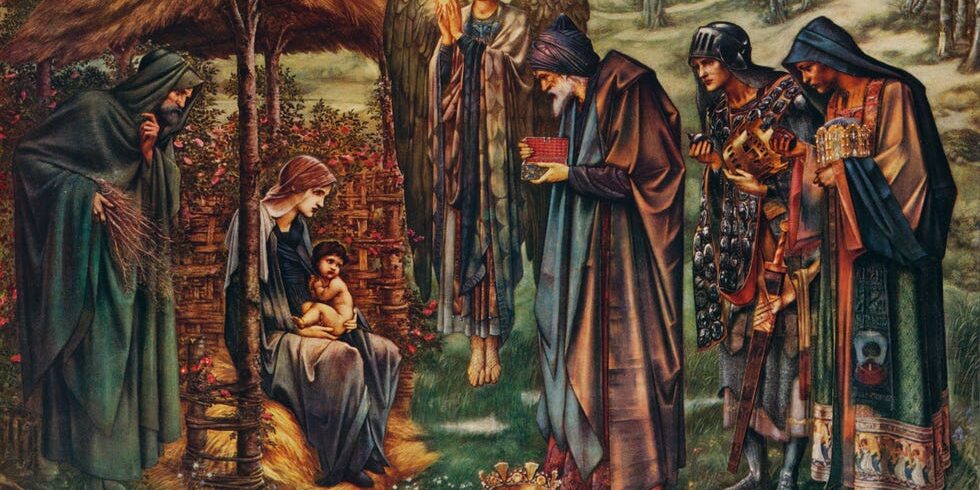
The Star of Bethlehem is one of the most famous pieces of Christmas iconography. Despite only appearing in one of the four canonical gospels (the Gospel of Matthew), the story of a celestial object guiding the three wise men to the newborn Jesus Christ in his manger is repeated in everything from church pageants to popular films. But what was the Star of Bethlehem, really?
Naturally, one secular answer would be to suggest that the Star of Bethlehem never existed at all—that it was merely an invention by the author of Matthew to have Jesus of Nazareth fulfill another Messianic prophecy. The Gospel of Matthew is full of narrative elements that align with various Old Testament prophecies, from the virgin birth prophesied in Isaiah 7:14 to the thirty pieces of silver from Zechariah 11:13. In that sense, the Star of Bethlehem could be seen as an effort to answer the prophecy written in Numbers 24:17, the Star of Jacob:
“I shall see him, but not now: I shall behold him, but not nigh: there shall come a Star out of Jacob, and a Sceptre shall rise out of Israel, and shall smite the corners of Moab, and destroy all the children of Sheth.”
But any attempt to dismiss the Star of Bethlehem as a mere literary flourish has to contend with the fact that there are real astronomical phenomena—and, in some cases, even documented events—that could explain the appearance of that famed “star of royal beauty bright, westward leading.” A new study has even put one cosmic candidate to the test.
As reported in Scientific American, while some have posited that the Star of Bethlehem was a conjunction between Saturn and Jupiter, new research written by planetary scientist Mark Matney and published in the Journal of the British Astronomical Association puts considerable weight behind an alternative theory: that the star of Bethlehem was actually a comet.
“Matney recalls how, as a student, he worked at a planetarium that ran a Christmas sky show telling the story of the Star of Bethlehem, which rose in the southern sky until it appeared to come to a stop overhead,” Scientific American wrote. “The planetarium show said that no known astronomical object could act in the way described by the story of the magi—Earth’s rotation means that everything in the sky rises in the east and sets in the west.”
But Matney disagreed. He believed that one celestial object could fit that description, “a long-period comet from the mysterious Oort Cloud.”
To strengthen his case, Matney turned to ancient Chinese writings, particularly the Astronomical Treatise of the History of the Former Han Dynasty, which told of a “hui‐hsing,” or broom star, that appeared in the spring of 5 B.C.E. Scientific American summarizes that this Chinese treatise appears to suggest that “the strange star remained in the same constellation for 70 days—far too long for a comet.”
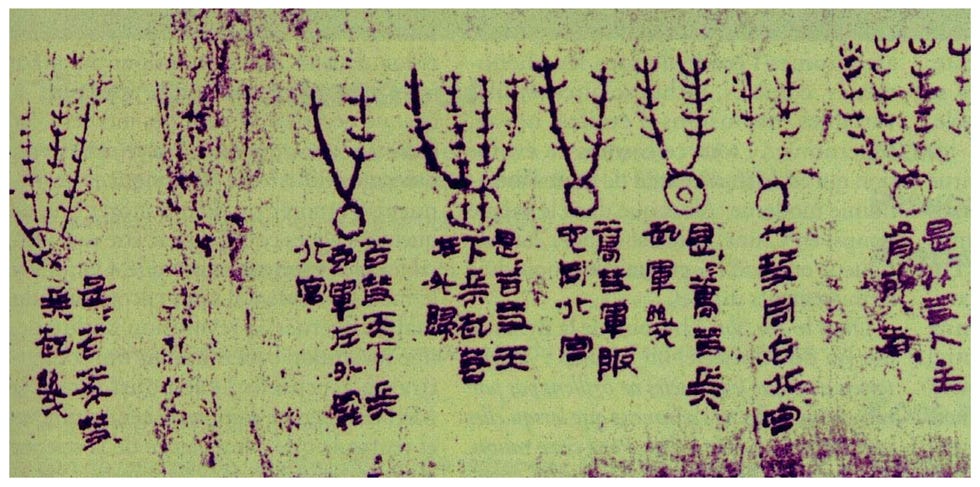
Chinese astronomical records, like the Mawangdui silk from around 300 B.C.E., can provide a vital insight on ancient astronomical events like the hui hsing, or “broom star,” which we now call comets.
This particular astrological event isn’t just an example of what type of “star” the Star of Bethlehem was—it could very well have been the very same star. That’s because, even though our contemporary dating system of B.C.E. and C.E. is rooted in what’s called the Anno Domini dating system, meant to chart all history based on whether or not it occurred “Before Christ,” it turns out one of the things that came into existence in that “Before Christ” period was likely… Christ.
Most scholars now agree that Jesus was likely born during the B.C./B.C.E. period, with 5 B.C.E. as a strong contender, largely because the Gospels of both Luke and Matthew depict the birth of Jesus as occurring during the reign of King Herod. The famed monarch died in 4 B.C.E., so Jesus’ birth needs to have occurred before then.
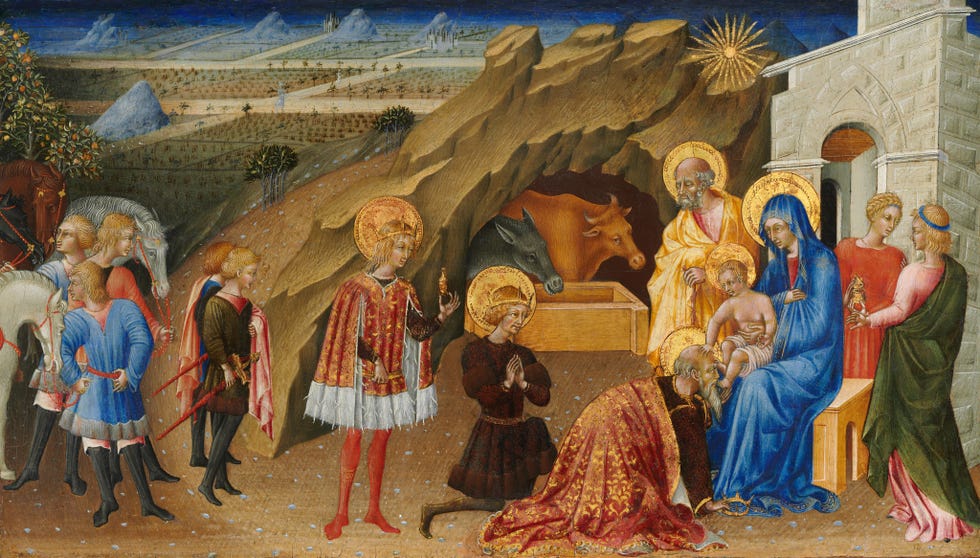
The Adoration of the Magi by Giovanni di Paolo, circa 1450
As for the Chinese-documented comet that may coincide with the birth of Jesus in 5 B.C.E., it should be noted that Matney is not the first to make this connection. Back in 1977, David H. Clark of the Royal Greenwich Observatory in Herstmonceaux, England proposed the same theory at a colloquium at New York University, as reported at the time by the New York Times.
Matney’s research cites Dr. Clark’s and builds on it, calculating which possible comet orbits this particular “broom star” could have taken. Matney also posits that the comet could have experienced a “temporary geosynchronous motion” wherein it would “temporarily match and counter Earth’s rotation rate,” causing it to appear to stop in place in the sky. Matney even takes the math a step further, matching one of his viable comet orbits to the path from Jerusalem to Bethlehem that the three wise men would have taken. In doing so, he determined that “one particular June day, this comet could have moved in such a way as to appear to ‘go before’ someone traveling from Jerusalem to Bethlehem and then ‘stop’ nearly overhead for about two hours.”
Naturally, this isn’t the final word on the Star of Bethlehem, nor did Matney intend it to be. Scientific American notes that Matney’s goal “is not to identify the Star of Bethlehem outright so much as to propose a valid astronomical object that could match its described behavior.” That being said, if Matney is right, you may have to wait to unwrap those Christmas presents until June if you want to be historically accurate.
Michale Natale is a News Editor for the Hearst Enthusiast Group. As a writer and researcher, he has produced written and audio-visual content for more than fifteen years, spanning historical periods from the dawn of early man to the Golden Age of Hollywood. His stories for the Enthusiast Group have involved coordinating with organizations like the National Parks Service and the Secret Service, and travelling to notable historical sites and archaeological digs, from excavations of America’ earliest colonies to the former homes of Edgar Allan Poe.