This post was originally published on here
Stanford has successfully engineered a human uterus lining (endometrium) to be capable of embryo implantation — the first step to creating an artificial womb.
On Tuesday, three studies published in the peer-reviewed scientific journal Cell described what they say is the most accurate replication of the earliest stages of pregnancy.
Researchers at Stanford collaborated with Cambridge, the Babraham Institute and a lab in Spain to try to learn more about how an embryo implants in the uterus.
Advertisement
Advertisement
These scientists hope their research eventually improves IVF success rates, since roughly 75% of transferred embryos fail to implant, per a study in the journal Frontiers in Endocrinology.
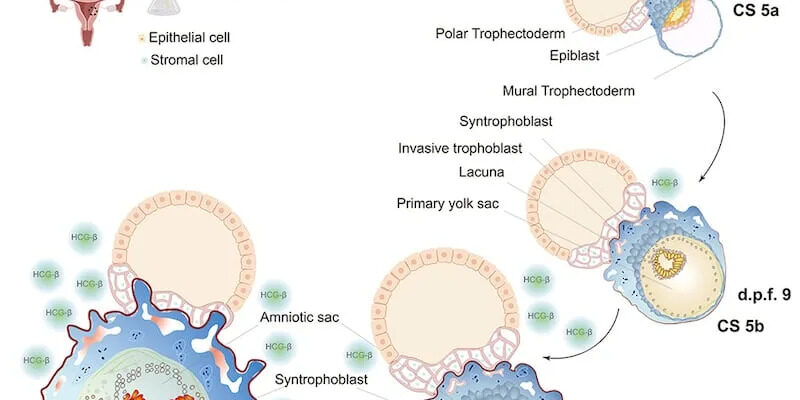
A graphical abstract from a study published on Dec. 23, 2025, of the 3D post-implantation co-culture of human embryo and endometrium. | Jinzhu Song et al., Cell Press
Similar research from China, in collaboration with Southwestern University in Texas, used cells and tissues from the lining of wombs to recreate part of the endometrium lining in little silicone devices.
Then researchers placed blastoids and embryos donated after infertility treatments inside the little device and watched it under a microscope. A human blastoid is a stem-cell-made copy of an early embryo stage, created without sperm or egg.
Jun Wu, a molecular biologist from the University of Texas Southwestern Medical Center who was involved in the research, told NPR, “For the first time, we observed the entire sequence of human implantation. We are very excited about this.”
Advertisement
Advertisement
“Human implantation is essentially a black box — a mystery,” he said. “Implantation happens very early on during pregnancy. Essentially we don’t know when, we don’t know where. It’s happening in a womb we cannot have access to.”
Beijing’s study tested about 50 IVF embryos and 1,000 blastoids.
Peter Rugg-Gunn, a biologist involved with the research at the Babraham Institute, delivered a similar sentiment. “We’ve been able to observe some really fantastic aspects of human embryo development, many of which have never been seen before. To be able to see these events for the first time, it was fantastic,” he said.
Each time an embryo or blastoid attached to the lab-created endometrium, the experiment was stopped before 14 days, due to legal and ethical rules.
The initial mother-embryo bond reproduced in lab
The reports published Tuesday attempt to recreate and study the initial bond between mother and embryo, when the latter implants.
Advertisement
Advertisement
“The key question we want to try to answer is what is the first cross-talk between embryo and mother,” senior author of Beijing Institute’s report, Lequian Yu, told the MIT Technology Review. “I think this is maybe the first time we can see the entire process.”
Yu said his group in Beijing is working to make their artificial womb more realistic by adding blood vessels, tiny pumps, immune cells and a blood supply.
Wu added that some researchers he knows view the study as an initial step to creating babies outside of a mother’s body. While “this technology is certainly related to ectogenesis, or development outside the body. … I don’t think it’s anywhere near an artificial womb. That’s still science fiction,” he said.
Some say the research brings up moral concerns
A bioethicist at Wake Forest University told NPR the new research could be “very troubling,” because it “could facilitate future attempts to support not only research on early embryos but on growing embryos for significant periods of time in labs, perhaps eventually to the point of fetuses.”
Advertisement
Advertisement
This could lead to the prospect of “growing babies” for “spare parts,” Iltis said. “They could be grown to be sources of organs and tissues for transplantation.”
Dr. Daniel Sulmasy, another bioethicist at Georgetown University, added, “For those of us who believe that humans are humans and deserving of ethical respect, whether embryonic, adolescent or elderly, these experiments are unethical.”
A Hastings Center bioethicist, Insoo Hyun, said the research could be a sort of “slippery slope scientifically.”
Lawyer Wesley Smith paralleled Hyun’s comment in the National Review on Wednesday. “What is the limiting principle that can be applied to experimenting on unborn human beings? Is it their size? Their time in existence? Is it birth? We have been told by some bioethicists that a born baby is no different morally than a fetus, so why stop there?” Smith asked.