This post was originally published on here
It’s one of the most beloved household board games – regardless of the ferocious arguments it causes at Christmas.
Now, scientists reveal the secret to beating friends and family at Guess Who?, the classic two-player game accompanied by the satisfying sound of snapping plastic.
Dr David Stewart, mathematician at the University of Manchester, says the trick is to always ask a question that splits your suspects ‘as close as possible into halves’.
That’s because you don’t want to risk asking a question that only eliminates a tiny minority of the suspects.
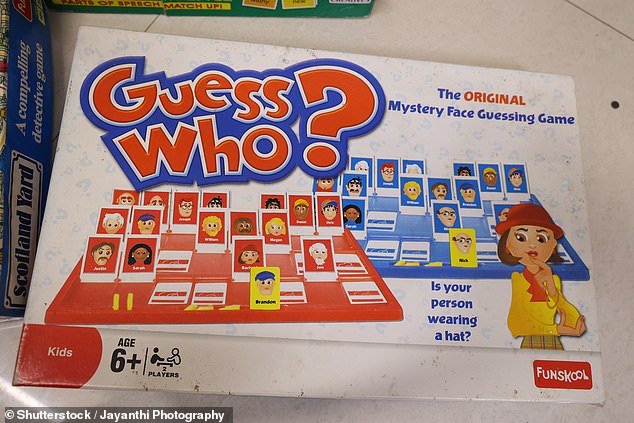
Since the game was released back in 1979, players have asked generic questions like ‘Do they have a hat?’ to guess their opponent’s character.
But instead asking about their hair colour or attire, you might want to be more precise with your inquiries.
Dr Stewart told the Daily Mail: ‘You can always ask a question that captures the exact number you want in the ‘yes’ category.
‘Use a formulation like: “Does their name come before ‘Nancy’ alphabetically?”‘
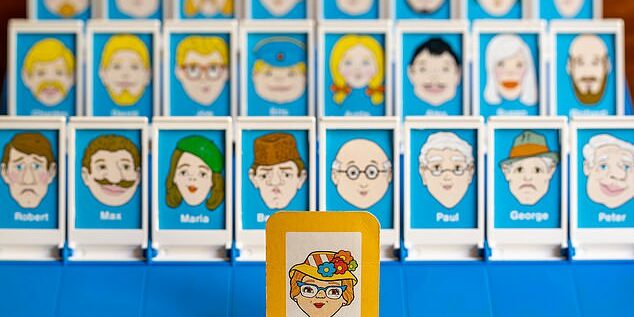
The format of Guess Who? is simple: each player has a board that features cartoon images of 24 people with names, including Bernard, Eric and Maria.
They also have a card picked from random that features one of these characters – which the other player has to guess the identity of.
The two players take turns to guess the identity of the other’s chosen character by asking yes-or-no questions, such as ‘are they wearing a hat?’ or ‘do they have a moustache?’
For example, if player 1 asks ‘do they have brown hair?’ and player 2 answers ‘yes’, player 1 knows to eliminate the characters that don’t have brown hair.
The researchers explain: ‘Upon eliminating characters, one flips down those characters’ image on one’s board. Each player knows how many the other has left, but not their names.’
The winner is simply the first person to correctly identify their opponent’s chosen character (but if both players correctly identify their opposition’s character in the same amount of moves it’s a draw).
A question you should never ask early on would be ‘Is your person wearing glasses?’ because there’s actually only five glasses-wearers on the whole board – and this is the mistake many players make.
However, it may be an acceptable question later in the game if you have, for example, four suspects left on the board with glasses and four without.
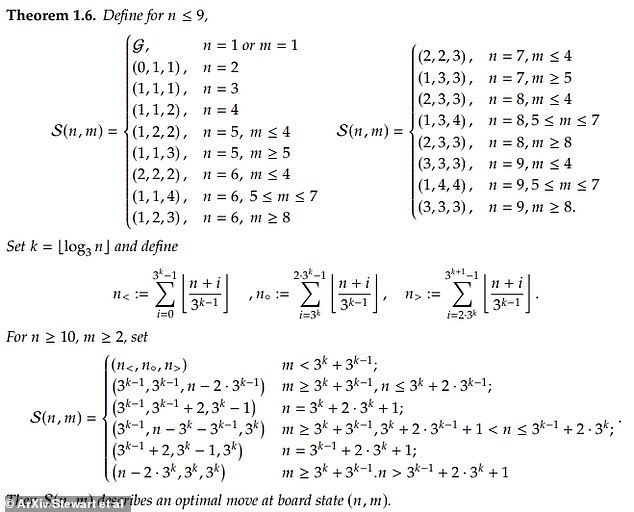
As another example, if you have 16 suspects left, you should ask a question that splits them in half – eight that would come under ‘yes’ and eight that would come under ‘no’.
Dr Stewart told the Daily Mail: ‘If it’s odd, say 15, then you want a 7-8 split.’
There are some exceptions to the half-and-half rule, however, depending on the number of suspects you have left, according to the academic.
For example, if your opponent has four left, you should aim for a 1-3 split if you also have four left.
As any board game fan knows, the classic approach to Guess Who? is to ask questions that always have an answer that’s either yes or no.
The team explain: ‘One is therefore able to split the suspect space into two parts. We thus call those questions bipartite.’
However, people can also improve their chances of ‘winning significantly’ by asking ‘tripartite’ questions (consisting of three parts).
The potential issue with this, however, is it takes a lot of effort to get your head around exactly what you’re asking – especially after few glasses of sherry on Christmas Day.
The example Dr Stewart and colleagues give of a tripartite question is: ‘Does your person have blonde hair OR do they have brown hair AND the answer to this question is no?’
They (try to) explain: ‘If we were to ask you this question and your person had blond hair, then you would say yes because the first line succeeds.
‘If they had grey hair, then both parts fail and you would say no; but if they had brown hair then you would find yourself, in effect, answering: ‘Is the answer to this question no?’
‘You cannot answer honestly, so we may assume that your head explodes.’
The scientists have published a brief pre-print paper, ‘Optimal play in Guess Who’, on the arXiv open-access online repository.
They’ve also created a legally-distinct’ online game to practice the strategy – where fans play on behalf of ‘Meredith’ who has been kidnapped by an ‘evil robot double’.