This post was originally published on here
While 2025 was not as grand as 2024 for celestial events, we enjoyed several spectacular highlights.
Skies were clear for the entire total lunar eclipse on March 14. The pairing of the two brightest planets, Venus and Jupiter, was quite a show the mornings of Aug. 11-12. The pairing of reddish Mars and the blue, white star, Regulus, was a surprising treat on June 17, due to the color contrast of the two objects. The sun continued to dazzle us with several displays of the northern lights, especially Nov. 12.
Let’s see what’s in store for 2026!
Celestial highlights for 2026
March 3: Total lunar eclipse. Partial eclipse begins at 4:50 a.m., total eclipse begins at 6:04 a.m., maximum eclipse at 6:33 a.m., moonset at 6:58 a.m.
Advertisement
Advertisement
April 25: National Astronomy Day.
June 9: Our two brightest visible planets, Venus and Jupiter, will be less than 2 degrees apart in the evening sky.
Aug. 12: Very partial solar eclipse. Partial eclipse begins at 1:11 p.m., maximum eclipse at 1:41 p.m., partial eclipse ends at 2:12 p.m.
Aug. 27-28: Partial lunar eclipse. Partial eclipse begins at 10:33 p.m., maximum eclipse at 12:12 a.m., partial eclipse ends at 1:51 a.m.
Oct. 4: Saturn at opposition, viewable from dusk to dawn.
Oct. 17: International Observe the Moon Night.
2026 Supermoons: Jan. 3, Nov. 24 and Dec. 23.
Space exploration highlights for 2026
NASA Artemis II launch is expected no earlier than April 2026. Artemis II is a planned lunar spaceflight mission led by NASA, under the Artemis program. This will be the second flight of the Space Launch System and first crewed mission of the Orion spacecraft. The mission is to send four astronauts on a 10-day journey around the moon. Artemis II will be the first crewed mission to orbit the moon since Apollo 17 in 1972. Artemis II’s crew is astronauts Reid Wiseman, Victor Glover, Christina Koch and Jeremy Hansen. The mission of NASA’s Artemis program is to establish a long-term presence on the Moon.
Advertisement
Advertisement
NASA’s SunRISE (Sun Radio Interferometer Space Experiment) – NASA’s heliophysics mission to launch summer of 2026. The mission will study solar radio bursts and map the Sun’s magnetic field from the outer corona to interplanetary space.
SpaceX plans to launch the first uncrewed Starships to Mars in 2026, during the next available Earth-Mars transfer window. These first vehicles will gather critical data on entry and landing which will lead the way to future crew and cargo deliveries.
NASA SpaceX Crew 12 launches no earlier than Feb. 15 and Crew 11 returns in March.
The king of the planets, Jupiter, reaches opposition on Jan. 10 when it will be visible from sunset to sunrise.
Night sky for January
Planets and the moon:
We will ring in the New Year with a fantastic planet show featuring our two largest gas giant planets! The nights are long with plenty of time to enjoy our evening planets!
Advertisement
Advertisement
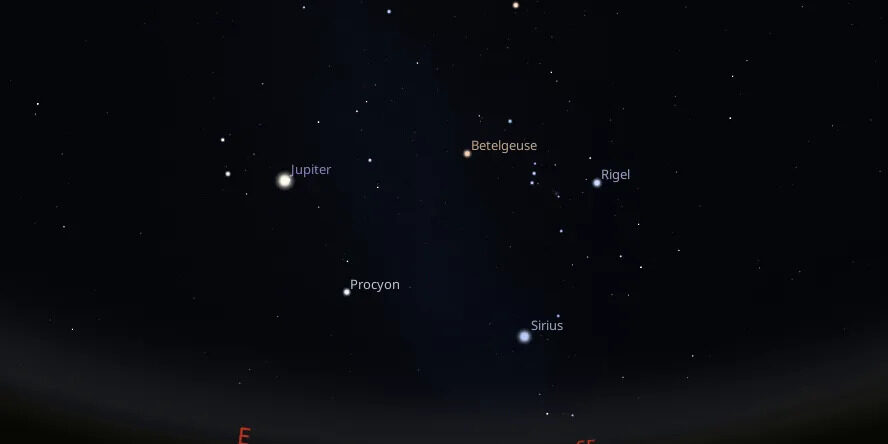
The king of the planets, Jupiter, reaches opposition on January 10 and is visible from sunset to sunrise. There is no doubt that you will be able to find brilliant Jupiter, at magnitude -2.7. Look east sixty minutes after sunset. The brightest object is Jupiter. Jupiter lies just to the left of mighty Orion, the Hunter and nearby Gemini, the Twins. This will be such a treat to view Jupiter amongst the bright stars of winter! Jupiter is a fabulous telescope target. Not only can you see the cloud bands that surround the gas giant, but also the four largest Galilean moons. Each night the moons are in different positions. If you are steady with a pair of binoculars, you can spot pinpoints of light around Jupiter which are the Galilean moons. Jupiter pairs with the Full Moon on January 3 and the nearly Full Moon on January 30.
The second largest gas giant planet, Saturn, can be found in the southwestern sky, at magnitude 1.0. When viewing through a telescope, the rings show a very slight tilt and the entire disk of the planet is visible. Saturn is such a lovely telescope object. Saturn pairs with the crescent Moon on January 23.
Saturn and Neptune will be in the same binocular view for the entire month. Neptune lies 3.5 degrees northeast of Saturn on January 1 and 1.7 degrees by January 31. Neptune shines at magnitude 7.8 and pairs with the Moon on January 23. A telescope will provide the best view of Neptune.
Uranus, at magnitude 5.7, can be found in the constellation Taurus, the Bull. Uranus lies just south of the Pleiades star cluster. A telescope or binoculars will be needed. The waxing gibbous Moon is near Uranus on January 26 and 27.
Advertisement
Advertisement
Mercury, at magnitude -0.6, is visible briefly in the morning sky of January 1. You will need a clear view of the eastern horizon, 30 minutes before sunrise. Binoculars may help.
Venus and Mars are not visible in January.
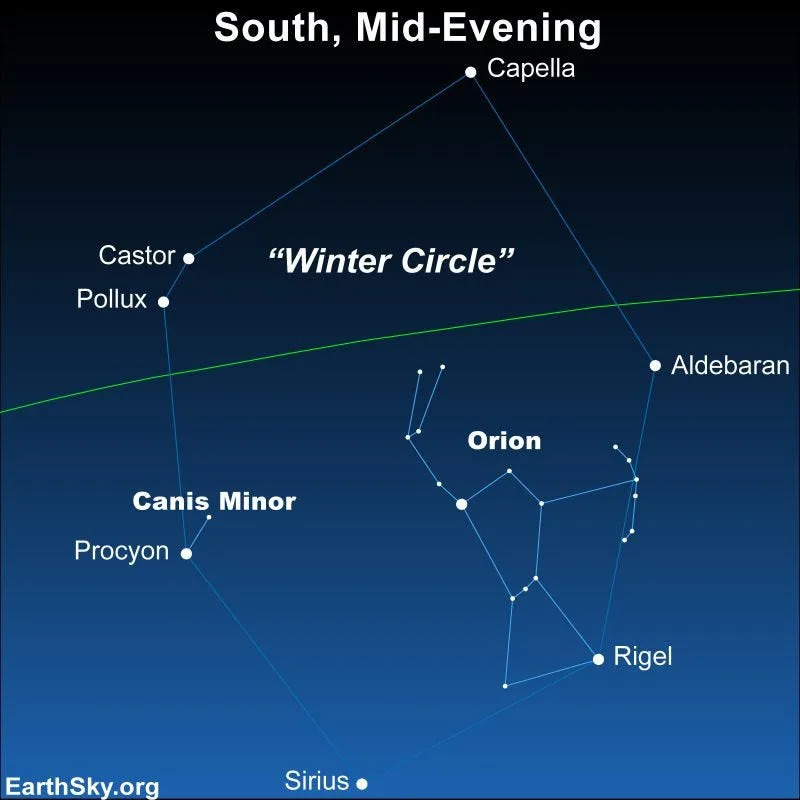
The constellation Canis Minor, the smaller hunting dog of Orion, the Hunter, is in the spotlight during January. The small constellation can be found by locating the bright star Procyon, which is to the left of Sirius, the brightest star in the night sky.
Night sky spotlight:
This month’s spotlight is on the smaller hunting dog of Orion, the Hunter, the constellation Canis Minor. Canis Minor is a small constellation and is 71 out of the 88 official constellations. An easy way to find Canis Minor is to locate the bright star Procyon, which is to the left of Sirius, the brightest star in the night sky. Procyon is also bright and is the eighth brightest star in our sky. Procyon is one of the six bright stars in the Winter Circle asterism. Its name means “before the dog” It rises before Sirius, which is called the dog star. Procyon is similar in temperature to our Sun and is 11.4 light years away. The second brightest star in Canis Minor is Gomeisa, which is a very hot star.
Advertisement
Advertisement
In mythology, the gods placed the Lesser Dog at the banks of the river or the Milky Way, so the dog would never be thirsty. Canis Minor is also close to the constellation Monoceros, the Unicorn. It looks like the Lesser Dog is standing on the Unicorn’s back.
The peak of the Quadrantid Meteor Shower is Jan. 3.
Hope you get the chance to experience this incredible planet and star show to kick off 2026!
For further night sky details, maps and audio, visit my website www.starrytrails.com.
Visit the Hoover Price Planetarium
Visit www.mckinleymuseum.org, for show dates and times. Planetarium shows are free with museum admission. The planetarium is located inside the McKinley Presidential Library & Museum, 800 McKinley Monument Drive NW in Canton. For more information, please call the Museum at 330-455-7043.

Suzie Dills
This article originally appeared on The Repository: 2026 will see celestial, space exploration highlights | Suzie Dills