This post was originally published on here
The masses of fundamental particles such as the Z and W bosons could have arisen from the twisted geometry of hidden dimensions, a new theoretical paper has demonstrated.
The work has outlined a way to bypass the Higgs field as the source of particle masses, offering a new tool for understanding how the Higgs field itself might have emerged, as well as a possible means of addressing some of the persistent gaps in the Standard Model of particle physics.
“In our picture,” says theoretical physicist Richard Pinčák of the Slovak Academy of Sciences, “matter emerges from the resistance of geometry itself, not from an external field.”
Related: The Higgs Boson Might Not Be The Portal to New Physics After All
The Higgs field was first proposed in the 1960s as a way to explain why fundamental particles have mass – a huge problem that had been thwarting efforts to build a consistent model of particle physics. It was thanks, in part, to the Higgs field that physicists could build the Standard Model we rely on today.
Here’s how it works. Imagine the Universe is filled with an invisible sticky goo. Any particles moving through the Universe are also moving through this goo, and each particle interacts with it slightly differently.
Advertisement
Advertisement
Particles that interact strongly with the goo as though wading through mud behave as “heavy”, like W and Z bosons. Particles that barely interact are “light”, like electrons. Photons don’t interact with it at all. This interaction is known as the Higgs mechanism, and it very neatly explains particle masses.
We know the Higgs field is real because its quantum ripple, the Higgs boson, was finally and very confidently discovered at the Large Hadron Collider in 2012. However, that doesn’t mean that the Higgs mechanism is the whole story.
We still don’t know, for example, why the Higgs field has the properties it does. Nor does the Higgs solution explain dark matter, or dark energy, or why the Higgs field even exists in the first place.
We’re missing some information somewhere – and Pinčák and his colleagues believe that some clues may lie in hidden geometry, according to their study of a seven-dimensional space called a G2 manifold.
Manifolds can describe the curvature of seemingly flat spaces at different scales. (yuanyuan yan/Moment/Getty Images)
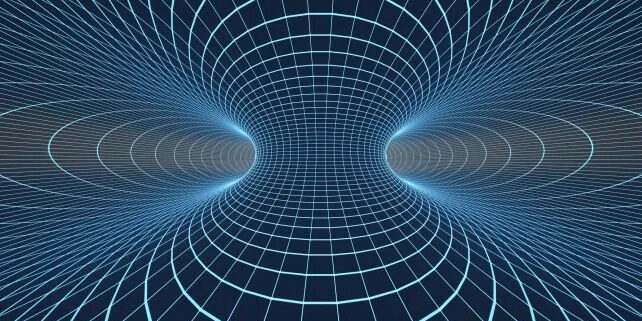
A manifold is a kind of mathematical space – a general term used for any ‘shape’ that can have curves, folds, or twists. Physicists often use manifolds to describe the geometry of spacetime, or the hidden extra dimensions proposed in theories like string theory.
Advertisement
Advertisement
These spaces can have more directions than the familiar up-down, left-right, and forward-backward of everyday life. Some manifolds require a full seven independent directions. A manifold with a specific seven-dimensional structure, arranged in a very tightly constrained way, is known as a G2 manifold.
The researchers developed a new equation called the G2–Ricci flow that allowed them to model how a G2 manifold changes over time.
“As in organic systems, such as the twisting of DNA or the handedness of amino acids, these extra-dimensional structures can possess torsion, a kind of intrinsic twist,” Pinčák explains.
“When we let them evolve in time, we find that they can settle into stable configurations called solitons. These solitons could provide a purely geometric explanation of phenomena such as spontaneous symmetry breaking.”
Advertisement
Advertisement
A soliton is like a single, self-sustaining wave that can keep its shape forever. The researchers found that their G2 manifold relaxed into just such a stable configuration – and that configuration had a twist, or torsion, that becomes imprinted onto W and Z bosons, producing the exact same mass-giving effect as the Higgs mechanism.

Subscribe to ScienceAlert’s free fact-checked newsletter
The results also tentatively suggest that the accelerating expansion of the Universe may be linked to curvature imparted by the kind of torsion of a G2 manifold could impart. And, if this torsion behaves as a field, it should manifest particles, the way the Higgs field gives rise to the Higgs boson.
The researchers named this hypothetical particle the Torstone, and described how such a particle should behave.
If it exists, the Torstone may be detectable in particle collider anomalies, strange glitches in the cosmic microwave background, and even gravitational wave glitches. Its existence is far from proven, but if the torsion field exists, now we know where to start looking.
Advertisement
Advertisement
It’s some pretty wild and heady stuff, but so was the Higgs field back in its day – and it took almost 50 years to prove. Hopefully, we won’t have to wait that long for answers about possible G2 manifolds, but so far, this approach promises a way towards solutions to some burning questions.
“Nature often prefers simple solutions,” Pinčák says.
“Perhaps the masses of the W and Z bosons come not from the famous Higgs field, but directly from the geometry of seven-dimensional space.”
The research has been published in Nuclear Physics B.