
This post was originally published on here

In her award-winning essay, young British science writer Hasset Kifle from Stoke on Trent used her personal experience as a competitive runner as her starting point for her article about the impact of ‘technological doping’, in the form of super shoes, on elite sport.
The world is moving forward at an unimaginable rate and technology is leading this bullet train into the unknown. In the world of sport, technological advancements have raised the question: How far is too far?
Running is an integral measurement of mankind’s physical and mental capabilities. It is a sport that thrives on competition: athlete vs athlete and athlete vs time.
More recently, it has become a playground for world-leading brands.
Technology doping, or technological doping, are terms coined to describe the competitive advantage gained by using high-tech sports equipment. It has caused notable perspective shift on what it means to be an athlete.
The top 10 fastest marathons by men and women were all run within the last seven years (with the exception of Paula Radcliffe in 2003). Could part of the reason be shoes? Shoes so advanced they have been nicknamed “super shoes”.
Testing – in the lab and on the world stage – has provided evidence of the enhancements of an athlete’s performance that stretches beyond physiological capabilities.
 Christopher Lee/Getty Images
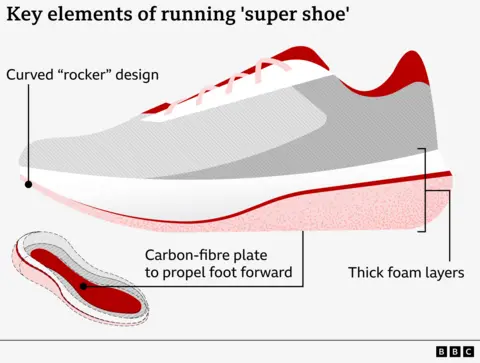
Super shoes consist of four main features: the midsole foam; the curved carbon-fibre plate; the stack height and the breathable upper.
These components work in synergy to produce a lightweight, highly cushioned and flexible shoe to maximise the energy returned to the athlete to propel them forward, while minimising the amount of energy exerted by the athlete themselves.
They were popularised in 2016, when Nike released the Nike Vaporfly, shoes that were showcased when they were worn by the top three male finishers in the Rio Olympic men’s marathon.
 Getty/The Washington Post
Research – partly funded by Nike and published in the journal Sports Medicine – showed that these shoes could reduce the energetic cost of running by 4%, compared with established marathon racing shoes. That translates to a desired pace being sustained for longer, eventually resulting in a faster finishing time.
These shoes have also caused controversy, because of the number of records broken by athletes wearing them. To combat this, in 2020, World Athletics – the international governing body for the sport – implemented regulations on the features that super shoes could have.
Those rules state that the maximum stack height must not exceed 40mm and that the shoes must have no more than one carbon plate.
Critics have also raised concerns that today’s athletes do not meet the standards of athletes in the past, precisely because technology has provided them with such an advantage.
One proposed solution is keeping separate lists for “technology-assisted records”. Arguably, this raises the question: who is the major competitor? Athletes or the brands producing these innovative technologies.
There could also be psychological effects associated with super shoes. If athletes believe they must wear them to run a faster time, they could become more reliant on the technology.
At the heart of it all running is the ultimate test of fitness – both through muscular strength in the short sprints to cardiovascular strength and endurance in the marathon. It is a battle between the mind and the body that begins before the starting gun even goes off.
As someone who has competed in various distances ranging from the 300m to the 5k, and trained with athletes who wear super shoes, it is important for me to have the ability to progress in the sport but also for the sport to progress with me. If that comes at the loss of the credibility of the sport, it seems that the world of sport has an important choice to make.