This post was originally published on here
Just after 3 a.m., Aaron Given goes looking for owls in the dark.
The quiet ritual marks the start of the Sea Islands Christmas Bird Count, a survey he began 15 years ago after realizing the region had been left out of Audubon’s continent-wide effort to track winter bird populations.
“You hear a lot of birds before you ever see them,” said Given, a town biologist on Kiawah Island. Each year, that means a pre-dawn start.
What keeps him coming back isn’t just the science, but the experience.
Rising Waters Lab
The Post and Courier’s Rising Waters Lab focuses on impacts of climate change and related policies and practices. It is supported by donations and grants to the nonprofit Public Service and Investigative Fund, whose contributors are subject to the same coverage we apply to everyone else. For more information and to donate, go to postandcourierfund.com.
It’s a full day outside, shared with other birders, and it brings the occasional surprise. Sometimes it’s spotting a rare species, a strange winter visitor or the quiet thrill of hearing a bird before you ever see it.
And it happens no matter what.
In 2018, during Charleston’s rare snow event that locals nicknamed “Snowmageddon,” the bird count still took place.
“That year, we had birds we’ve never recorded on the count before — and we haven’t seen them since.”
Among those seen during that rare snowfall: the least bittern, the smallest heron in North America. The tiny, elusive bird has even been known to sway within the marsh grasses as a way to avoid predators.
During last year’s last count, the volunteer-based bird census recorded 25,677 individual birds and 161 different species.
Audubon’s Christmas Bird Count, which runs from mid-December to early January, brings together bird enthusiasts of all levels. Over the course of a day, participants take to the field to count as many birds and species as they can. Records from the annual event now span more than 125 years, making the tradition an invaluable tool for scientists who aim to better understand how bird populations have changed across the western hemisphere.
A different kind of holiday tradition
The Christmas Bird Count got its start in 1900 when early members of the Audubon Society wanted an alternative to what was then known as the Christmas Side Hunt, a competition to see how many birds they could shoot.
“This was done kind of as a protest, but also a way of just saying, ‘Hey, let’s just start documenting some of these birds that we’re seeing,’” said Matt Johnson, director of Audubon’s Beidler Forest Center and compiler of South Carolina’s Christmas Bird Count.
What started with about 27 birders has since grown to become the longest-running community science bird project, boasting around 83,000 participants across the hemisphere, according to Audubon. In South Carolina, around 1,400 birders participated in last year’s count.
The Christmas Bird Account has evolved since it’s beginning. Today, the counts occur during a three-week window around the holidays, not just on Christmas Day. Each count covers one 15 mile-wide circle — South Carolina has 30 — that birders revisit each year. The number of birders per circle varies, with some counts garnering hundreds of participants or about a dozen people on the smaller teams.
Each count is organized by a compiler, who is charged with securing access to private property within the circle and managing all the data. Participants move through established routes during a 24-hour period, marking down every bird they see or hear along the way.
Sometimes, the birding is slow. Sometimes, it can get intense. Andy Jones, executive director of the Spring Island Trust in Beaufort County, participated in the Harris Neck National Wildlife Refuge count, which is south of Savannah. As birds flew in to roost in the evening, counters called out the birds as they saw them, Jones said. The team counted over 5,000 birds in 90 minutes.
While each count only runs for 24 hours, the work to manage and compile the data continues throughout the year. Participants need to prepare sometimes by finding a boat for their part of the survey, or getting permission to access private property or gated communities. After local compilers screen data from the count, it’s sent up the chain, where it’s scrutinized at the state and national level by Audubon staffers. The final report typically is released months later.
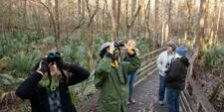
People look through binoculars during the Christmas Bird Count at the Audubon Beidler Forest in Harleyville, SC.
The Christmas Bird Counts bring together new and experienced birders from across the state, with many dedicated birders organizing, and participating in, multiple counts. Jones organized one count and participates in four others between South Carolina and Georgia.
Of the 30 Christmas Bird Counts in South Carolina, two stand out on the national level. Hilton Head has one of the highest numbers of participants in the country, with around 300 birders each year.
The count in McClellanville also has made it to the national leaderboard a number of times. During last year’s count, the circle was tied for 16th nationally in the number of bird species spotted. Organizer Nathan Dias said the amount of protected, undeveloped land in the circle is the reason the counts are so high. The circle includes portions of the Francis Marion National Forest, Cape Romain National Wildlife Refuge, and the Santee Coastal Reserve, “a mecca for ducks,” Dias said.
Even with all the success the McClellanville count has had, Dias isn’t sure their winning streak will continue.
“McCellanville is probably not going be top dog for a whole lot longer because erosion is killing us out on the beaches and the marshes,” he said.
Jetties by Georgetown are stopping the flow of sand from reaching areas down shore, Dias noted. Though erosion is taking its toll on marshes and beaches that attract so many birds, the count is doing well for now, thanks in no small part to conservation efforts within its range.
A boon for bird science
It will take months for compilers to sort out this year’s Christmas Bird Count data. For the 2026 count, Given, of Kiawah Island, said he’s especially interested in seeing whether people on the sea islands spot painted buntings.
While the birds are pretty common, the timing of their stay has prompted questions, he said. Usually they are seen here from April to October.
“But over the last 10 years or so, more and more painted buntings have been overwintering in our area,” Given said. “I’ve been curious to know why. Is it a function of climate change potentially? Could it be more people are feeding birds and they’re more visible? Are these birds actually residents? Are they using that birdfeeder year-round or just for the winter time?”
While a single Christmas Bird Count in a given year can’t tell researchers much about species trends or distributions, the data complied over years is an invaluable tool.
“There’s no other dataset like this,” Jones said.
What’s called “effort data,” which includes things like distance a participant walked or drove, helps understand how different species are faring. If someone takes five minutes to see five birds, that indicates a much higher number of birds than seeing that number of five hours.
Using the publicly available dataset, researchers can better understand how different bird populations are responding to climate change. Clemson researchers used Christmas Bird Count data to study duck populations in the Southeastern United States. They found the number of ducks is overall unchanged, but the species had been shifting north due to warmer average temperatures.
These citizen-science efforts, he said, can help answer those questions and more over time. The key is continuing to collect this data year after year. The 2026 Kiawah Island count will take place Friday, Jan. 2.
Kiawah Island residents have until Dec. 31 to let Given know if they want to participate by sending him an email at [email protected]. Prospective participants can find their closest Christmas Bird Count here.
“It’s literally a snapshot of what’s happening one day of the year. But when you combine it with thousands of other counts, that’s when the data really starts to mean something,” Given said.