This post was originally published on here
The ongoing Barry Arm landslide has alerted experts, driving a push to understand and monitor its progress before it triggers a megatsunami that could devastate all surrounding life.
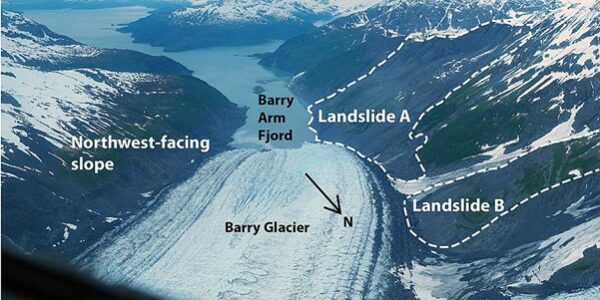
In 2019, Valisa Higman was boating around the Barry Arm fjord when she noticed massive and unusual fractures on the cliffs above the nearby Barry Glacier in Alaska. This kickstarted major efforts, with satellite data confirming that a massive section of the mountain had descended about 180 meters between 2009 and 2015.
Just a year after the discovery, a group of scientists came together to release a letter to the state of Alaska, warning its inhabitants about the slope’s instability, and worse, that it could trigger a catastrophic tsunami.
By comparing historical records of the mountain, it was revealed that the landslide had already started its descent in the late 1950s. Aerial images from this period show the scarf of the cliff detached from the bedrock, indicating that the mountain was slipping under its own weight.
However, only between 2010 and 2017 did the landslide accelerate downwards, shifting it to a highly hazardous natural event. Experts cited the cause as the loss of the mountain’s underlying support and of course, climate change.
The scary reality of this event is that should 500 million cubic meters of rock from the landslide fail altogether at once, it would lead to a megatsunami, which is vastly different from the waves caused by usual undersea earthquakes.
When the rocks hit the water, and estimated initial wave that’s 200 meters high would hit ground zero, which is within the Barry Arm fjord itself. Then, a secondary wave would surge up the mountain walls around it, potentially reaching heights of 500 meters devastating all flora and fauna. With the area having high community presence from the nearby town of Whittier, kayakers, fishermen, and cruises alike, many people could be caught in the damage.
Within the proximity of this megatsunami is also Prince William Sound, which was the location of the cataclysmic Exxon Mobil oil spill that occurred 36 years ago. The accident saw the spillage of up to 11 million gallons of crude oil killing thousands of seabirds, sea otters, and orcas, among countless other species. While cleanups took place, scientists estimate that as much as 23,000 gallons of oil remain immobilized, buried and bound to sediment.
With a potential megatsunami in the offing, it would scour the shorelines, remobilizing these oil-bound sediments back into the ocean. While the original spill stayed mostly on the surface, this remobilized oil would likely mix into the water, making it harder to clean, while poisoning wildlife once again.
[embedded content]
Grasping the seriousness of such an event, a multi-agency team with the US Geological Survey, Alaska Earthquake Center, and the Alaska Division of Geological and Geophysical Surveys began installing monitoring equipment in 2020.
Radar satellites were used to measure millimeter-ground shifts, while seismometers helped listen for ‘cracks’ and ‘groans’ of moving rock. Years later, the addition of timelapse camera arrived alongside infrasound arrays that can hear low-frequency sounds that human ears can’t.
While the landslide is currently stable, moving less than two inches per day, a few weeks ago researchers involved in monitoring the mountain made a breakthrough. By taking on the monumental task of manually reviewing an entire year’s worth of seismic data, they identified over 32,000 Short Impulsive events.
These are tiny pops and cracks that computer algorithms had simply ignored as background noise when in fact, they were found to be caused by micro-fractures caused by thawing and freezing cycles around the glacier.
Scientists realized that these seasonal seismic pulses reflected the patterns in the mountain’s hydraulic system that is driven by temperature. Knowing this, experts can now identify when water pressure is building up inside the mountain – which as it turns out, is one of the main triggers for a major landslide.
Should seasonal pulses suddenly start occurring in different intensities or time periods in a year, scientists will be on red alert for a potential landslide.
But while current efforts might be able to mitigate any loss of human life, it cannot protect wildlife in the way of the tsunami. With climate change being a contributing factor, it goes to show the devastating double-edged impact of human actions.
Coupled with its first immense impact, should the tsunami remobilize oil residuals, the loss of life would be profound. Sadly, with the current deterioration of the landslide, such a situation seems to be inevitable.

Enjoyed this article? Click here to read more Gen Z focused change stories.