This post was originally published on here
As the interstellar visitor 3I/ATLAS speeds away from our part of the universe, scientists are still engaged in a heated debate that sounds more like a script by Arthur C. Clarke than a typical astronomical report. Is it merely a rock-and-ice wanderer, or a high-tech piece of equipment observing Earth? NASA officials maintain that the object is a regular comet, but Harvard astrophysics professor Avi Loeb, known for his controversial views, is determined that the mystery should not fade into the depths of space.
Professor Loeb has consistently doubled down on his assertion that this cosmic interloper exhibits too many ‘anomalies’ to be ignored. After initially appearing to soften his stance following the object’s closest approach to Earth on Dec. 19, Loeb has returned to his original hypothesis. ‘You can’t just say, “I know the answer” and ignore the anomalies. That’s not viable,’ Loeb told reporters.
He argues that because the arrival of such an object could be a ‘black swan’ event — a rare phenomenon that seems inevitable only in hindsight — humanity must at least consider the possibility that it is technological in nature. Loeb has specifically ranked the object a ‘four’ on his personal scale of 0 to 10, where 0 represents a natural comet and 10 an active alien threat, noting that its behaviour remains too inconsistent for a standard icy rock.
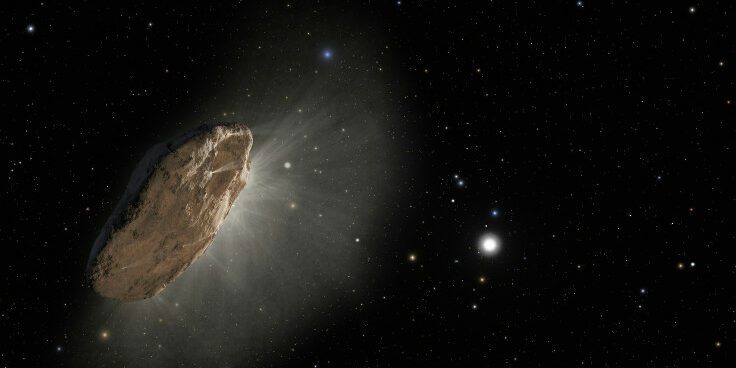
NASA Hubble Space Telescope/Unsplash/IBTimes UK
The Mathematical Odds Challenging the Origins of 3I/ATLAS
Central to Loeb’s argument is the sheer improbability of the object’s flight path. He noted that the trajectory of 3I/ATLAS was aligned to within 5 degrees of the ecliptic plane — the path our planets take around the sun. The probability of this occurring by sheer chance is a staggering 0.2%.
This precision has led to speculation that the object was not wandering aimlessly, but was instead conducting deliberate reconnaissance on our solar system. Furthermore, the object’s nucleus is roughly 5 km wide and over 33 billion tons, making it a million times more massive than ‘Oumuamua and a thousand times more massive than 2I/Borisov, yet it is moving significantly faster than both.
This theory of directed movement becomes even more compelling when looking at its interaction with our solar system’s gas giant. Loeb points out that for a craft to monitor Jupiter effectively, it would need to enter the planet’s Hill Radius — a zone where Jupiter’s gravity overpowers the sun’s. Remarkably, calculations from NASA’s Jet Propulsion Laboratory show that during its closest approach in March, the object will be at a minimum distance of 53,445 million km from Jupiter.
Loeb suggests that a massive, non-fragile planet like Jupiter would be the ideal target for an alien probe to monitor, drawing a direct parallel to the monoliths found in 2001: A Space Odyssey. He has urged the space defence sector to use the Juno spacecraft to check for any ‘new objects in orbit’ that 3I/ATLAS might have deployed.
Loeb is particularly focused on the object’s non-gravitational acceleration; his calculations suggest that for a natural comet to achieve this speed, it would have to lose roughly 13% of its total mass in evaporation — a level of outgassing that has not been visually confirmed by current telescope data.

Pexels
Decoding the Metallic Signature of 3I/ATLAS
The object’s chemical makeup may be the most puzzling evidence. The gas plume around the nucleus was found to have a strange metallic composition when it was looked at. There is a lot more nickel in the plume than iron, which is the same ratio as nickel alloys made in factories on Earth.
Furthermore, the nickel-to-cyanide ratio is orders of magnitude larger than anything seen in the thousands of comets previously documented. ‘This might indicate a technological origin for these abundances,’ Loeb remarked. Intriguingly, the gas plume was also found to contain only 4% water by mass, whereas familiar comets are typically water-rich, further deepening the mystery of its origins.
Further anomalies include a 600,000-mile ‘anti-tail’ — a jet facing toward the sun rather than away — which Loeb believes could be a ‘jet-shield’ used to deflect solar particles. Additionally, the object arrived from a direction within 9 degrees of the famous Wow! signal, a mysterious radio transmission from 1977 that remains the strongest candidate for an intentional alien broadcast.
Near perihelion, the object also brightened faster than any known comet and emitted a distinct blue hue, which Loeb speculates could be the signature of a high-energy engine rather than mere reflected sunlight.
As the International Asteroid Warning Network continues its planetary defence campaign to gather data until Jan. 27, 2026, the world waits to see if 3I/ATLAS is a natural wonder or, as Loeb warns, a potential ‘Trojan Horse’ hiding secrets we are only just beginning to grasp. Regardless of the outcome, the professor believes this is just the beginning, as new observatories are expected to find similar interstellar objects every few months in the coming decade.