This post was originally published on here
Scientists recently stumbled upon something incredible just off the coast of the Greek island of Milos. While exploring the seafloor with high-tech underwater robots, they found a massive field of hydrothermal vents—essentially underwater chimneys and cracks that spew boiling hot, gas-rich water from deep inside the Earth.
The team was “stunned” by what they saw. Usually, these vent fields are small, but this one is huge. The seafloor there is crisscrossed with active “fault lines” (cracks in the Earth’s crust). These cracks act like giant straws, allowing hot fluids to rise up and burst through the seabed.
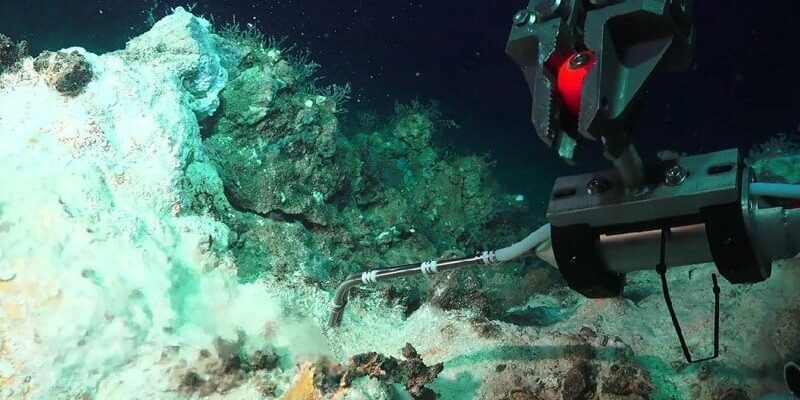
The view through the robot’s cameras was spectacular: shimmering, boiling water rising into the cold sea and thick, colorful “microbial mats”—essentially carpets of strange bacteria that thrive on the chemicals being pumped out of the earth. The “microbial mats” provide a rare look at how life might have started on early Earth or how it could exist on other planets (like Jupiter’s moon, Europa).
Milos is now officially home to one of the most important underwater volcanic systems in the Mediterranean.
The hydrothermal vents off Milos
The surveys, published in a study in Scientific Reports, revealed previously unknown hydrothermal activity at depths ranging from 100 to 230 meters.
“We never expected to find such a large field of gas flares off Milos,” says Solveig I. Bühring, senior author of the study and scientist at the MARUM — Center for Marine Environmental Sciences, University of Bremen, who led the expedition during which the vents were discovered.
“When we first observed the vents through the ROV cameras, we were stunned by their diversity and beauty — from shimmering, boiling fluids to thick microbial mats covering the chimneys.”
First author Paraskevi Nomikou of the National and Kapodistrian University of Athens explains that the arrangement of the vent clusters closely mirrors the island’s underlying fault structure.
“Our data clearly show that the gas flares follow the patterns of the major fault systems around Milos,” Nomikou explains. “Different fault zones influence different vent clusters, especially where several faults meet. These tectonic structures strongly control how and where hydrothermal fluids reach the seafloor.”
Building on this work, researchers are planning a follow up expedition to Milos, the Kolumbo submarine volcano near Santorini, and Nisyros.