
This post was originally published on here
Scientists have revealed a simple trick to produce completely clear ice cubes – and it could impress your guests this evening.
While drinks bought in a posh bar usually come with a slab of perfectly clear ice, the chunks you make at home are typically cloudy.
Paulomi Burey, a professor in Food Science at the University of Southern Queensland, has now lifted the lid on the science behind the perfect cube.
And it turns out using regular water is fine – because it’s all to do with the freezing process.
‘Homemade ice is often cloudy because it has a myriad of tiny bubbles and other impurities,’ she wrote on The Conversation.
‘In a typical ice cube tray, as freezing begins and ice starts to form inward from all directions, it traps whatever is floating in the water: mostly air bubbles, dissolved minerals and gases.
‘These get pushed toward the centre of the ice as freezing progresses and end up caught in the middle of the cube with nowhere else to go.’
That’s why when making ice the usual way – just pouring water into a vessel and putting it into the freezer – will always end up looking somewhat cloudy, she said. So, what should you do?
The best way to create clear ice is to use ‘directional freezing’, Professor Burey explained.
This is the process of forcing water to freeze in a single direction instead of from all sides at once, like it does in a regular ice cube tray.
Doing this means the impurities and air will be forced to the opposite side from where the freezing starts, leaving the ice clear except for a small cloudy section.
‘In practice, this means insulating the sides of the ice container so that the water freezes in one direction, typically from the top down,’ Professor Burey said.
‘This is because heat transfer and transition from liquid to solid happens faster through the exposed top than the insulated sides.’
The simplest way to have a go at this at home is to use an insulated vessel – for example an insulated food or drinks container or an insulated mug.
Fill the container with water and place it in the freezer, checking on it periodically, she said.
Once all the impurities and air bubbles are concentrated in a single cloudy area at the bottom, you can tip the ice out and either scrape away this water before it’s fully frozen through or let the block freeze solid before cutting off the cloudy portion with a large serrated knife, then cut the ice into cubes for your drinks.
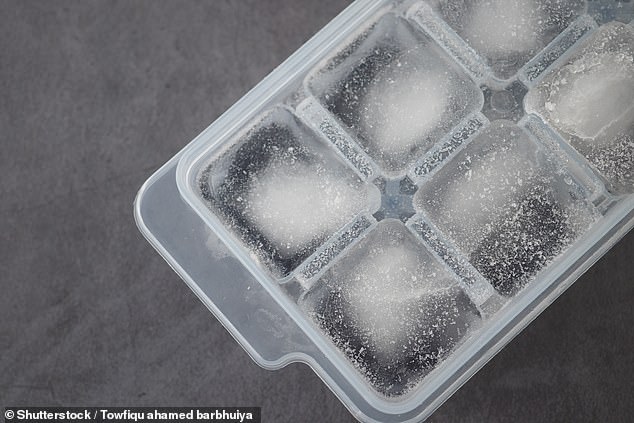
There are also some commercially available insulated ice cube trays, she explained, which make the process even easier.
‘As well as looking nice, clear ice is denser and melts slower because it doesn’t have those bubbles and impurities,’ Professor Burey added.
‘This also means it dilutes drinks more slowly than regular, cloudy ice. Additionally, because it’s less likely to crumble, clear ice can be easily cut and formed into different shapes to further dress up your cocktail.’
She warned there are some myths about clear ice that simply don’t work, including that using boiling water can help.
While starting out with boiling water does mean it will have less dissolved gases in it, it doesn’t remove all impurities, she explained. It also doesn’t have an effect on the freezing process, so the ice will still become cloudy.
Using distilled or filtered water also does not stop impurities or bubbles forming in the centre if frozen using conventional methods.
‘With a little help from science you can make clear ice at home, and it’s not even that tricky,’ she said.
And with the average ice cube taking three to four hours to freeze, there’s still time to have a go at making your own clear ice to ring in the New Year tonight.
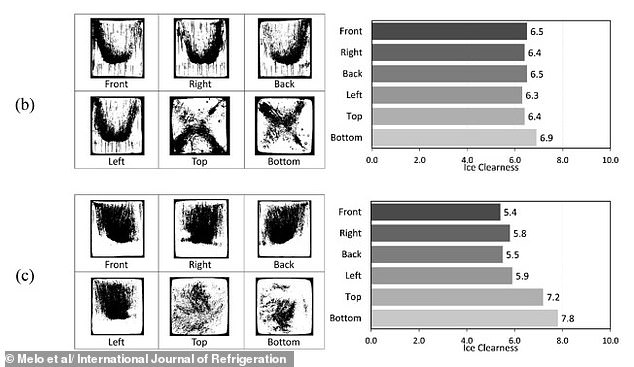
A study, published last year in the International Journal of Refrigeration, found that the freezing process – rather than the quality of water – is the main driver of clear ice formation.
It showed very similar levels of ice clearness in cubes made from both tap water and boiled water which were frozen at -4°C.
Meanwhile Denis Broci, director of bars at the Mayfair luxury hotel Claridge’s, has previously recommended using crescent-shaped ice as it has less surface area than cubes and is therefore slower to melt.
If people do decide to boil their water before freezing it, he suggests covering it with a paper towel or cloth to prevent dust contamination while cooling.