This post was originally published on here
The loss of a longtime companion is a pain many people—and coyotes—know all too well.
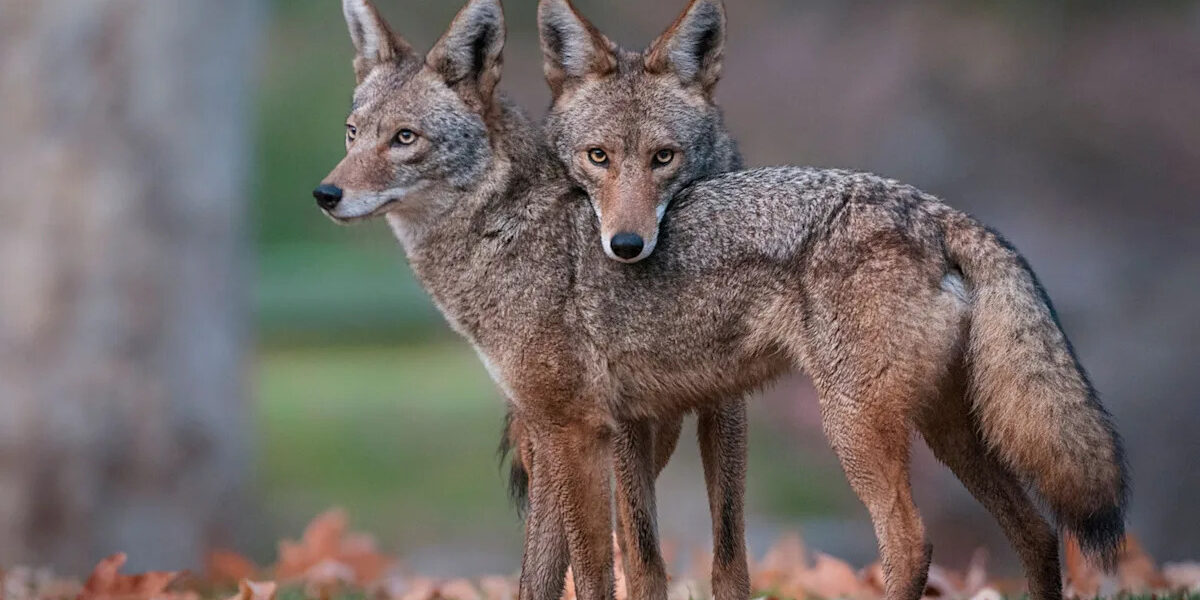
About a decade ago, scientists discovered that coyotes mate with just one partner in their lifetimes. But more recent research has turned to the sadder side of their lifelong love: the grief of widowhood.
Scientists hope their inquiries can build compassion for these oft-misunderstood carnivores and perhaps guide the development of new mental health treatments for humans.
Advertisement
Advertisement
“We have this opportunity to really understand what happens during loss and how that might translate to improved outcomes for people who have extended grief,” says neuroscientist Sara Freeman, an associate professor of biology at Utah State University who is studying the changes that occur inside the brains of coyotes that have lost their mates.
(Why this coyote and badger ‘friendship’ has excited scientists)
Together forever
About 3 to 5% of mammals are known to be monogamous, meaning they select one mate for life. Still, many monogamous species such as wolves “cheat,” says Stan Gehrt, longtime coyote researcher and professor of wildlife ecology at The Ohio State University.
This doesn’t seem to be the case for coyotes. Gehrt co-authored a 2012 study that found 100% faithfulness among coyote pairs, meaning they practice an even rarer form of commitment called genetic monogamy. Focusing on urban coyotes in the Chicago area, researchers collected genetic information and found no evidence of cheating partners among 18 litters of 96 offspring, something that Gehrt calls “pretty remarkable.” Since then, he and his team have collected 10 additional years of unpublished data that backs up their original conclusions.
Advertisement
Advertisement
Having multiple partners has evolutionary benefits including increased reproductive success and genetic diversity.
But genetic monogamy has advantages, too—it allows coyotes to have larger litters since dads take an active role in pup care, Gehrt says. It also helps them establish and maintain their territory, as the duo marks and defends it together when they’re not busy mating or caring for their young.
Gehrt’s team has found that Chicagoland’s coyotes stay with the same partner forever, despite many opportunities to rendezvous with new lovers in a dense urban setting. The one exception is the death of a mate.
“It’s just an amazing thing,” Gehrt says. “That means that a coyote, when they finally select their mate, that’s potentially the only animal they’re going to live with for the rest of their life. So that’s a really big decision.”
Advertisement
Advertisement
(Coyotes have expanded their range to 49 states—and show no signs of stopping)
‘Til death do us part
Much like humans, coyotes display grief-like behaviors after losing a partner. Gehrt recounts a story about a female that he and his team temporarily trapped in order to replace a tracking collar. Her mate stayed close to her during the process, and when Gehrt briefly took her into the lab, her male companion “howled nonstop” until Gehrt returned her. “There was clearly a lot of emotional stuff going on with that animal,” he says.
Signs of grief in coyotes include persistent long howls that some scientists describe as “mournful,” lethargy, decreased appetite, and a diminished spirit—they may hang their head low, for instance. Bereaved coyotes may also return to a spot where a partner or pup was last seen.
Coyotes aren’t the only animals that express behaviors that could be interpreted as grief. Prairie voles, small stocky rodents that also practice genetic monogamy, display what Freeman, the Utah State University neuroscientist, calls a “depressive-like behavior” during experimental swim tests following the loss of their mates. Freeman, who studied these animals alongside Larry Young, a scientist well-known for his work examining prairie vole pair-bond formations, says that normally these creatures will swim around and try to get out, but those who have lost a partner are more apt to float “like they don’t care.”
Advertisement
Advertisement
For the past six years Freeman has focused on the behavioral, hormonal and neural basis of coyote monogamy. Her team conducts field studies at the United States Department of Agriculture (USDA) National Wildlife Research Center in Milville, Utah, whose Predator Research Facility keeps a captive coyote population for research that helps guide management strategies for their wild counterparts.
For a recent paper, Freeman and colleagues mapped and evaluated changes in the receptor for a hormone called corticotropin releasing factor (CRF) in coyote brains following the loss of their partner. CRF, found in both human and coyote brains, is activated in response to stressors such as grief and alerts the body’s stress system, known as the hypothalamic-pituitary-adrenal axis, ultimately releasing cortisol into the bloodstream. Cortisol, sometimes referred to as the “stress hormone,” increases when we feel some sort of psychological or actual stress and plays a key role in the “fight or flight” response.
(Downtown coyotes: Inside the secret lives of Chicago’s predator)
The researchers obtained brain samples from six deceased coyotes, three of which were widows. They found that CRF receptors in the olfactory tract, the region of the brain responsible for processing smell, as well as the hippocampus, the brain’s learning and memory site, increased in widowed coyotes compared to non-widows.
Advertisement
Advertisement
Freeman surmises that grief could alter coyote brain neurochemistry to coordinate memory function and sensory processing. This might aid widows in detecting social scents in their environment—say, urine from their lost mate as they try to find them or the odor of a new potential partner.
She warns that the study shouldn’t be generalized too broadly. The sample size was small, all of the coyotes were female, and each female had been widowed for different amounts of time: three days, four months and 14 months, respectively.
Still, such research could begin to fill important gaps about coupling in monogamous species, says Freeman, who adds most other inquiries have focused on how pair bonds form.
Her team’s investigations could also eventually help guide grief treatment in humans because of our shared biology with coyotes. This could include the development of new drugs and even non-pharmaceutical approaches to stress and grief such as exercise programs, she says. Physical activity such as yoga, running, walking and martial arts have already been linked with better grief outcomes for people who have lost a loved one.
Compassion breeds conservation
Apart from possible applications to humans, Freeman hopes her work can help build compassion for coyotes, which are often regarded as pests and targeted in wildlife killing contests and by frustrated landowners. Some pet owners also have negative views of these wild canids because of fears that they will kill their cat or dog. Freeman suggests people might think twice about shooting a coyote if they knew that its mate would experience psychological distress similar to a person who has lost a spouse.
Advertisement
Advertisement
While not endangered, coyotes play an important role in their ecosystems. Julie Young, who oversaw the USDA’s Predator Research Facility in Utah for 11 years and is now director of Utah State University’s Berryman Institute, says that coyotes eat a lot of fruit and help disperse seeds throughout the landscape via their excrement. This could help mitigate the effects of climate change due to increased carbon storage potential, according to one study she co-authored.
Human coexistence with coyotes has another advantage, according to Young. If one coyote in a pair is killed, that can start a cascade effect where territory is lost, new coyotes move in and coyote-on-coyote strife ensues. These issues can spill over to the human world, resulting in “problem coyotes.”
Gehrt has seen firsthand how highlighting coyotes’ monogamous nature can change minds. For years, he and his colleagues have given public talks to help demystify urban coyotes and shift peoples’ negative attitudes about coexistence.
“Nothing really convinced people or didn’t really change their attitude that much until we started talking about this stuff, which is the monogamy,” he says. “And it’s weird, but you can just see the people in the audience, their faces change.”