This post was originally published on here
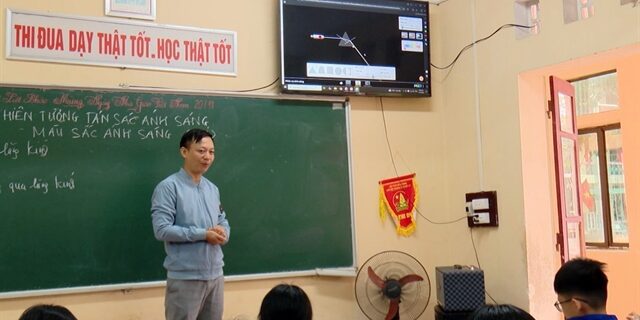
| Teacher Nguyễn Văn Vĩnh demonstrates a light-dispersion experiment using AI technology for students in his class. — VNA/VNS Photo |
NINH BÌNH — In a science classroom at Bắc Lý Lower Secondary School, ninth-grade students watch white light pass through a prism and break into bands of colour. But the experiment is not on a lab bench; it plays out on a computer screen.
With a few taps, an artificial intelligence (AI) application recreates the process in motion, allowing students to zoom in, slow it down and replay it as often as they need. For many, it is the first time a textbook concept has felt tangible.
Across Ninh Bình Province, AI is quietly reshaping how lessons are taught and absorbed. Schools are adopting AI not to replace teachers, but as a tool to support visual learning, experimentation and student-centred instruction, an education approach officials say is increasingly urgent as digital technologies transform classrooms worldwide.
At Bắc Lý, teacher training has been a priority. Educators receive guidance on integrating AI tools into lesson plans and on assessing student learning when digital simulations are involved.
Nguyễn Văn Vĩnh, a natural sciences teacher, says the technology allows him to explain abstract phenomena more clearly than traditional methods ever could.
“With AI simulations, students can see every step. They understand faster, and they understand more deeply,” he said.
During a lesson on light dispersion, students moved beyond static textbook images to interactive experiments showing how white light separates into distinct colours as it passes through a prism. Animated visuals, enlarged viewing angles and replay functions helped reinforce concepts that once relied heavily on verbal explanation.
For students, the difference is immediate.
“Lessons don’t feel limited to the textbook anymore. When we interact directly with the experiment on the computer, we remember it longer,” said Trương Lương Hùng, a student in class 9D.
Bắc Lý has developed a phased implementation plan that includes hands-on training, demonstration lessons and regular professional discussions to ensure consistency across classrooms.
“The goal is not to let AI think for students. It should support their thinking, creativity and ability to learn independently. Teachers still guide the process,” a school representative said.
Despite limited infrastructure, some teachers have already begun using AI to structure lessons around activities such as warm-ups, exploration and practice, increasing student engagement.
The approach is not limited to general education. At Biên Hòa High School for the Gifted, AI-assisted teaching has become a part of training programmes for high-achieving students, particularly in chemistry.
Teacher Đinh Thị Xoan uses AI to design lessons that combine theory with simulated experiments, exposing students to colourful chemical reactions and visual phenomena, such as bubbling, precipitation and dissolution, that are difficult to reproduce repeatedly in physical labs.
“In the past, creating advanced exercises took a lot of time. AI helps tailor problems to different learning levels, especially for gifted students, without making the work too easy or overwhelming,” she said.
In 2025, Xoan introduced an experimental-practice framework for training national-level science students, an initiative that education officials say has helped modernise teaching methods within the province.
School administrators acknowledge that AI also brings risks if used carelessly.
Nguyễn Thị Bích Hằng, principal of Biên Hòa High School for the Gifted, said students must be taught not only how to use AI, but how to use it responsibly.
“The key is guidance. Students need to understand that AI is a tool, not a substitute for human thinking,” she said.
Provincial leaders see the changes as part of a longer transition rather than a short-term experiment.
Đinh Thị Lụa, deputy secretary of Ninh Bình Province’s Party’s Committee, said schools could not afford to stand outside the technological shift that isreshaping education globally.
“Schools need to engage proactively, not just to keep up, but to take a leading role in innovation,” she said.
For now, the transformation is most visible in small moments: a student replaying a simulation, a teacher adjusting a lesson in real time, a classroom where curiosity is sparked by something once confined to a page.
In Ninh Bình, those moments are becoming part of everyday learning. — VNS