This post was originally published on here
The air around us may be carrying vastly more microscopic plastic than scientists ever realized.
Over the last 20 years, scientists have come to recognize microplastics (MPs) and nanoplastics (NPs) as a growing form of pollution. These tiny plastic particles have now been found throughout the entire Earth system, including the atmosphere, hydrosphere, lithosphere, and biosphere.
As evidence of their spread has grown, researchers studying climate change and biogeochemical cycles have paid increasing attention to plastics. Despite this interest, major questions remain unanswered. Scientists still struggle to measure how much plastic exists, where it comes from, how it changes over time, and where it ultimately ends up. These uncertainties are especially pronounced in the atmosphere, largely because current tools have difficulty detecting particles that range from microscopic to nanoscale sizes.
A New Way to Measure Plastic in the Air
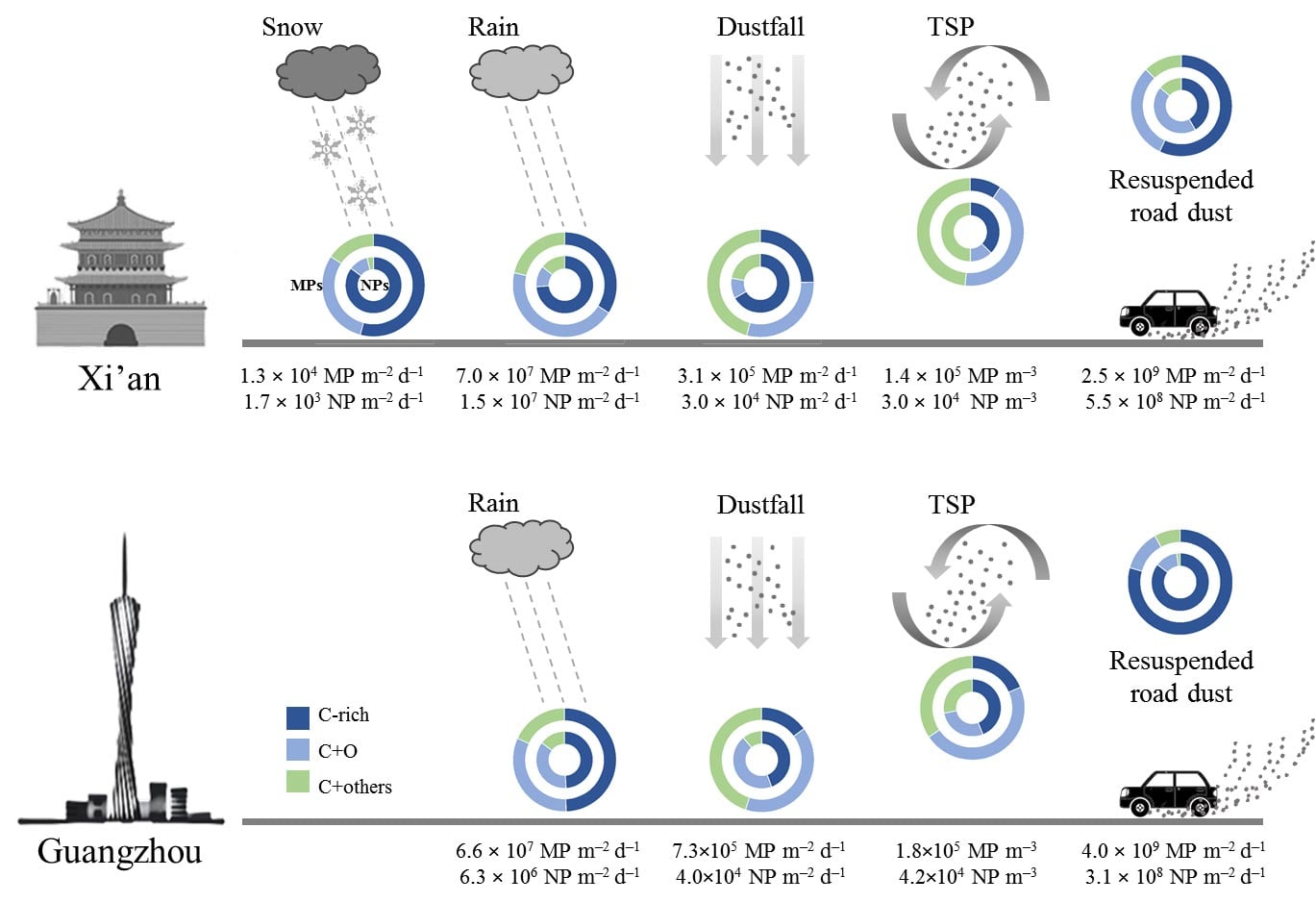
To overcome these limitations, researchers from the Institute of Earth Environment of the Chinese Academy of Sciences (IEECAS) created a semi-automated analytical approach designed to measure plastic particles in the air. The method also tracks how plastics move between different environmental pathways, including airborne particles, dustfall, rain, snow, and dust resuspension.
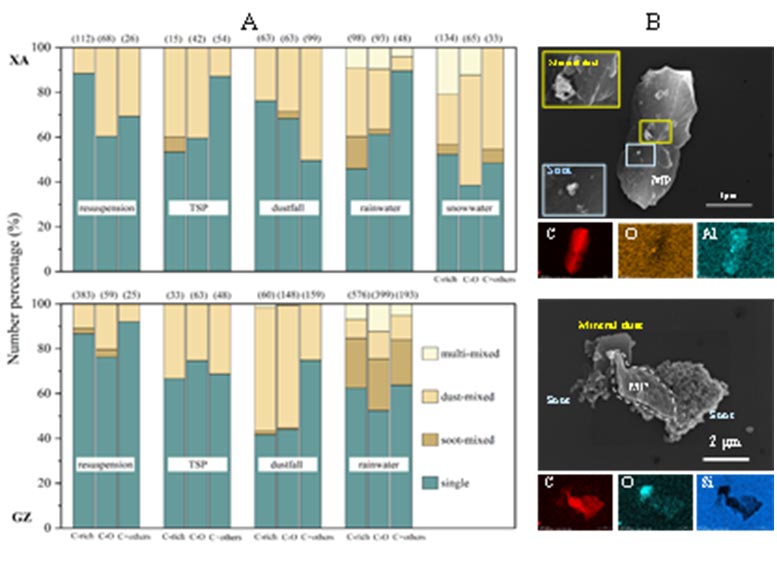
The team applied this approach in two large Chinese cities, Guangzhou and Xi’an. Their system relies on computer-controlled scanning electron microscopy, which reduces human subjectivity compared with traditional manual analysis. This allowed the researchers to detect plastic particles with greater consistency and sensitivity than earlier techniques.
Plastic Levels Far Higher Than Expected
Using this automated system, the scientists found plastic concentrations in total suspended particulates (TSP) and dustfall fluxes that were two–six orders of magnitude higher than levels reported by visual identification methods (e.g., manual SEM-EDX, μ-FTIR, or μ-Raman). These results suggest that previous studies may have significantly underestimated the amount of plastic present in the atmosphere.
The study also revealed that the movement of MPs and NPs varied widely across atmospheric pathways, spanning two to five orders of magnitude. Much of this variation was linked to road dust resuspension and wet deposition. Samples collected from deposition showed more diverse mixtures of plastic particles than those taken from aerosols or resuspended dust, pointing to increased particle clumping and removal as plastics travel through the air.
Why Atmospheric Plastics Matter
Notably, this research represents the first time nanoplastics as small as 200 nm have been detected in complex environmental samples. The findings offer one of the most detailed measurements to date of plastics in the atmosphere, which remains the least understood part of the global plastic cycle.
By clarifying how plastics move, transform, and settle from the air, the study provides important insight into their potential effects on climate processes, ecosystems, and human health.
The research was published today (January 7) in Science Advances.
Reference: “Abundance of microplastics and nanoplastics in urban atmosphere” 7 January 2026, Science Advances.
DOI: 10.1126/sciadv.adz7779
Never miss a breakthrough: Join the SciTechDaily newsletter.
Follow us on Google and Google News.