This post was originally published on here
RUMFORD — A chance encounter at the Rumford Public Library by a 25-year-old Peru man has brought renewed interest in STEM (Science, Technology, Engineering and Mathematics) programs and 3D printing for area patrons.
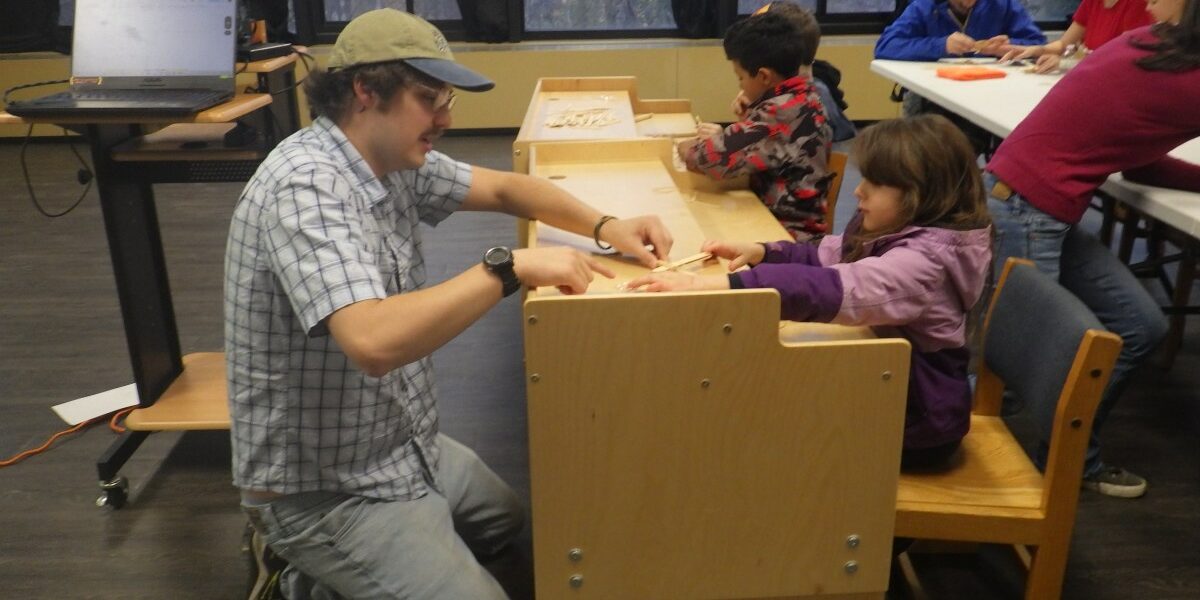
Since May, Matt Frost has become a hit with kids and their parents at the library, where he has been volunteering his time teaching STEM and organizing engineering projects for a couple Thursdays each month, according to Children’s Librarian Sarah Cotnoir.
Frost said he attended the University of Maine in Orono for a couple of years to study chemical engineering.
Then one day last year, he was drawn to the Rumford Public Library after seeing a little 3D printed folder on the front door.
“I like 3D printing a lot. I thought that was really cool and I talked to them about it and they said they hadn’t gotten it (the printer) to work in a long time,” said Frost, who asked if he could fix it up.
Library officials asked if Frost wanted to run the printer and if he could also do some creative engineering activities with kids. He agreed.
“I’d never been able to do this before and this is really, really fun for me. The kids are really into it. That’s my favorite part,” he said.
One creative engineering event Frost offered recently was about structural engineering and bridge building. The lesson included a discussion about what makes a bridge strong, the different types of bridges, how engineers build bridges and what materials and designs should be used.
After the lesson, the kids entered into two challenges to see whose bridge could hold the most weight.
The first challenge had the kids testing their skill at making a strong paper bridge that could hold toy cars and pennies. For this test they worked individually and used different folding techniques to create strength and structure.
They learned that it’s not just about the type of material being used that makes a bridge strong, it’s actually mostly about structure that gives a bridge its strength.
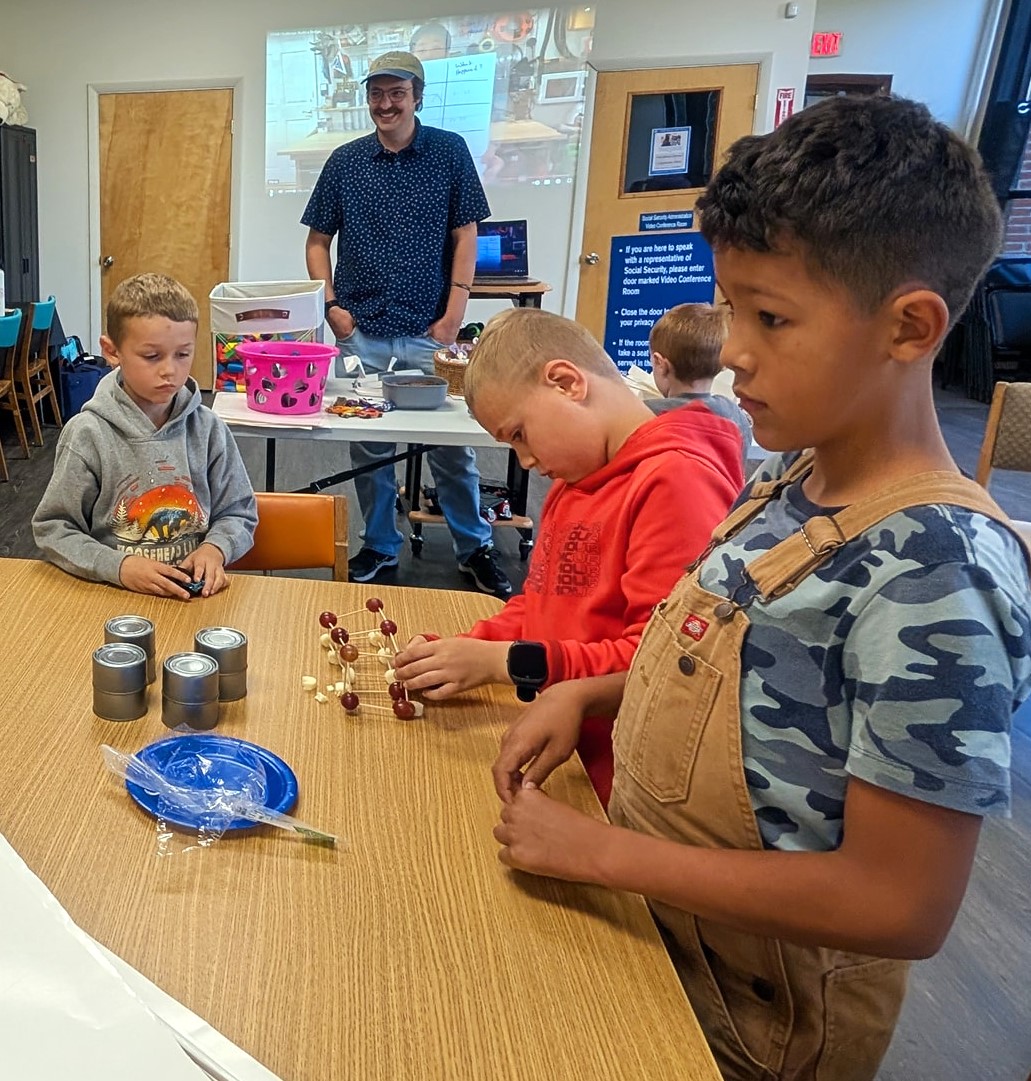
The second challenge involved breaking up into four large teams. The kids worked collaboratively to build a truss bridge using grapes, cheese, toothpicks and tin cans. In this challenge, they learned that using various materials (and combining more than one building method) can help you achieve a more complex design which gives your bridge exponentially greater strength.
Frost said he has acquired a handful of used 3D printers that were not working when he obtained them, including a couple that had been thrown away.
He currently has four of the printers working, but three are still broken. The workable 3D printers are used in classes at the library.
“I love fixing stuff. I like the ability of taking something that’s broke/busted, and then making it something else because it’s less waste and I get to learn about it, too,” Frost said.
During one week, he brought all the working printers to the library for a scavenger hunt program.
He said the only thing that takes a little time is getting the printing done for requests from individual kids because it takes awhile to create it.
They make these selections from websites that show examples of these projects. For example, Frost said one tower project will require three days for the 3D printer to complete.
A parent at one program he hosted asked Frost about becoming a substitute science teacher, a job for which you don’t need to have all the teaching credentials.
“That would be cool. I might look into that,” he said.
Frost said he is currently between jobs.
“I don’t know what I want to do,” he said. “But right now, I’m really enjoying this.”