This post was originally published on here
Proton collisions at the LHC appear wildly chaotic, but new data reveal a surprising underlying order. The findings confirm that a basic rule of quantum mechanics holds true even in extreme particle collisions.
High energy proton collisions can be imagined as a boiling sea of quarks and gluons, including short lived virtual ones. In this extreme phase, particles seem to have far more ways to interact and change than the smaller number of more orderly particles that later spread out from the collision point. At first glance, this early stage appears vastly more complex. Yet measurements from the LHC accelerator show that this picture is incomplete and that proton collisions are better explained by an improved theoretical model.
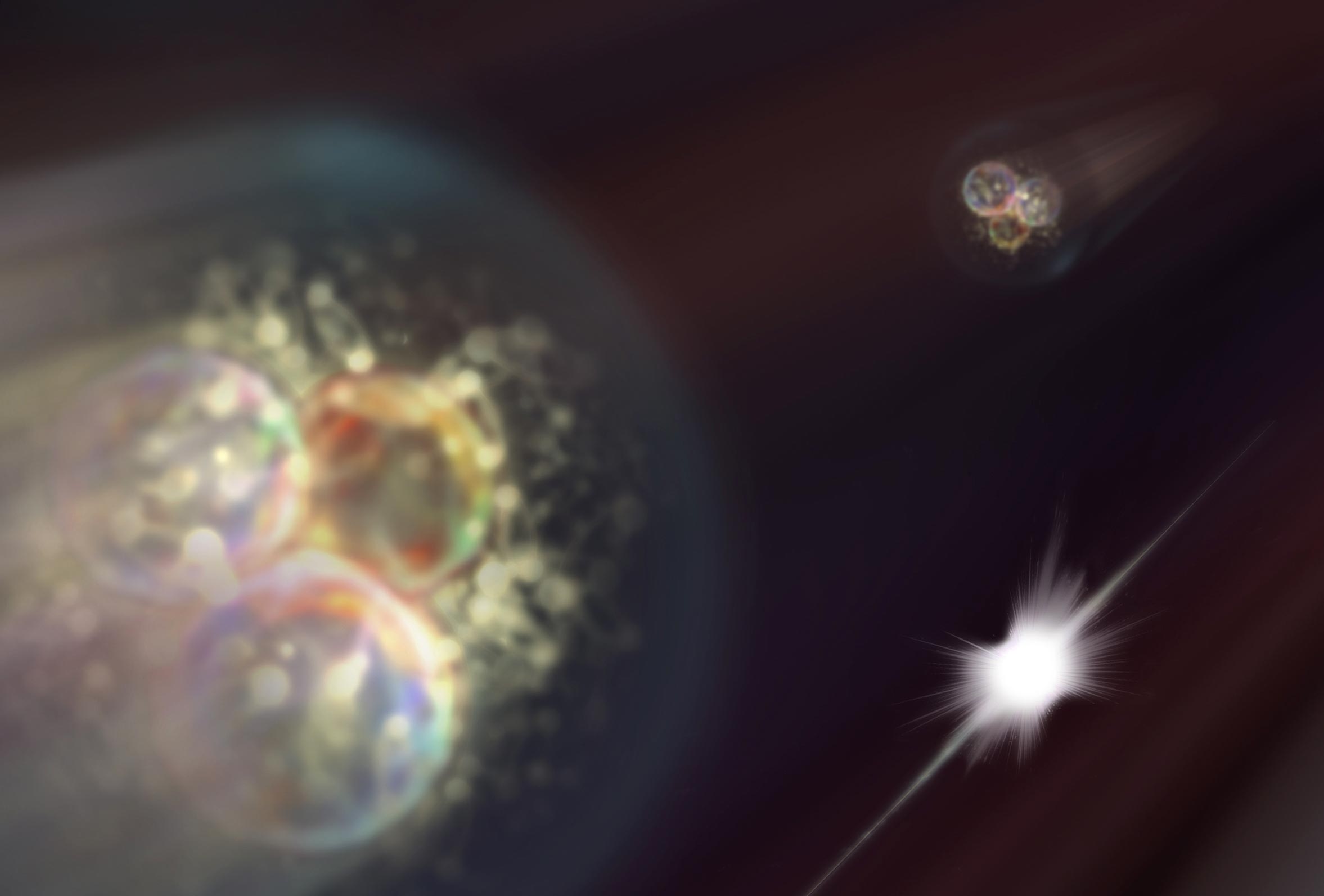
A tremendous amount happens when protons collide at very high energies. Protons are hadrons, i.e. clusters of partons, which include quarks and the gluons that bind them together. When two protons strike each other with enough energy, their quarks and gluons, including virtual ones that exist only briefly, undergo a web of complex interactions. As the system cools, quarks combine to form new hadrons that fly away from the collision region and are detected by experiments.
Based on this sequence, it seems natural to expect that the entropy of the produced hadrons, which describes how many different states the system can occupy, would differ from the entropy during the earlier parton phase. That initial phase looks especially chaotic, with many quarks and gluons interacting at once.
New Insights Into Entropy at the LHC
The latest research examining entropy in both hadrons and partons during proton collisions was published in Physical Review D. The study was carried out by Prof. Krzysztof Kutak and Dr. Sandor Lokos from the Institute of Nuclear Physics of the Polish Academy of Sciences (IFJ PAN) in Cracow.
“In high-energy physics, so-called dipole models have been used for some time to describe the evolution of dense gluon systems. These models assume that each gluon can be represented by a quark-antiquark pair that forms a dipole of two colors – here we are not talking about ordinary colors, but the color charge that is a quantum property of gluons. Dipole models based on the average number of hadrons produced in a collision allow us to estimate the entropy of partons,” explains Prof. Kutak, who has spent more than a decade studying the entropy of complex quark gluon systems.
Refining the Dipole Model
Two years ago, Prof. Kutak worked with Dr. Pawel Caputa from Stockholm University to develop a modified version of the dipole model. Their approach treated one existing description of gluon system evolution as the dominant framework and then added additional effects that become important at lower collision energies, where fewer hadrons are produced. This step forward was possible after the researchers recognized links between the equations used in dipole models and those found in complexity theory.
To check whether this generalized dipole model matched reality, Dr. Lokos proposed comparing it with experimental data collected at the LHC. The analysis drew on measurements from four major experiments: ALICE, ATLAS, CMS and LHCb. Together, these data cover a broad range of collision energies, from 0.2 teraelectronvolts up to 13 TeV, the highest energy currently reached by protons at the LHC.
“In our article, we show that the generalized dipole model describes the existing data more accurately than previous dipole models and, moreover, works well in a wider range of proton collision energies,” emphasizes Prof. Kutak.
What Entropy Reveals About Quantum Mechanics
This result brings the discussion back to a central question. During proton collisions, is the entropy in the phase dominated by quark and gluon interactions different from the entropy of the hadrons that later escape the collision site? According to the Kharzeev-Levin formula for entropy, it should not be different. The new findings confirm this idea. While the outcome surprises some physicists, others see it as a natural result of one of the most fundamental principles of quantum mechanics, known as unitarity.
Unitarity may sound abstract, but the concept itself is straightforward. The equations that govern how a quantum system evolves over time must conserve total probability, which always adds up to one, and they must allow processes to be reversible. In simple terms, unitarity means that probability and information cannot vanish or appear from nowhere.
“The unitarity of quantum mechanics is something that physics students learn about. The formalism of quantum chromodynamics, the theory describing the world of quarks and gluons, is based on unitarity. However, it is one thing to deal with a theory that exhibits a certain feature at the level of quarks and gluons on a daily basis, and quite another to observe it in real data on produced hadrons,” says Prof. Kutak. He points out that unitarity is what makes it possible to infer information about parton entropy across a wide range of collision energies.
Future Tests With Upgraded Experiments
Additional tests of the generalized dipole model are expected in the next decade, following the planned upgrade of the LHC accelerator. An improved ALICE detector will allow scientists to study regions where gluon interactions are denser than those explored so far.
Researchers are also looking ahead to data from the Electron-Ion Collider (EIC), now under construction at Brookhaven National Laboratory in the USA. At the EIC, electrons will be collided with protons. Because electrons are elementary particles, these experiments will offer a powerful way to examine dense gluon systems within individual protons.
Reference: “Entropy and multiplicity of hadrons in the high energy limit within dipole cascade models” by Krzysztof Kutak and Sándor Lökös, 14 November 2025, Physical Review D.
DOI: 10.1103/23wn-66np
Never miss a breakthrough: Join the SciTechDaily newsletter.
Follow us on Google and Google News.