This post was originally published on here
There’s really no shortage of end-of-the-world predictions. People have been convinced civilisation is about to collapse for thousands of years. One of the earliest examples goes back nearly 4,800 years, when a writer in ancient Assyria complained that young people had lost their morals, a sure sign, he believed, that society was falling apart. Ever since, prophets, pastors and public figures have tried to put a firm date on humanity’s final chapter, usually with little more than belief to back it up.But one prediction keeps resurfacing for a different reason. It didn’t come from a sermon or a vision. It came from a respected scientific journal.
A doomsday date hidden in mathematics
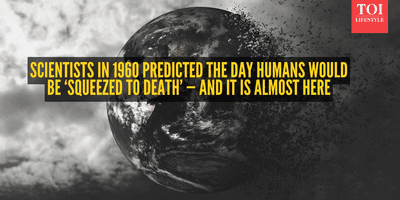
In November 1960, Science published a paper by three University of Illinois researchers, Heinz von Foerster, Patricia M. Mora, and Lawrence W. Amiot, that pointed to a possible end-of-the-world scenario on Friday, November 13, 2026.What set this warning apart from earlier claims was its foundation. Unlike predictions by Jewish leader Simon bar Giora, who believed the world would end around 70 AD, or South African pastor Joshua Mhlakela, who said the apocalypse would arrive last October, this one was based on mathematical modelling. The researchers studied population growth trends in Western society and followed the numbers to their logical conclusion.Their takeaway was unsettling but straightforward: advances in medicine and technology were allowing the human population to grow at an accelerating pace, one that could eventually become impossible to sustain.
Overpopulation, not asteroids or nuclear war
Foerster, Mora and Amiot weren’t warning about nuclear war, asteroid strikes or supervolcanoes. Their concern was far more ordinary, and far harder to escape. Overpopulation.According to their calculations, the number of people on Earth would “tend towards infinity” around 2026. In simple terms, they argued that population growth would spiral so fast that food and resources wouldn’t be able to keep up. When the paper was published, the global population was around three billion. As we head into 2026, that number has crossed eight billion, according to United Nations estimates, with population decline not expected until around 2080.Their ideas echoed those of British economist Thomas Malthus, who warned back in 1798: “Famine seems to be the last, the most dreadful resource of nature. The power of population is so superior to the power of the earth to produce subsistence for man, that premature death must in some shape or other visit the human race.”Von Foerster described the mathematical breaking point in stark language:“The climax will come at a calculable date in the future, which Von Foerster, in mathematical terms, calls to (t sub zero). ‘For obvious reasons,’ he says, ‘to shall be called ‘doomsday,’ since it is on that date that N (the number of ‘elements,’ or people) goes to infinity, and the clever population annihilates itself. Our great-great-grandchildren will not starve. They will be squeezed to death.’”
Why the world hasn’t ended yet
So far, the worst-case scenario hasn’t played out. Population has exploded, but food production has managed to keep pace thanks to advances in farming, fertilisers, irrigation and crop genetics. Time and again, innovation has delayed the kind of famine Malthus feared.Still, the idea of a future “Malthusian crisis” clearly weighs on some minds, particularly very wealthy ones.Meta CEO Mark Zuckerberg, currently ranked sixth on the Forbes billionaires list, has spent $187 million (£139m) on a 1,600-acre property in Hawaii. He is reportedly building a luxury ranch there that includes a 5,000-square-foot underground bunker with its own food and energy supplies. Amazon founder Jeff Bezos has paid $147 million (£109m) for two mansions on Indian Creek Island in Florida, while Oracle founder Larry Ellison now owns almost the entire Hawaiian island of Lanai.As reported by Forbes and other US media outlets, these locations aren’t just beautiful, they’re also remote and defensible. That’s a familiar theme in apocalyptic fiction, where food shortages often spiral into riots, violence and societal breakdown.