This post was originally published on here
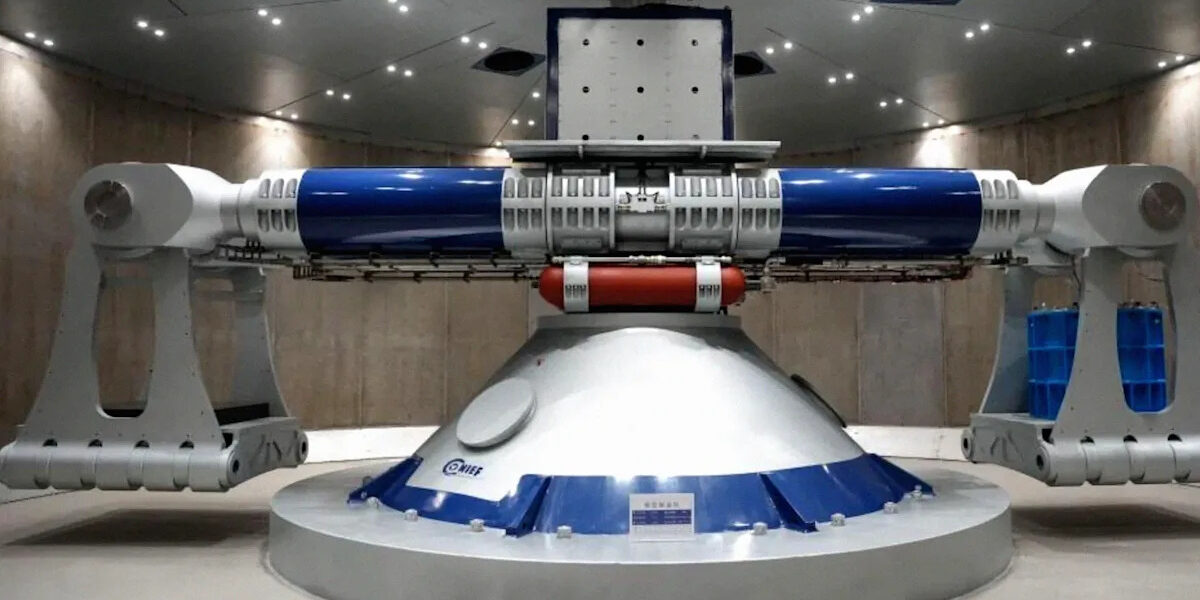
China has unveiled an extremely powerful “hypergravity machine” that can generate forces almost two thousand times stronger than Earth’s regular gravity.
The futuristic-looking machine, called CHIEF1900, was constructed at China’s Centrifugal Hypergravity and Interdisciplinary Experiment Facility (CHIEF) at Zheijang University in Eastern China, and allows researchers to study how extreme forces affect various materials, plants, cells, or other structures, as the South China Morning Post reports.
It can effectively compress space and time, allowing researchers to recreate the conditions during catastrophic events, from dam failures to earthquakes. For instance, it can analyze the structural stability of an almost 1,000-feet-tall dam by spinning a ten-foot model at 100 Gs, meaning 100 times the Earth’s regular gravity.
Advertisement
Advertisement
It could also be used to study the resonance frequencies of high-speed rail tracks, or how pollutants seep into soil over thousands of years.
The machine officially dethroned its predecessor, CHIEF1300, which became the world’s most powerful centrifuge a mere four months ago.
The previous record holder was the centrifuge at the Army Corps of Engineers in Vicksburg, Mississippi, which can generate 1,200 g-tonnes, a metric that combines gravitational acceleration (G) and a mass measured in tonnes (2,200 pounds), of force.
To generate these forces, CHIEF1900 spins a payload inside a beefy centrifuge, not unlike those being used by the US Air Force to simulate high G-forces during pilot training.
Advertisement
Advertisement
Except that the forces are orders of magnitude stronger. It can generate 1,900 g-tonnes of force, or 1,900 times the Earth’s gravity. To put that into perspective, a washing machine only reaches about two g-tonnes.
Engineers had to overcome some significant challenges in getting CHIEF1900 up to that mighty force. For one, spinning at such high speeds generates an enormous amount of heat. To dissipate all of it, the engineers came up with a vacuum-based temperature control system, as the SCMP reports, which uses coolant and forced-air ventilation to keep things cool enough.
“We aim to create experimental environments that span milliseconds to tens of thousands of years, and atomic to [kilometre] scales — under normal or extreme conditions of temperature and pressure,” Zhejiang University professor and CHIEF’s chief scientist Chen Yunmin told the SCMP.
“It gives us the chance to discover entirely new phenomena or theories,” he added.
More on centrifuges: NASA Tests System to Fling Satellites Into Sky Using Huge Centrifuge