This post was originally published on here
New scientific data show the planet’s oceans continued to absorb heat at unprecedented levels in 2025, setting a record for ocean warming and underscoring the growing impact of human-driven climate change.
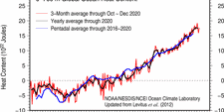
A study published in the peer-reviewed journal Advances in Atmospheric Sciences found that global upper ocean heat content, a measure of heat stored from the surface down to 2,000 meters, increased by about 23 zettajoules in 2025 compared with 2024.
That marked the highest amount of heat ever recorded by modern scientific instruments, continuing a long-term trend tied to rising concentrations of greenhouse gases.
The report was compiled by an international team of more than 50 ocean and climate scientists, using multiple independent datasets, including measurements from instruments such as Argo floats, satellites and ocean surveys to track changes in heat stored in the world’s oceans.
Scientists say oceans absorb more than 90% of the excess heat generated by human-caused warming, making ocean heat content one of the clearest indicators of climate change.
What the record means
The oceans’ growing heat content has important real-world impacts:
Stronger storms and weather extremes: warmer oceans provide more energy for hurricanes, typhoons and heavy rainfall events, contributing to more intense weather systems.
Sea level rise: heat causes water to expand and amplifies glacial melt, both of which contribute to rising seas that threaten coastal communities.
Ecosystem stress: prolonged ocean warming and marine heatwaves contribute to mass coral bleaching and ocean biodiversity loss.
According to the study, roughly one-third of the global ocean area ranked among its top three warmest conditions on record between 1958 and 2025, with particularly high heat content in regions like the South Atlantic, Mediterranean, North Indian Ocean, and Southern Oceans.
Global climate context
The World Meteorological Organization reports that the past decade continues to rank among the warmest on record, and preliminary data indicate that 2025 was likely the second or third warmest year globally, driven in part by continued ocean heating.
“Ocean warming has far-reaching consequences for weather, sea levels and marine ecosystems,” said climate experts, who emphasize that cutting greenhouse gas emissions remains the most effective means of limiting further warming.
A long-term challenge
The trend documented in the new study reflects decades of accumulation of heat in the ocean. According to climate data records, ocean heat content has been rising rapidly since the 1960s, with the pace of warming accelerating in recent years.
Because the ocean stores vast amounts of heat, even temporary reductions in greenhouse gas emissions would take years to fully show up in ocean temperatures. This “thermal inertia” means that the effects of warming already in the system will continue to unfold for decades.
For more science on global ocean warming and long-term climate trends, the full report is available in Advances in Atmospheric Sciences: “Ocean Heat Content Sets Another Record in 2025.”
Helpful links.
Click here to read the full scientific paper on Springer: Ocean Heat Content Sets Another Record in 2025.
To read the World Meteorological Organization global summary: 2025 likely second or third warmest year on record, click here.