This post was originally published on here
The post Deep-Sea Ghost: How Scientists Finally Caught the Whale No One Had Ever Seen appeared first on A-Z Animals.
Quick Take
-
Achieving the first live photographs of a ginkgo-toothed beaked whale ended a 66-year mystery since the species was first described in 1958.
-
The 43-kilohertz signal led to a 60-year identification challenge for biologists tracking unknown cetaceans.
-
New acoustic data reveals a habitat shift, demonstrating that these whales are year-round residents in the deep-water canyons of California and Baja California, Mexico.
-
Recovering the DNA sample involved distracting a curious albatross to recover the biopsy sample.
For more than 60 years, the ginkgo-toothed beaked whale (Mesoplodon ginkgodens) was one of the ocean’s greatest mysteries. Although identified in 1958, our basic understanding of this rare whale was limited to the “forensic” evidence of weathered carcasses that occasionally washed ashore. No scientist had ever photographed or filmed one of these mysterious animals alive in the wild. However, that all changed in June 2024 when an international research team off the coast of Baja California, Mexico, documented the first live sighting and photographs of the elusive ginkgo-toothed beaked whale.

For 66 years, it was a phantom of the deep. Now, groundbreaking research, acoustic clues, and an unexpected albatross intervention finally reveal the secrets of the ginkgo-toothed beaked whale. © A-Z Animals
Decoding a Deep-Sea Ghost
For years, marine biologists were puzzled by a recurring, high-frequency echolocation click in their audio recordings, known simply as BW43. While scientists knew the sound belonged to a beaked whale, they couldn’t put a face to the name.
Advertisement
Advertisement
The signal was a distinctive ‘upsweep’ pulse peaking at 43 kilohertz. When slowed down for human ears, it sounds like a fingernail dragging across the teeth of a plastic comb. For decades, the prime suspect was Perrin’s beaked whale — another species never before seen alive.
Studies show that beaked whales are carrying more toxins in their blubber than they used to.
©Zen HP/Shutterstock.com
To protect deep-sea life, scientists need to link specific underwater sounds to the species making them. This is especially true for beaked whales, which are rarely seen at the surface and are often known only by their unique acoustic signals. Without the ability to identify which whale produces which sound, it is nearly impossible to track their migrations, map their habitats, or estimate their population sizes.
In 2020, Dr. Elizabeth Henderson and her team began launching annual expeditions to northwestern Baja California. Their vessel, Pacific Storm, towed a 492-foot cable with hydrophones (underwater microphones) to triangulate clicking whales in real-time. Once a sound was localized, observers on deck used high-powered binoculars to scan the horizon for the brief moments when the whales surfaced for air.
The Great Biopsy Rescue
Finally, in June 2024, the team recorded the BW43 pulses just seconds before a small group of whales surfaced close to the research vessel. As the crew captured the first-ever live images, researcher Robert Pitman fired a biopsy dart to collect a skin sample, while the hydrophones confirmed the whales were indeed the source of the BW43 pulses.
However, the skin sample was nearly lost when a curious albatross swooped down and began pecking at it. In a frantic effort to save the priceless genetic data, the crew started shouting and throwing their breakfast rolls into the water to lure the bird away.
Advertisement
Advertisement
The carb-heavy distraction worked, allowing researchers to recover the sample. Subsequent DNA analysis confirmed that the mysterious BW43 signal belongs to the ginkgo-toothed beaked whale. This breakthrough has closed a 60-year gap in marine biology, turning a “biological ghost” into a recognized, living part of the ocean’s ecosystem.
A Specialized Deep-Sea Hunter
The data collected by the Pacific Storm expedition confirms that the ginkgo-toothed beaked whale is much more than a rarity — it is a highly successful, specialized predator. The species is robust and powerful, allowing it to withstand the immense pressure of the deep ocean.
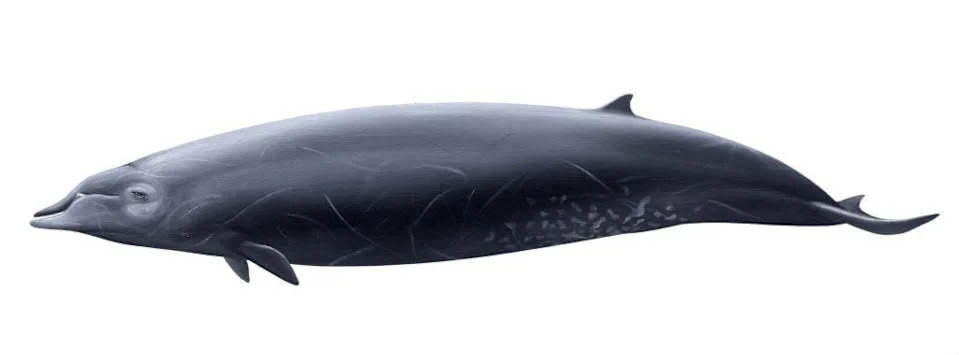
Adults reach approximately 17 feet long and weigh roughly 4,056 pounds. They have sturdy bodies with small, pointed flippers and a wide, curved dorsal fin with a rounded tip. One of the most exciting findings is the color of the whales. Because whale skin darkens quickly after death, the striking color differences between male and female whales had previously been unknown. Males are primarily dark blue-black with white blotches on their bellies. Adult males typically have white “rake marks” or scars from fighting other males. Females, in contrast, are primarily a muted mid-grey color with a lighter-colored belly and lack the males’ rake marks.
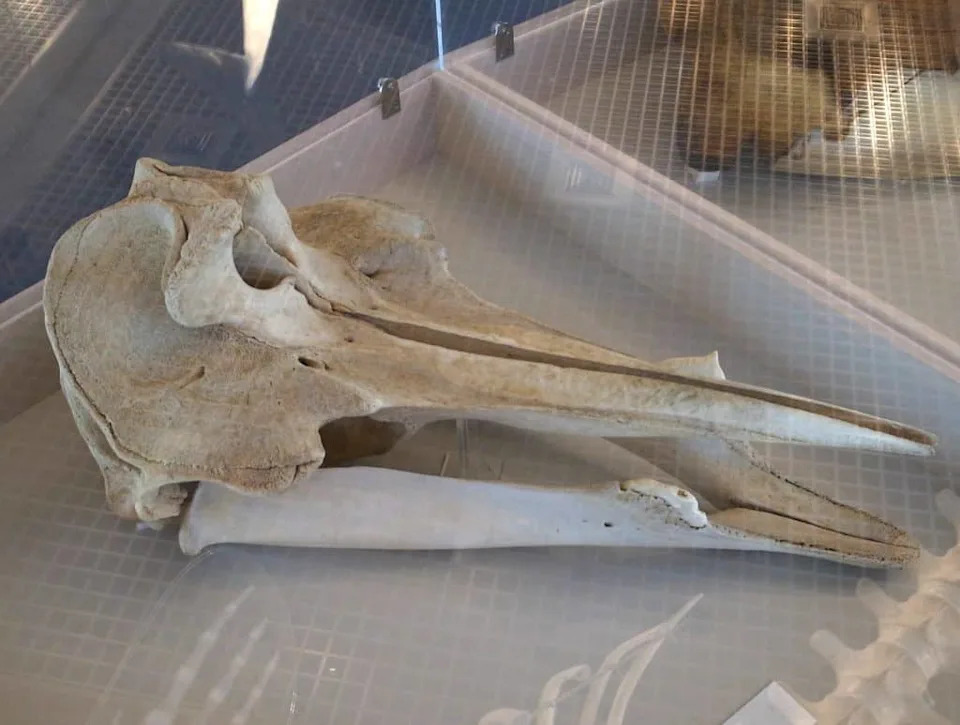
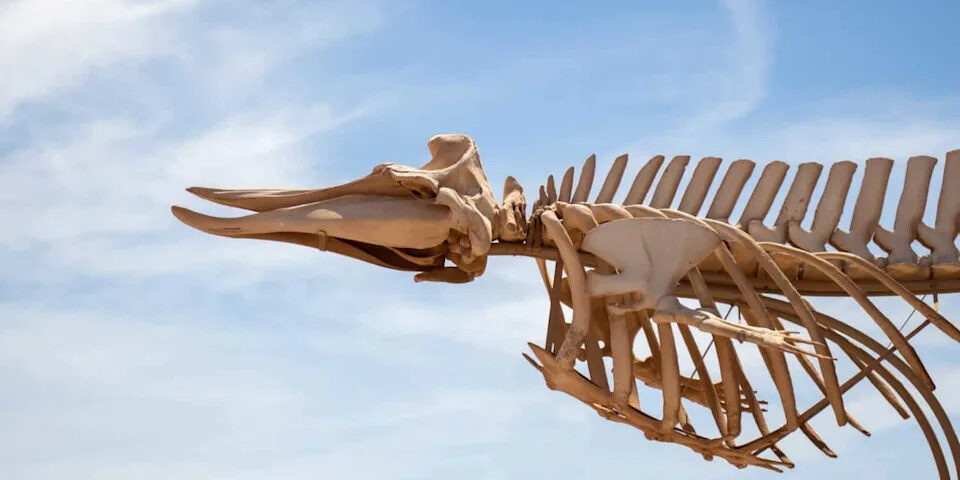
The ginkgo-toothed beaked whale’s most iconic feature is its head and jaw structure, which gives the species its name. Its smoothly sloping forehead leads into a medium-length beak. It also has a noticeably arched lower jaw, creating a distinct side profile. Adult males have a single pair of teeth that erupts from the middle of the lower jaw. These teeth are broad and fan-like, mimicking the shape of a Japanese ginkgo tree leaf. Unlike other beaked whales with long tusks, these teeth are mostly hidden by skin flaps, exposing only their sharp tips.
Life in the Abyss
The ginkgo-toothed beaked whale is a master of the “midnight zone,” a world of crushing pressure and absolute darkness. Its ghostly reputation comes from its extreme lifestyle, as it spends 99 percent of its life hidden deep beneath the waves.
Advertisement
Advertisement
Built for endurance and power, these whales typically dive to depths greater than 3,000 feet to forage. A single dive can last more than an hour. When the whales surface to breathe, they stay for only a few fleeting minutes, often appearing as nothing more than a dark, log-like shape before vanishing into the depths below.
Interestingly, these whales do not use their iconic ginkgo-shaped teeth for chewing; instead, they are suction feeders. They use powerful throat muscles to create a vacuum, pulling deep-sea fish, squid, and crustaceans directly into their mouths.
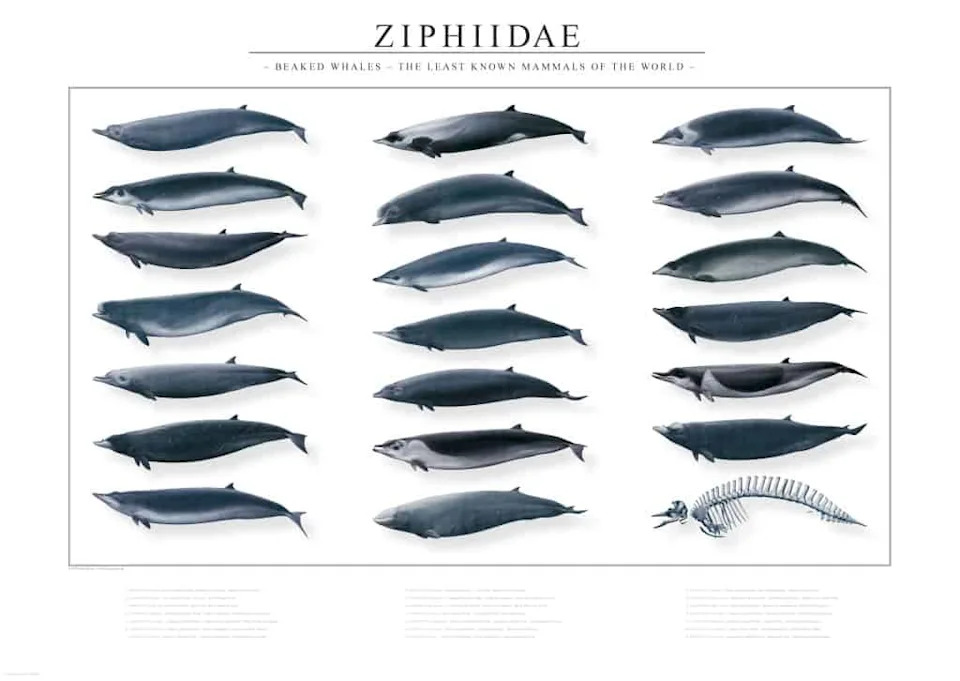
While much of the whale’s social life remains a mystery, the rake marks and scars on males suggest they engage in physical combat to compete for mates or dominance. Circular scars from cookiecutter sharks also indicate that these whales are constantly navigating a complex and dangerous deep-sea food web.
Redrawing the Global Map
Recent expeditions in 2024 and 2025 have fundamentally changed our understanding of where ginkgo-toothed beaked whales live. Previously, scientists assumed the whales were rare visitors to North America since their carcasses were frequently found in Japan. However, the consistent BW43 acoustic signals prove that these whales are likely year-round residents of the deep-water canyons off California and Northern Baja. The species is now recognized as a likely year-round resident of the Eastern Pacific, rather than merely a rare visitor from the West.
Conservation and Safeguarding the Silent Deep
Beaked whales are among the most acoustically sensitive creatures on Earth. Modern naval activity — specifically Mid-Frequency Active Sonar (MFAS) — can be catastrophic for them. High-frequency noise can frighten whales away from vital feeding grounds for days or weeks. Panic caused by sonar can also force whales to surface too quickly. Much like human divers, a rapid ascent causes nitrogen bubbles to form in the whale’s blood, leading to fatal decompression sickness.
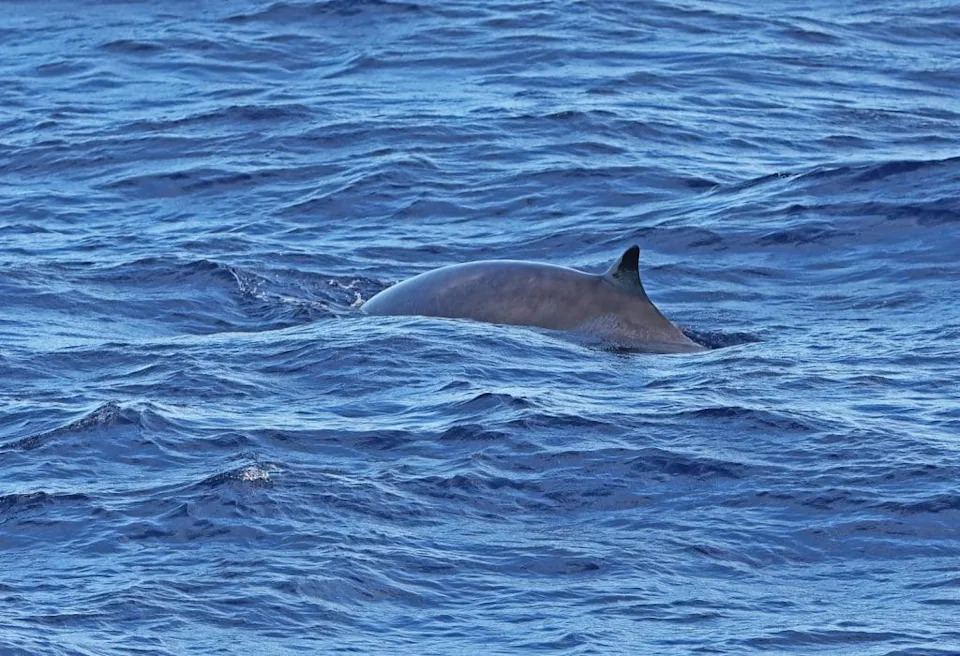
As deep-sea fishing expands into deeper waters, beaked whales are getting caught in large fishing nets more often.
©Neil Bowman/Shutterstock.com
Beaked whales are particularly vulnerable because of their intense deep-diving habits. They spend most of their lives performing long, deep dives to hunt for food, followed by only very brief breaks at the surface to breathe. This extreme lifestyle leaves them with very little physical margin to handle additional stress.
Advertisement
Advertisement
Finally linking the BW43 signal to a specific species allows researchers to help protect these whales without ever having to see them. By reviewing years of underwater recordings, researchers can now map out where these whales live year-round. With this map, conservationists can work with navies and shipping companies to reroute exercises and vessels away from high-density whale hotspots.
The post Deep-Sea Ghost: How Scientists Finally Caught the Whale No One Had Ever Seen appeared first on A-Z Animals.