This post was originally published on here
The post How Shark DNA Preserves Razor-Sharp Eyesight Over Hundreds of Years appeared first on A-Z Animals.
Quick Take
-
Maintaining perfect vision for 400 years is a biological achievement for the Greenland shark.
-
Operating at 9,500 feet creates high-pressure conditions that typically trigger retinal DNA fragmentation.
-
Retinas containing only rod cells contribute to the Greenland shark’s successful hunting habits.
-
Harvesting tissue near Disko Island was essential to determine why retinal structures never age.
The longest living vertebrate on Earth may have a thing or two to teach us about maintaining our eyesight into old age. New research has shown that the Greenland shark does not experience impaired or degenerated vision as it ages. This could be good news for future sufferers of diseases such as macular degeneration, which affects older adults. Here we unpack the fascinating research and its implications for both Greenland sharks and humans.
About Greenland Sharks
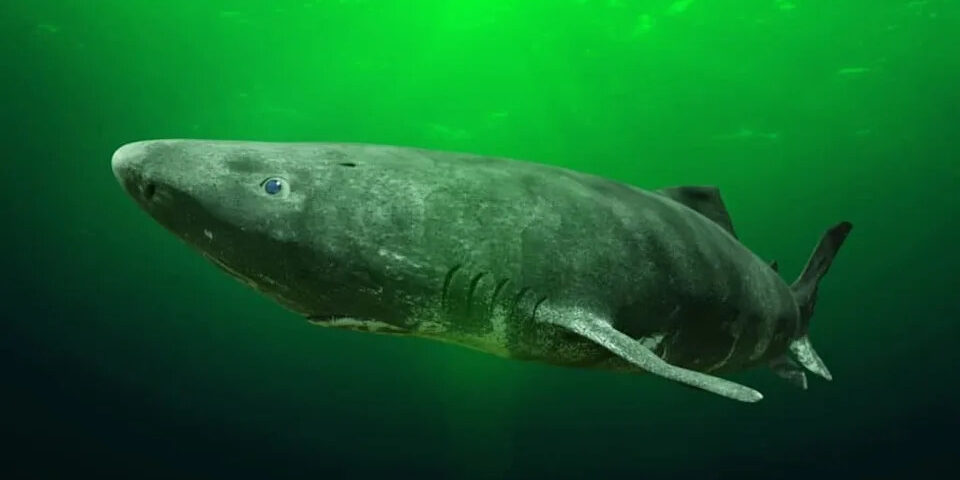
Greenland sharks (Somniosus microcephalus) are a large, sluggish shark species found in the north Atlantic, from the coast of New England and Canada to Scandinavian waters. They live mainly in deep water on continental and insular shelves and occupy intertidal regions. Occasionally, they are spotted in river mouths and shallow bay areas and have rarely been spotted at the mouth of the Seine River in France. Thanks to their huge size, which can be up over 20 feet in length, they have no predators. Their estimated lifespan is 400 years! These sharks live a solitary life, mainly hanging out near the sea floor, feeding on fish (including herring and salmon), seals, and small whales.
Challenges to Greenland Shark Eyesight
Several factors should pose challenges for Greenland sharks to see at all. They live in water that is both very cold (as low as −1.1 °C) and deep (approaching 9500 feet), creating high-pressure conditions. Also, in the waters surrounding Greenland, a parasitic copepod (small crustacean) can attach itself to the shark’s cornea and obscure their vision.
Are Greenland Sharks Blind?
Many scientists once assumed that Greenland sharks cannot see at all! This is a reasonable assumption because many other deep-sea creatures have entirely lost their vision. These creatures, which include cavefish, live in complete darkness. Their retinas have degenerated, and the genes that control the ability to convert light into nerve signals has been lost. Given that Greenland sharks live in dimly lit environments amid harsh conditions and surrounded by parasites, it would not be surprising if they, too, were blind.
Greenland sharks have the longest known lifespan of all vertebrate species.
©Dotted Yeti/Shutterstock.com
However, these sharks successfully hunt fast-moving prey such as seals and scavenge from fishing nets. They can also capture and consume newborn seal pups. All of this suggests that they can see. So, a team of researchers from the University of Basel, in Switzerland, the University of California, the University of Copenhagen, Denmark, Indiana University South Bend, and the Virginia Institute of Marine Science set out to find out more. The results were published in the journal Nature in January 2026. They wanted to establish whether the Greenland shark possesses a lifelong functional visual system.
How Was the Greenland Shark Study Conducted?
The eyes of Greenland sharks caught between 2020 and 2024 using long lines off the coast of the University of Copenhagen’s Arctic Station on Disko Island were used in the study. The eyeballs were dissected and preserved in a fixative solution prior to freezing. The tissue underwent a barrage of scientific tests, including genomics, transcriptomics, in situ hybridisation (RNAscope), ultramicrotomy, chromatin staining, mass spectrometry, in vitro opsin regeneration, and spectrophotometry.
What Was Discovered About Greenland Shark Eyesight?
Greenland shark retinas contain only rod cells as opposed to rods and cones, which are found in many other animals (including humans). Typically, this retina cell structure is seen in animals that inhabit low-light conditions. Furthermore, their rod cells were both densely packed and elongated, which is similar to that seen in other deep-dwelling and nocturnal sharks. Importantly, all of the delicate layers of the retinas examined were intact. There were no obvious signs of deterioration despite the animals being over 100 years old!

As humans get older, their eyesight deteriorates.
©Ammentorp Photography/iStock via Getty Images
So, the scientists conducted another test to determine if any retinal DNA had fragmented, which is often associated with degeneration and cell death. Amazingly, there was no sign of DNA damage or cell death within the retinal tissues. This is in marked contrast to what you would find in human retinas. Our retinas suffer both photoreceptor loss and DNA damage as we age. If a human could live to be 400 years old, we would lose up to 90 percent of our rod photoreceptors.
Advertisement
Advertisement
What’s more, genetic analysis revealed that genes producing bright-light (cone-based) vision were no longer active in these sharks. In contrast, there was a robust expression of DNA repair-associated genes in the retina. This means that the shark’s body was actively repairing damaged DNA over the animal’s long lifespan.
Implications for Human Vision
As humans live longer, we face conditions and diseases associated with aging. Glaucoma and macular degeneration are two examples of conditions that affect older adults. The Greenland shark has shown us how mechanisms can help to keep eye tissue alive and protect it from damage. These magnificent creatures have eyesight perfectly adapted to their environments. More importantly, their vision carries on working perfectly for hundreds of years. If these findings could be applied to humans, poor eyesight in old age could eventually become a thing of the past.
The post How Shark DNA Preserves Razor-Sharp Eyesight Over Hundreds of Years appeared first on A-Z Animals.