This post was originally published on here
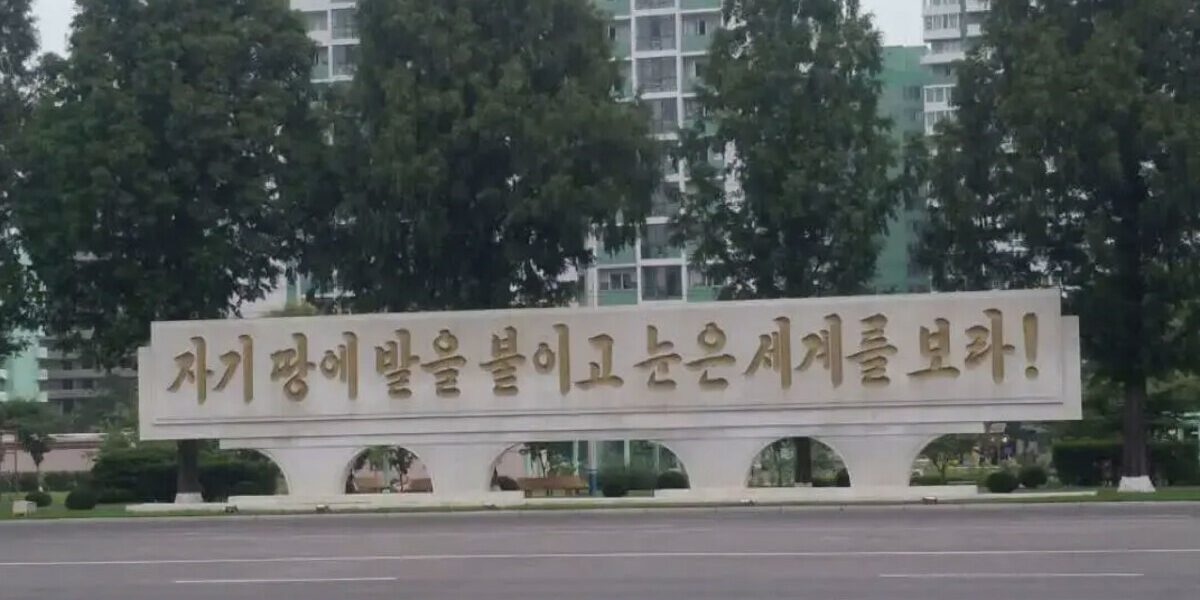
Motto by Kim Jong-il: “Plant your feet firmly on your own soil, and set your eyes upon the world’ (Image: zhuanlan)
“Plant your feet firmly on your own soil, and set your eyes upon the world.” There is not a single university student in North Korea who does not know this phrase.
It was a handwritten motto gifted in 2010 by the then-leader, Kim Jong-il, to Kim Il-sung University to commemorate the completion of its modern e-library.
That year, this phrase swept across the country, stirring new passion for inquiry and pride in being a student of science. Its power lay in the fact that it indicated that Kim Jong-il, the father of the current ruler Kim Jong-un, who was well known for his love of art and music, was turning his attention toward scientists.
At last, the Dear Leader, as he was known, was showing interest in those who had been little more than insignificant figures in the country until then.
There is a simple example that shows the position scientists hold in North Korea. If ten medals are made, nine are given to singers. Have you ever seen a performance by the Korean People’s Army State Merited Chorus and Symphony Orchestra, known as the Merited Choir? The number of medals hanging from their chests is staggering. They cover the entire right side of each person and spill over onto the left.
I will leave it to your imagination how much singing contributes to national development. And the one medal left—where does it go? The government agonizes over whether to give it to a miner, a soldier, or a scientist.
This is why I once swore I would never go to a science and engineering college, even if I died. In the world I saw with my young eyes, scientists and engineers were powerless. They lived in small houses and wore shabby clothes.
By the time I reached my final year of high school, when I had to decide my future path, I had never seen a scientist living a prosperous life. It always puzzled me. Why were they so poor, when they worked so hard? Reason suggests that if you work less, you earn less. Work more, earn more. But the lives of scientists did not follow this logic at all.
Even so, I was forced by my parents to take the path of science. Their thinking was different from mine. Their generation lived by selling resources. They picked pine mushrooms from the mountains, caught squid from the sea, and mined coal underground. But with the money from selling resources, the state barely survived.
To my parents, living off resources in such a small country seemed far too limited. So they concluded that soon resources would be exhausted, and the age of science and technology would arrive.
They firmly believed that in their children’s generation, scientists and engineers would live well. And in 2010, with Kim Jong-il’s handwritten motto – Plant your feet firmly on your own soil, and set your eyes upon the world – it seemed that such an age had finally come.
No one rejoiced more than we scientists. But let me tell you how much, and in what way, we actually benefited.
I had a friend who was truly brilliant. He won a gold medal at the International Mathematical Olympiad. After finishing his studies in China, the state appointed him as a teacher at Pyongyang First Middle School. As the name suggests, this is the top school for gifted students. I admit I was filled with envy.
“Isn’t it wonderful now that the age of science and technology has arrived?” I asked him one day.
“What age of science and technology?” he shot back. “Look at me. I’m still poor. What kind of age is this?”
Though he was the very embodiment of science and technology, his life had not changed at all. He still scraped by, tutoring students in his spare time.
This is the reality of the so-called “age of science and technology” in North Korea. It is nothing more than a manipulative trick by the party. They praise scientists with words, without giving them a single penny. As always, we were deceived.
Looking back, I see that my friend understood this truth better than I did.
In 2016, the regime of Kim Jong-un celebrated the successful launch of the Kwangmyŏngsŏng-4 satellite. Meaning “bright star” or “lodestar” in direct reference to his father, Kim Jong-il, this was the fourth in a series of satellite launches that went back to 1998. All media outlets praised and spotlighted those who achieved it. Korean Central Television broadcast their stay in Pyongyang for over a month.
Watching them, it was clear they had poured their lives and energy into their work. Their frail bodies, pale faces, and graying hair told the story. And their bewildered reactions to Pyongyang’s dazzling sights reminded one of country mice visiting the city.
Of course, no celebration could be complete without a performance by the Moranbong Band. This is the all-female band whose members were handpicked by Kim Jong-un and who played a fusion of pop, rock, and light classical music using electronic violins, synthesizers, and electric guitars. This was dazzlingly modern for North Korea. The cameras caught the embarrassed faces of some men, unable to hide their discomfort at the bold gestures of the young performers.
But what was far more shocking came afterward. At least to me, and to ordinary North Koreans. That was when the government assigned houses to the performers of that celebration concert.
Yes. The people who launched a satellite were given a show to watch, while those who performed the show were given houses.
Why does North Korea treat scientists and engineers this way? Is science and technology less useful to the regime’s survival than music? Perhaps my parents had foresight in sending me to study science, but in North Korea that age has still not arrived. My parents were too far ahead of their time.
Perhaps such an age, an age when scientists live well, will never come.
Back in the North, we often joked among ourselves: “There’s no point in relying on friends because we’re all destined to be scientists.” We said it because we all knew what the life of a scientist was like. It was a funny line, but also deeply sad.
“Plant your feet firmly on your own soil, and set your eyes upon the world.” But what good comes from telling us to look upon the world, when they won’t let us go out into it?
My older brother studied hard to compete in the International Collegiate Programming Contest. He was confident, and dreamed of bringing honor to himself and his country. He was so determined he lost sleep preparing. But just days before the competition, he heard the news that the government had canceled the country’s participation because it couldn’t afford the airfares.
Perhaps that is why they told us to keep our feet planted on our own soil.

Born in Chongjin in 1990, Jang Mi was not a studious child, but under her mother’s influence, she graduated from high school and went on to university to take math and science. She worked as a wedding video editor for seven years until her defection in 2019.