This post was originally published on here
Once considered a potential breakthrough in particle physics, the hypothetical particle has now been ruled out by researchers at Fermilab’s MicroBooNE experiment.
The sterile neutrino was supposed to explain strange behaviors observed in neutrino experiments for over thirty years. But according to new findings published by the MicroBooNE collaboration, there is no sign of it. This result removes one of the most persistent mysteries in modern physics.
A Ghost Particle That Never Left a Trace
Neutrinos are some of the most mysterious particles known to science. They are incredibly small, don’t carry electric charge, and pass through matter so easily that trillions move through our bodies every second without any effect. Scientists have known for decades that neutrinos can switch between three different types, electron, muon, and tau, based on their oscillations. But some experiments reported behavior that couldn’t be explained by these three alone.
The sterile neutrino was proposed to solve this problem. Unlike the known types, it would interact only with gravity, not with matter. That made it extremely hard to detect, but potentially very powerful in explaining gaps in the Standard Model. The idea became popular after repeated experiments seemed to show anomalies in how neutrinos changed form.
According to Popular Mechanics, researchers at Fermilab believed they might be on the trail of this fourth neutrino when they saw signs of muon neutrinos turning into electron neutrinos at unusual rates. But finding out whether a sterile neutrino was involved required a much deeper investigation.
Turning to Microboone for Answers
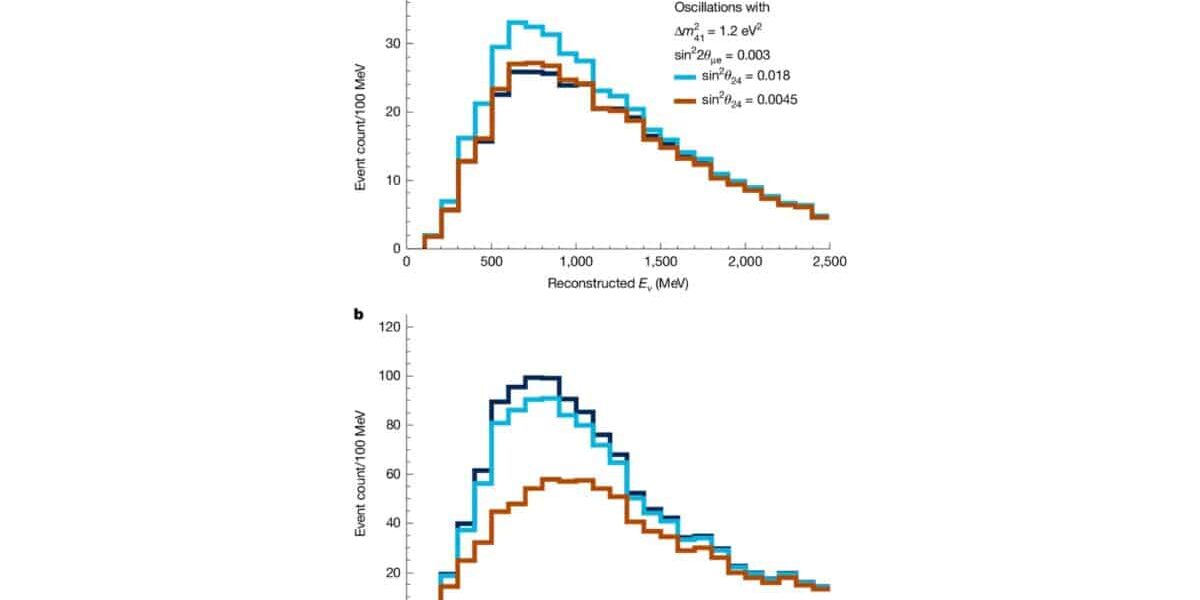
The MicroBooNE experiment was created to investigate these anomalies more closely. Located at the U.S. Department of Energy’s Fermilab in Illinois, it uses a powerful neutrino beam and a sensitive detector filled with liquid argon to measure how neutrinos change as they travel. The experiment’s goal was to break through the “degeneracy” of neutrino states, meaning it would try to catch neutrinos shifting types in ways the Standard Model couldn’t explain.
The researchers looked for two signs: if muon neutrinos were becoming electron neutrinos at a rate not predicted by current physics, or if electron neutrinos were disappearing in a way that implied interference. Both would suggest a hidden fourth particle at work.
But the experiment’s data showed no such effects. “We find no evidence for either [muon to electron neutrino] flavor transitions or [electron neutrino] disappearance,” the researchers reported in a paper published in Nature. In other words, the strange behavior seen in past experiments wasn’t caused by a sterile neutrino.
Simplifying the Standard Model
While the result may seem like a loss, it actually helps clean up a messy chapter in neutrino research. For years, sterile neutrinos had been used as a possible answer for unexplained observations in how neutrinos interact with atomic nuclei and detectors. But this lack of confirmation “is more of a gain than a loss for particle physics.”
By ruling out a particle that would have added complexity to the Standard Model, scientists can now focus on other directions without being weighed down by an unconfirmed theory. The MicroBooNE experiment has removed a major uncertainty from the field.