This post was originally published on here
The breakthrough, reported in the journal Science Advances on January 1, comes from a team at the Chinese Academy of Sciences (CAS). Using a method based on plasma-wall self-organization, researchers maintained plasma stability at densities far above traditional limits, removing a major obstacle to sustained fusion reactions.
Nuclear fusion is often described as the holy grail of clean energy. Unlike fission, it doesn’t produce long-lived radioactive waste and relies on abundant fuel sources. But the conditions required to trigger and maintain a fusion reaction (extreme heat, pressure, and confinement) have long kept it out of reach. Among the most stubborn of these challenges has been the Greenwald Limit, an empirical cap on how dense plasma can get before becoming unstable in tokamaks. Overcoming it has been one of the field’s top priorities.
The EAST (Experimental Advanced Superconducting Tokamak) reactor, operated in Hefei, China, has been at the forefront of magnetic confinement fusion experiments for years. With its latest success, it becomes the first tokamak to experimentally reach a state in which plasma remains stable even as its density continues to increase, something long thought to be unachievable.
Record-Breaking Plasma Density and How It Was Achieved
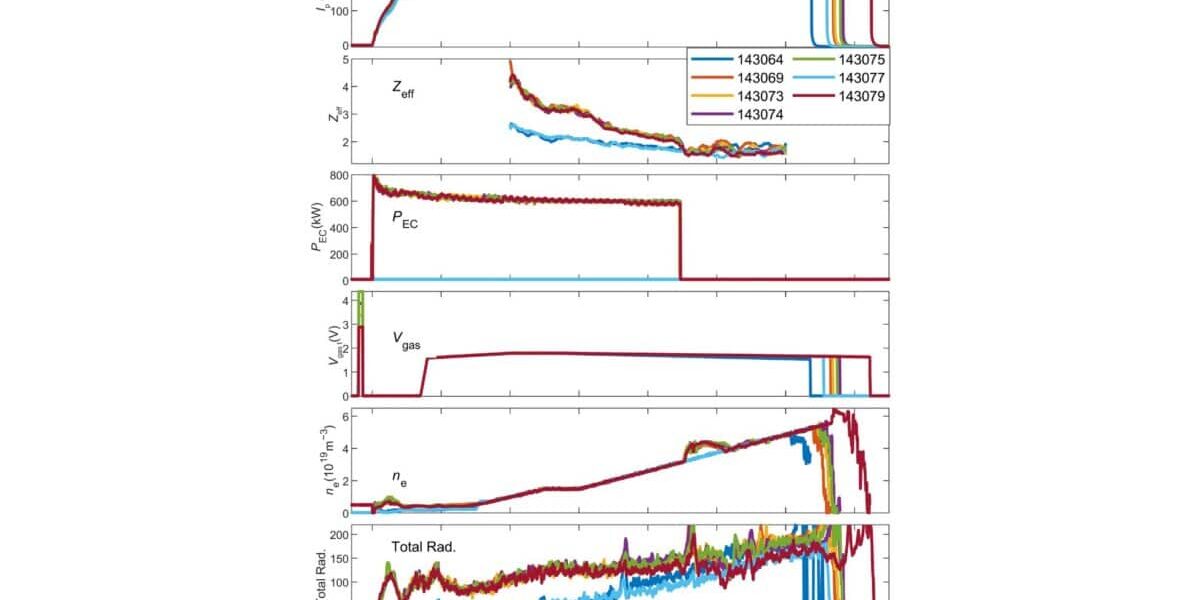
At the heart of the breakthrough lies a specific startup method: electron cyclotron resonance heating (ECRH)-assisted ohmic startup. By preloading the reactor with high-pressure neutral gas and applying targeted microwave heating during the early phase of plasma formation, the team was able to carefully shape the interaction between the plasma and the tokamak walls.
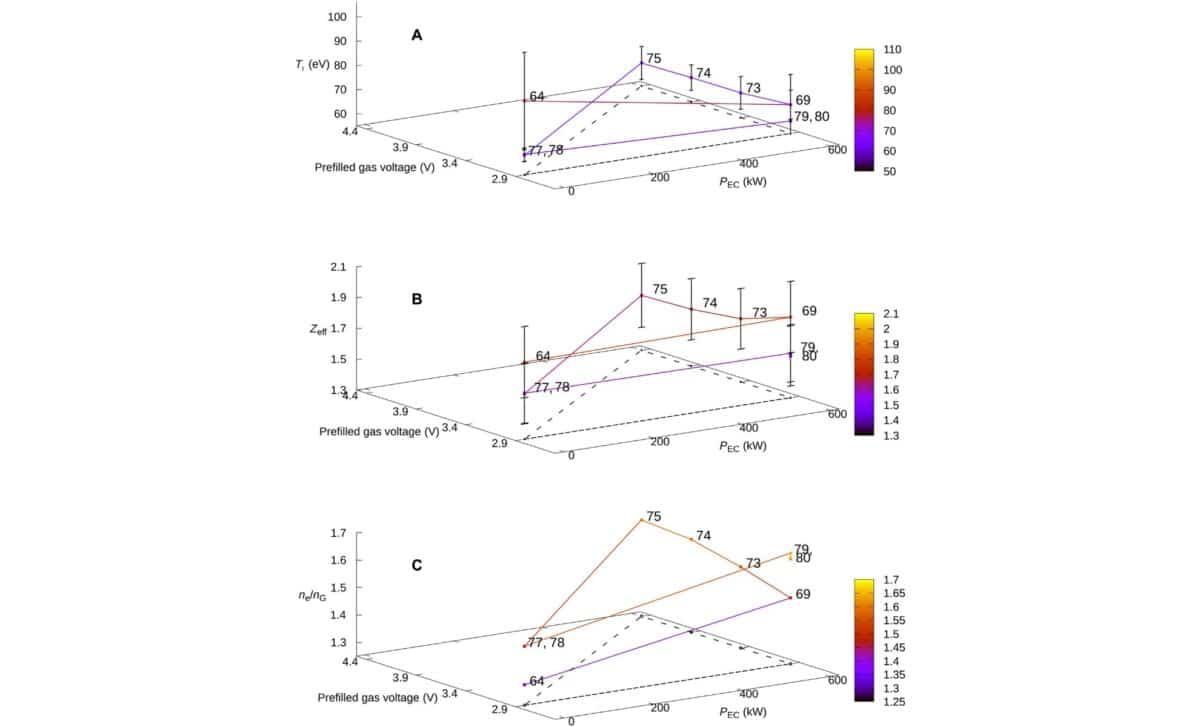
According to Science Advances, the experiments achieved line-averaged electron densities in the range of 1.3 to 1.65 times the Greenwald limit, compared to EAST’s typical range of 0.8 to 1.0. The researchers noted that this performance was made possible by reducing impurity radiation and improving plasma cleanliness, key factors predicted by the plasma-wall self-organization (PWSO) theory.
By controlling parameters such as prefilled gas pressure and ECRH power, researchers manipulated wall conditions to limit the release of contaminants like tungsten and carbon into the plasma. As reported by the Chinese Academy of Sciences, this control kept the plasma from destabilizing and allowed the team to push it deeper into a high-density regime. In this state, energy losses were minimized, and plasma remained steady far beyond what the empirical Greenwald threshold would normally permit.
Confirming a Long-Debated Theory on Fusion Limits
The experiment marks the first real-world validation of the PWSO theory, a model developed to explain how plasma and the surrounding reactor walls interact during high-density operation. The theory, initially introduced by researchers at CNRS and Aix-Marseille University, suggests that there is a “density-free basin” in which plasma can remain stable at much higher densities, as long as the right balance between impurity radiation and wall interaction is achieved.
The EAST results align with this prediction. Measurements taken during the experiments confirmed that the plasma temperature around the divertor region decreased as prefilled gas pressure increased, a behavior that matches the conditions described by the PWSO model. This suggests EAST successfully accessed the predicted “density-free” regime where the usual instabilities tied to high density are suppressed.
Professor Ping Zhu of Huazhong University of Science and Technology, who co-led the research, said the findings “suggest a practical and scalable pathway for extending density limits in tokamaks and next-generation burning plasma fusion devices.” Associate Professor Ning Yan, also involved in the research, added that the same method would be applied in future high-confinement EAST runs.
Implications for Future Tokamak Designs and International Research
The successful breach of the Greenwald Limit at EAST is expected to influence the design and operation of future fusion reactors worldwide. According to reporting from Live Science on January 9, similar density breaches had been recorded before (such as in the U.S. Department of Energy’s DIII-D facility and the University of Wisconsin’s experimental tokamak) but the Chinese achievement goes a step further by entering the stable density-free regime for the first time.
These results are especially relevant for ITER, the international fusion megaproject under construction in France. Both China and the U.S. are among the major contributors to ITER, and data from EAST may inform key decisions about how to manage plasma-wall interactions in that reactor as it prepares for first plasma later this decade.
China has reportedly invested over $13 billion into fusion research over the past three years and is working on multiple fusion approaches beyond magnetic confinement, as noted by Oilprice.com. While commercial fusion power is still years away, EAST’s new findings remove one of the largest physical barriers to ignition, and bring experimental fusion a step closer to becoming an actual power source.