This post was originally published on here
NASA to Earthlings: Help us farm Mars.
The nation’s space agency has launched an international competition to help feed astronauts stationed on Mars, asking for a two-week meal plan to feed an undetermined number of people. Winners can take home a $750,000 prize, as long as they’re U.S. citizens.
The competition, known officially as “Mars to Table” ‒ evoking the foodie phrase “farm to table” ‒ asks participants to design a system for growing and producing food on the Red Planet. Organizers say they want to use what they learn from this competition to help both Mars astronauts and people still on Earth.
“By designing food systems that operate reliably under extreme constraints, Mars to Table highlights approaches that reduce dependence on fragile supply chains, maximize resource efficiency, and enable food production where traditional systems fall short,” competition organizers said in an announcement. “In doing so, the challenge bridges space exploration with Earth’s most demanding food challenges.”
Winning the next space race
President Donald Trump has vowed that an American will be the first person to set foot on Mars, and has outlined an ambitious project to return astronauts to the Moon in two years, and to begin building a permanent nuclear-powered lunar outpost by 2030. A mission to test out some of that technology, Artemis II, is scheduled to launch sometime in the next several months.
Advertisement
Advertisement
NASA is hoping to send people to Mars sometime in the 2030s, although Congress earlier in January killed a precursor program designed to collect rock samples from Mars and return them to Earth. That “Mars Sample Return” project would have helped pioneer new technologies that could be used on crewed Mars missions.
Astronauts headed to and living on Mars will face significant food challenges, NASA notes, from making sure they get proper nutrition to “menu fatigue” from eating the same meal too frequently. NASA has previously said experiments aboard the International Space Station are helping inform food planning for Mars missions.
NASA noted that it already knows how to produce and package food for short-duration missions, or missions like the ISS where resupply is possible. Officials also said the competition is aimed at developing ways to farm on Mars.
In the contest, up to half of the food can originally come from Earth, which indicates organizers want entries prioritizing high-nutrition crops.
Advertisement
Advertisement
Competitors have until Aug. 21 to submit their proposals for the Mars to Table contest, with winners announced in September. International teams can compete, but are not eligible for the cash prize.
The competition evokes the 2015 Matt Damon blockbuster movie The Martian, in which a stranded NASA astronaut grows potatoes in order to survive.
Why target Mars?
Depending on their orbits, Mars and Earth can be as close as 33 million miles or as far apart at 249 million miles, NASA said.
Earth is the third planet orbiting the Sun, and Mars is the fourth. Known as the red planet because it’s covered in iron-rich rocks that have rusted, scientists believe Mars once had water, although none has yet been found by probes.
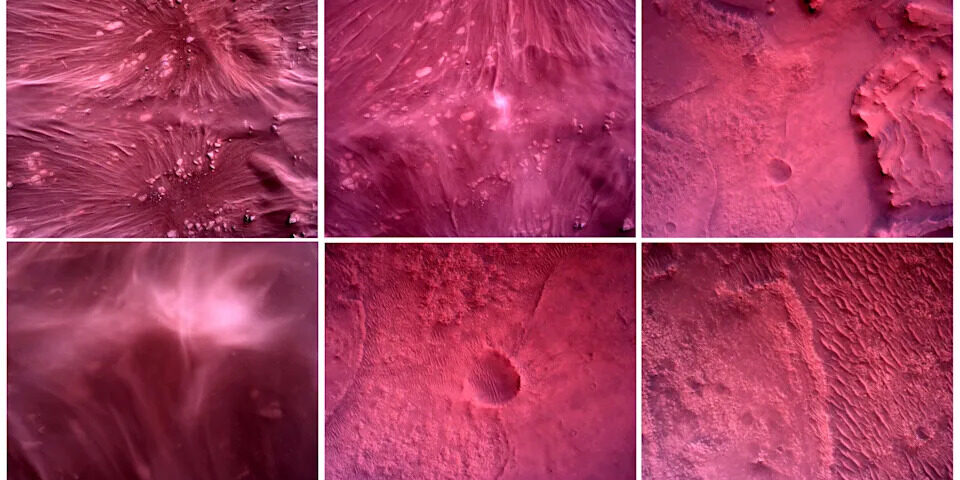
The surface of Mars directly below NASA’s Mars Perseverance rover is seen using the Rover Down-Look Camera in a combination of images acquired February 22, 2021.
Its gravity is about 40% what we have on Earth, meaning a person who weighs 200 pounds on Earth weighs 76 pounds there. It also has a thin atmosphere, with almost no breathable oxygen.
Advertisement
Advertisement
In addition to the food problem, NASA scientists are also tackling how to provide power and shelter to astronauts living on Mars. While nuclear power appears to be in the running for the power solution, NASA said it’s working with private contractors to determine how to best shelter astronauts from micrometeoroids and radiation.
Scientists are also studying how to make oxygen on Mars and developing laser-based communication systems that would permit faster transfer than current radio-based systems.
Republican megadonor Elon Musk has criticized the speed at which NASA operates, and has suggested that private rockets like his Starship will instead be more successful. Musk’s SpaceX says that up to a million people will be needed to build a new city on Mars, with Earth launches up to 10 times daily during favorable orbital windows necessary to carry the people and cargo to build a second home for humanity.
This article originally appeared on USA TODAY: NASA needs takeout on Mars