This post was originally published on here
New research indicates that humans shaped their environments through hunting and controlled use of fire tens of thousands of years before agriculture emerged. According to the study’s co-authors, the findings offer a revised view of how early humans interacted with the landscape.
Picture Europe tens of thousands of years ago as a landscape dominated by dense forests and roaming herds of elephants, bison, and aurochs, alongside small human communities equipped with fire and simple weapons. New research suggests these early people altered their surroundings far more than scientists once believed.
An international research team, including scientists from Aarhus University, used advanced computer simulations to examine how vegetation in Europe was shaped during two past warm periods. The models assessed the combined influence of climate, large animals, fire, and human activity, and the results were compared with detailed pollen records from the same time intervals to determine how each factor contributed to changes in plant cover.
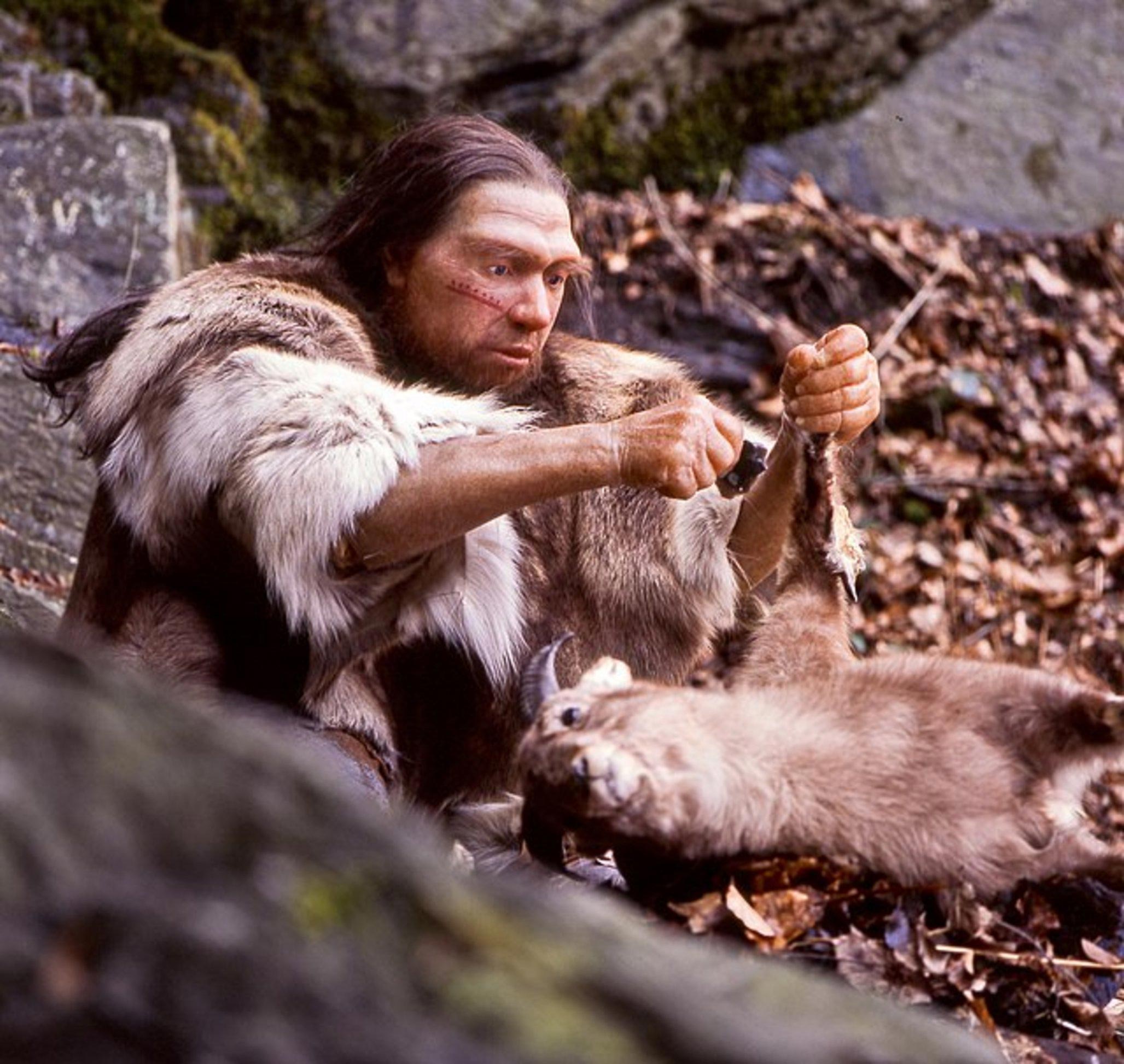
The findings show that both Neanderthals and later Mesolithic hunter-gatherers significantly influenced European vegetation patterns. These impacts occurred long before agriculture emerged, indicating that humans began reshaping landscapes much earlier in prehistory than previously assumed.
“The study paints a new picture of the past,” says Jens-Christian Svenning, professor of biology at Aarhus University and one of the researchers behind the study, which was undertaken in collaboration with colleagues in archaeology, geology, and ecology from the Netherlands, Denmark, France, and UK.
“It became clear to us that climate change, large herbivores, and natural fires alone could not explain the pollen data results. Factoring humans into the equation – and the effects of human-induced fires and hunting – resulted in a much better match,” says Jens-Christian Svenning.
The results have just been published in PLOS One.
Humans displaced large animals
The researchers concentrated on two distinct warm phases in Earth’s past.
The first is the Last Interglacial period, which occurred from about 125,000 to 116,000 years ago, when Neanderthals were the only human population living in Europe. The second is the Early Holocene, spanning roughly 12,000 to 8,000 years ago, shortly after the end of the last ice age, when Mesolithic hunter-gatherers of our own species, Homo sapiens, inhabited the region.
During the Last Interglacial period, Europe supported a diverse community of large animals. Elephants and rhinoceroses shared the landscape with bison, aurochs, horses, and deer, creating ecosystems far richer than those seen today.
In the Mesolithic, the picture was different: The largest species had disappeared or their populations had been greatly reduced in size – due to the general loss of megafauna that followed in the wake of the spread of Homo sapiens across the globe.
New view of prehistoric man
“Our simulations show that Mesolithic hunter-gatherers could have influenced up to 47% of the distribution of plant types. The Neanderthal effect was smaller, but still measurable – approximately 6% for plant type distribution and 14% for vegetation openness,” says Anastasia Nikulina.
The human-induced effects on vegetation included both fire effects – burning of trees and shrubs – and a previously overlooked factor: the hunting of large herbivores.
“The Neanderthals did not hold back from hunting and killing even giant elephants. And here we’re talking about animals weighing up to 13 tonnes. Hunting also had a strong indirect effect: fewer grazing animals meant more overgrowth and thus more closed vegetation. However, the effect was limited, because the Neanderthals were so few that they did not eliminate the large animals or their ecological role – unlike Homo sapiens in later times,” says Jens-Christian Svenning.
Anastasia Nikulina and Jens-Christian Svenning both believe that the results offer a new perspective on the role of our ancestors in the natural landscape. In fact, it challenges the notion of an ‘untouched landscape’ in Europe before agriculture came along:
“The Neanderthals and the Mesolithic hunter-gatherers were active co-creators of Europe’s ecosystems,” says Jens-Christian Svenning. “The study is consistent with both ethnographic studies of contemporary hunter-gatherers and archaeological finds, but goes a step further by documenting how extensive human influence may have been tens of thousands of years ago – that is, before humans started farming the land,” elaborates Anastasia Nikulina.
Interdisciplinary knowledge behind study
She highlights the interdisciplinary collaboration – between ecology, archaeology palynology (knowledge about pollen) – and the development of advanced computer models for simulating past ecosystems as strengths of the study.
“This is the first simulation to quantify how Neanderthals and Mesolithic hunter-gatherers may have shaped European landscapes. Our approach has two key strengths: it brings together an unusually large set of new spatial data spanning the whole continent over thousands of years, and it couples the simulation with an optimization algorithm from AI. That let us run a large number of scenarios and identify the most possible outcomes,” says Anastasia Nikulina.
Jens-Christian Svenning adds: “The computer modelling made it clear to us that climate change, the large herbivores such as elephants, bison, and deer, and natural wildfires alone cannot explain the changes seen in ancient pollen data. To understand the vegetation at that time, we must also take human impacts into account – both direct and indirect. Even without fire, hunter-gatherers changed the landscape simply because their hunting of large animals made the vegetation denser,” says Jens-Christian Svenning.
Despite the new study, there are still gaps in our understanding of the early impact of humans on the landscape, says Jens-Christian Svenning.
Anastasia Nikulina and Jens-Christian Svenning emphasize that it would be interesting to do computer simulations of other time periods and parts of the world. North and South America and Australia are particularly interesting because they were never populated by earlier hominin species before Homo sapiens, and you are therefore able to compare landscapes in the recent past with and without human influence.
“And although the large models paint a broad picture, detailed local studies are absolutely essential to improve our understanding of the way humans shaped the landscape in prehistoric times,” says Jens-Christian Svenning.
Reference: “On the ecological impact of prehistoric hunter-gatherers in Europe: Early Holocene (Mesolithic) and Last Interglacial (Neanderthal) foragers compared” by Anastasia Nikulina, Anhelina Zapolska, Maria Antonia Serge, Didier M. Roche, Florence Mazier, Marco Davoli, Elena A. Pearce, Jens-Christian Svenning, Dave van Wees, Ralph Fyfe, Katharine MacDonald, Wil Roebroeks and Fulco Scherjon, 22 October 2025, PLOS ONE.
DOI: 10.1371/journal.pone.0328218
Never miss a breakthrough: Join the SciTechDaily newsletter.
Follow us on Google and Google News.