This post was originally published on here
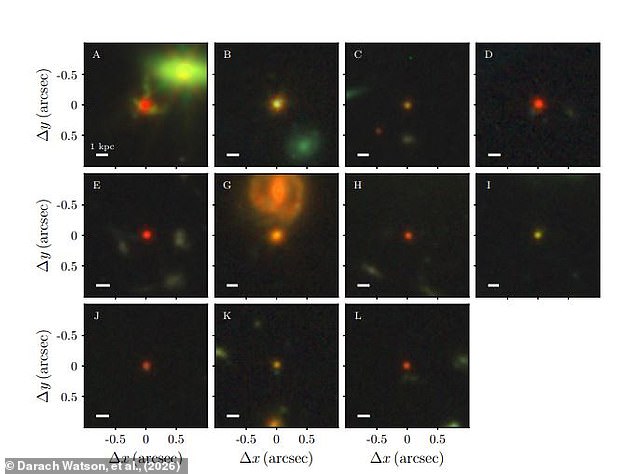
Scientists have solved one of the universe’s great mysteries as they finally reveal the identity of the ‘little red dots’ in deep space.
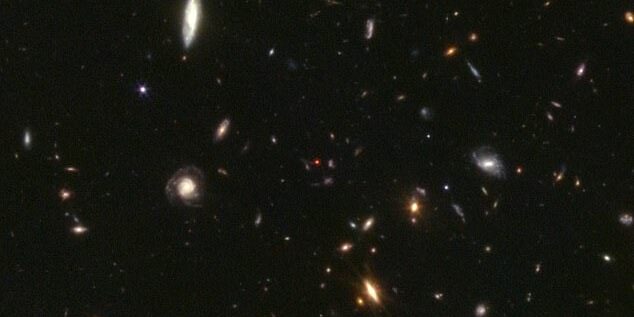
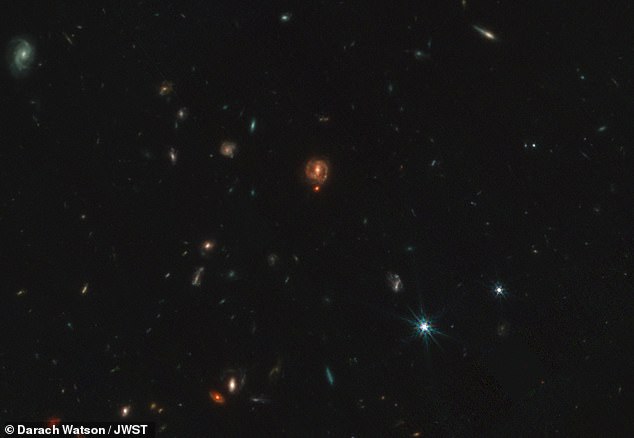
Ever since the James Webb Space Telescope (JWST) started peering back into the dawn of the universe, experts have been perplexed by the appearance of these tiny red dots.
Astronomers found hundreds of the faint lights in images from when the universe was only a few hundred million years old, without any clue what they might be.
Now, scientists from the University of Copenhagen have revealed that the JWST’s little red dots are actually ‘the most violent forces in nature’.
According to a new study, published in the journal Nature, the red dots are actually supermassive black holes concealed in ‘cocoons of ionised gas’.
As these young black holes feed on their cocoon, the swirling matter creates a vast amount of heat and radiation that shines out through the cloud of gas.
Lead author Professor Darach Watson says: ‘We have captured the young black holes in the middle of their growth spurt at a stage that we have not observed before.
‘The dense cocoon of gas around them provides the fuel they need to grow very quickly.’
When the first little red dots were discovered, they presented a baffling puzzle for astronomers of the early universe.
The dots first appear in images from around 13 billion years ago, and simply disappear about a billion years later.
At first, scientists thought that the dots must be very young galaxies in their earliest stages of formation.
However, this didn’t fit with our understanding of how the universe evolved after the Big Bang, as the first galaxies shouldn’t have been visible until much later.
Others suggested that the dots might be black holes, ultra-dense bodies formed by the collapse of enormous stars, but there was another problem.
Scientists couldn’t explain how any black hole could have become big enough to form a red dot so soon after the Big Bang.
Professor Watson’s solution is that the black holes that form little red dots are actually much smaller than previously thought.
He says: ‘When gas falls towards a black hole, it spirals down into a kind of disk or funnel towards the surface of the black hole.
‘It ends up going so fast and is squeezed so densely that it generates temperatures of millions of degrees and lights up brightly.’
‘The red colour arises because the UV and X-ray radiation from the central black hole is absorbed and reprocessed by the ionised gas around it, which gives it the characteristic red colour and spectra that look reminiscent of a star.
Professor Watson and his co-authors looked at the spectral emission lines, the ‘fingerprint’ of the light being released, from several little red dots.
Just as they had suspected, these spectral lines were missing much of their UV and X-ray radiation, suggesting that the light was passing through a cloud of gas.
More importantly, this data also shows that little red dots are far smaller than previously thought.
Professor Watson told the Daily Mail: ‘They are quite small – only a few light days or weeks at most.
‘The only mechanism we know in the universe that can dump that much energy in such a small volume is a BH.’
In fact, their analysis shows that the masses of these objects are about 100 times lower than astronomers had assumed.
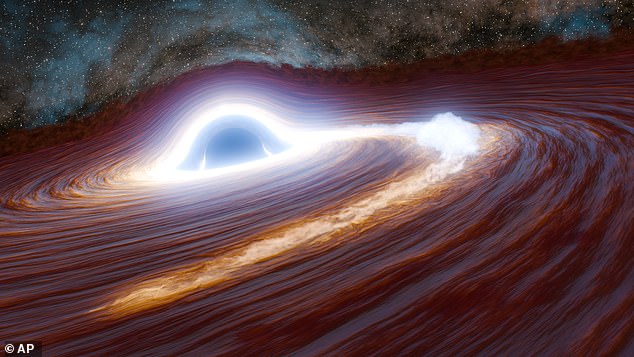
Even though these would be some of the smallest black holes ever discovered, they are still up to 10 million times more massive than the sun and have diameters of over 6.2 million miles (10 million km).
However, that is still ‘small’ enough to be consistent with our understanding of how black holes formed after the Big Bang.
The researchers say this discovery could shed light on how black holes appeared so quickly in the early universe.
These young black holes’ feeding frenzies could allow them to grow at speeds close to the maximum theoretical rate, known as the Eddington Limit.
That could explain why astronomers have started to discover black holes with masses up to a billion times greater than the sun, just 700 million years after the Big Bang.
‘We found that the black hole masses are 10 to 100 times smaller than previously supposed, and that they are accreting gas at the limit, so these facts ease up very much on the problem of how they grow so fast,’ says Professor Watson.
‘These black holes are more like one of the missing links between stellar mass black holes and the real monster black holes that lie in quasars that are 1000 times larger than the Little Red Dots.’