This post was originally published on here
Four astronauts returned to Earth early Thursday morning after leaving the International Space Station a month early because of a medical issue.
NASA’s SpaceX Crew-11 safely splashed down off the coast of San Diego after just over five months aboard the space station. The crew included two NASA astronauts, Zena Cardman and Mike Fincke; Japanese astronaut Kimiya Yui; and Russian cosmonaut Oleg Platonov.
The SpaceX Dragon spacecraft returned to Earth at 1:41 a.m. MST and the astronauts were sent to a nearby hospital for evaluation.
Advertisement
Advertisement
“I couldn’t be prouder of our astronauts and the teams on the ground at NASA, SpaceX, and across our international partnerships,” said NASA Administrator Jared Isaacman, in a release from the agency. “Their professionalism and focus kept the mission on track, even with an adjusted timeline.”
Crew-11’s return to Earth
On Jan. 8, NASA announced that Crew-11’s mission would end a month early because of a medical situation involving one of the astronauts, as previously reported by the Deseret News. NASA has not disclosed which astronaut had the medical issue or what the nature of the medical situation was. The crew was scheduled to return in mid-February.
The astronaut is said to be in stable condition and the mission was ended out of an abundance of caution.
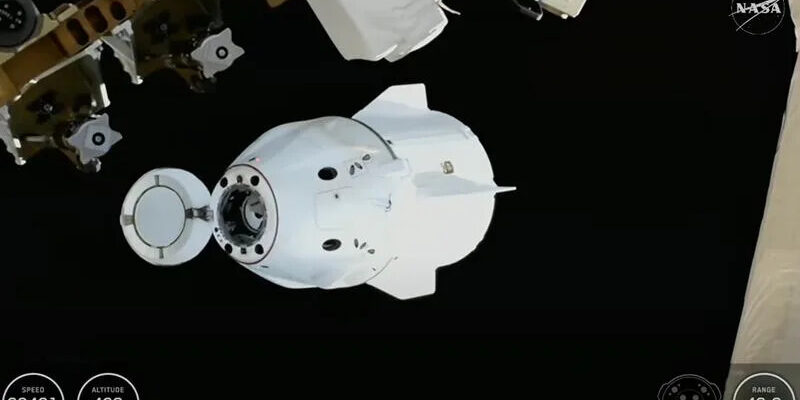
This screengrab from video provided by NASA TV shows the SpaceX Dragon departing from the International Space Station shortly after undocking with four NASA Crew-11 members inside on Wednesday, Jan. 14, 2026. | NASA via Associated Press
The crew prepared for its departure on Tuesday by parking cargo, transferring hardware and reviewing procedures for the return to Earth. Crew-11 left the International Space Station on Wednesday at 3:20 p.m. MST. This was the first time in the 25-year history of astronauts living on the space station that someone had to return to Earth because of a medical issue, per ABC News.
Advertisement
Advertisement
After leaving the space station, the crew waited in orbit for 9½ hours until the spacecraft’s trajectory was in line with the landing site, according to The New York Times. The final fall back into Earth’s atmosphere was started by a 13-minute thruster firing. The capsule was slowed with parachutes before landing in the Pacific Ocean.
After the planned overnight hospital stay, all four crew members will return to Houston for standard postflight reconditioning and evaluations at NASA’s Johnson Space Center, per NASA’s release.
Crew-11’s time on the International Space Station
The Crew-11 mission left Earth on Aug. 1, 2025, launching from NASA’s Kennedy Space Center in Florida, per NASA’s news release. During their 167 days on the space station, the group traveled nearly 71 million miles, completed over 2,670 orbits around Earth and conducted more than 140 science experiments.
The research the astronauts conducted helps space agencies prepare for future human exploration of the moon and eventually Mars.
Advertisement
Advertisement
“Missions like Crew-11 demonstrate the capability inherent in America’s space program — our ability to bring astronauts home as needed, launch new crews quickly, and continue pushing forward on human spaceflight as we prepare for our historic Artemis II mission, from low Earth orbit to the Moon and ultimately Mars,” Isaacman said in the release.
This mission was Fincke’s fourth spaceflight, the second for Yui and the first for both Platonov and Cardman. Fincke has spent a total of 549 days in space, ranking him fourth among NASA astronauts for cumulative days in space.
During their time on the International Space Station, the crew also celebrated the 25th anniversary of the first crew’s arrival on the space station.
Other astronauts currently aboard the International Space Station
After Crew-11’s departure, three other astronauts remain on the space station: NASA’s Christopher Williams and Russia’s Sergey Kud-Sverchkov and Sergey Mikaev. That crew arrived on a Russian Soyuz spacecraft in November and is scheduled to stay on the space station until summer.
Advertisement
Advertisement
Another Crew Dragon is scheduled to launch in mid-February, bringing four new astronauts to the space station, per The New York Times. That mission, Crew-12, will spend nine months in orbit.
Both Crew-11 and Crew-12 are part of NASA’s Commercial Crew Program, a partnership with private companies to help deliver people to and from the International Space Station.
NASA officials are investigating if Crew-12 could launch sooner so the space station isn’t short-staffed for as long. According to The New York Times, it is unclear yet whether an early Crew-12 launch would interfere with preparations for NASA’s Artemis II mission. That mission will send four astronauts on a journey around the moon without landing and is trying to launch in early February.