This post was originally published on here
Astronomers have uncovered a startling behavior in black holes: they toggle between launching high-speed plasma jets and blasting powerful winds, but never do both at once. This seesaw-like activity, discovered through three years of observation, reveals a self-regulating mechanism that could reshape our understanding of black holes’ role in galaxy evolution.
The discovery stems from detailed monitoring of the black hole binary system 4U 1630−472, using NASA’s NICER X-ray telescope and the MeerKAT radio array. Scientists tracked this system across multiple outbursts and found that black holes appear to operate under a strict energetic trade-off, either expelling matter as jets or winds, but not both. This finding challenges previous assumptions that these outflows might coexist, instead suggesting a deeper physical constraint tied to how black holes distribute energy.
The implications are far-reaching. Black holes don’t just swallow matter from surrounding space, they also influence how galaxies grow by controlling how material is expelled. Since both jets and winds help redistribute gas and dust (the building blocks of stars) this behavior could determine star formation rates and, by extension, the long-term evolution of galaxies.
Magnetic Fields Drive an Energy Tug-Of-War
The team focused on 4U 1630−472, a stellar-mass black hole around ten times the mass of the Sun. This object pulls material from a companion star into a glowing accretion disk, where intense gravitational forces heat the gas into plasma. But instead of passively consuming this matter, the black hole seems to alternate between two energetic responses: relativistic jets and high-ionization winds.
“We’re seeing what could be described as an energetic tug-of-war inside the black hole’s accretion flow,” explained Jiachen Jiang from the University of Warwick. Observations showed that each time the X-ray wind appeared in the data, the radio jet disappeared, and vice versa. This anti-correlation remained consistent across 28 simultaneous NICER and MeerKAT observations from 2020 to 2023.
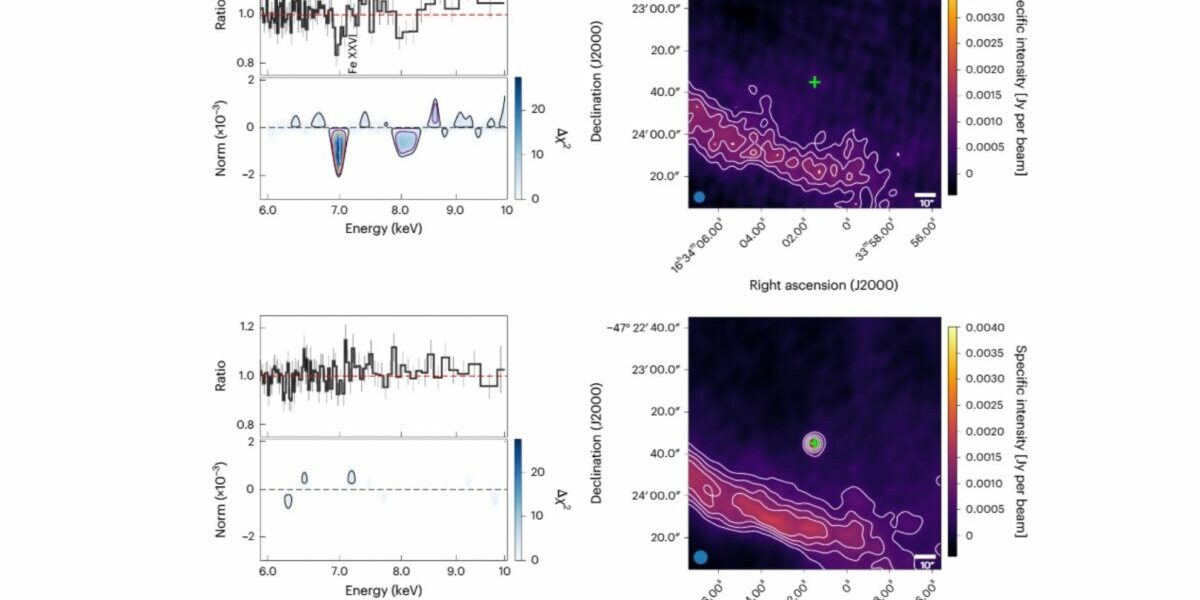
In one case, NICER recorded an X-ray wind traveling at roughly 300 kilometers per second, marked by a strong Fe XXVI absorption line. The corresponding MeerKAT data, taken within two days, revealed no detectable radio jet, with an upper flux limit of 0.45 mJy. On another occasion with nearly identical X-ray flux, the black hole emitted a 1.90 mJy radio jet while showing no signs of X-ray winds. These patterns suggest not randomness but a regulated switching mechanism.
Same Energy, Different Modes of Escape
Despite these dramatic shifts in outflow type, researchers noted that the total amount of matter and energy expelled remained consistent. According to the article published in Nature Astronomy on January 5, 2026, this stability implies that black holes maintain a steady output, simply changing the form of their emission depending on internal conditions, particularly the configuration of magnetic fields in the accretion disk.
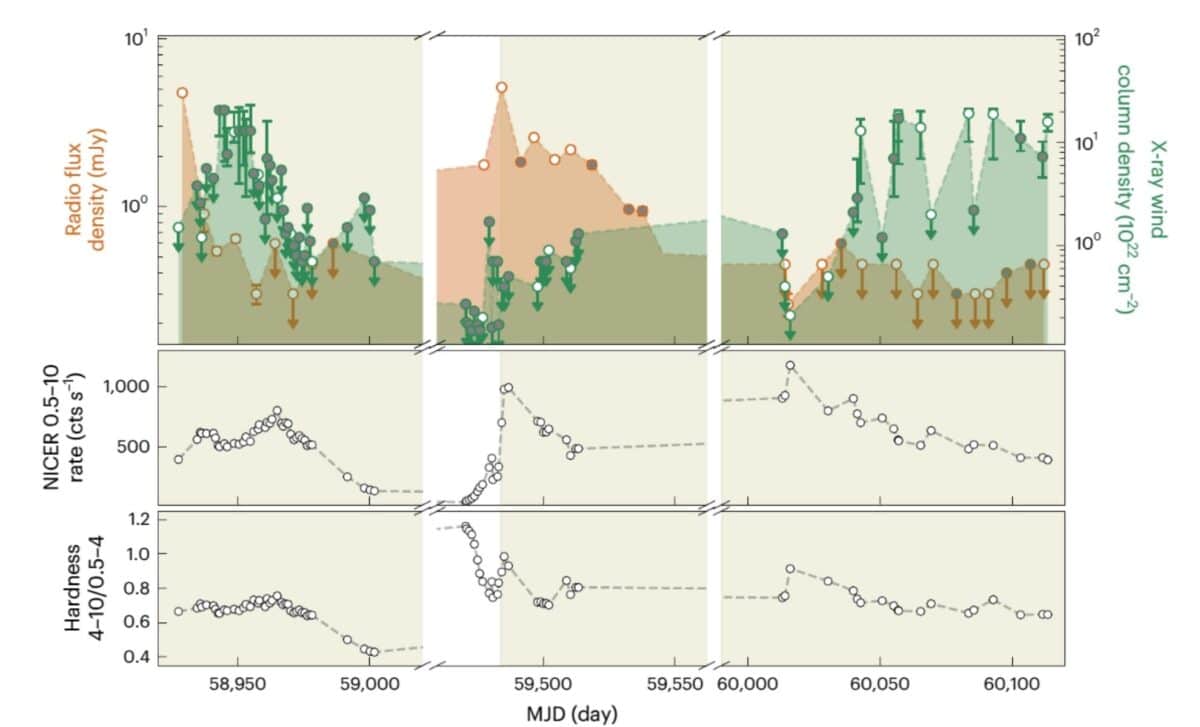
“When the black hole fires off a high-speed plasma jet, the X-ray wind dies down, and when the wind starts up again, the jet vanishes,” said Jiang. This seesaw mechanism suggests that jets and winds compete for the same reservoir of infalling matter. One explanation is that strong poloidal magnetic fields channel matter into jets, while weaker or more tangled fields allow winds to dominate.
During the 2021 outburst of 4U 1630−472, the system exhibited radio flux densities between 2 and 5 mJy, accompanied by negligible X-ray wind signatures (column densities below 10²² cm⁻²). In contrast, the 2022–2023 soft state phase showed strong X-ray winds with column densities up to 3 × 10²³ cm⁻², and radio flux dropped to under 1 mJy. These transitions occurred without significant change in the accretion disk’s X-ray brightness, reinforcing the idea that magnetic field architecture, not fuel supply, governs the switch.
The Seesaw’s Effect on Galactic Ecosystems
What makes this discovery more than a curiosity is its broader impact on galaxy evolution. The outflows from black holes (whether in the form of jets or winds) inject energy back into their environment, influencing how gas and dust are distributed across galaxies. This in turn affects where and when stars can form.
According to the research, the seesaw pattern in 4U 1630−472 operates independently of accretion rate, meaning black holes may inherently regulate their own feedback to the cosmos. While jets punch through interstellar material at near-light speed, winds disperse gas more gradually, altering star formation conditions differently.
Zuobin Zhang of the University of Oxford, co-author of the study, emphasized this point, saying the data “highlight the complex interplay and competition between different forms of black hole outflows.” Understanding this interplay is key to grasping how stellar-mass black holes, like those in X-ray binary systems, shape their host galaxies over time. This self-regulating behavior now joins the growing body of evidence that black holes aren’t merely consumers of matter, but also active participants in the structure and evolution of the universe.