This post was originally published on here
Last Updated:
Supermassive black hole in galaxy J1007+3540 awakens after 100 million years, spewing powerful plasma jets across millions of light-years like a cosmic volcano


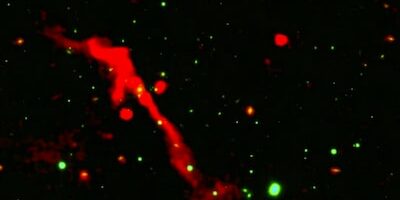
This LOFAR DR2 image of J1007+3540, overlaid on an optical Pan-STARRS image, shows a bright inner jet, signalling the reactivation of a previously ‘dormant’ supermassive black hole at the heart of the giant radio galaxy. (Image: LOFAR/Pan-STARRS/S. Kumari et al.)
A remarkable discovery from the depths of the universe has captivated astronomers. A massive black hole, which had remained dormant for around 100 million years, has suddenly become active. Scientists liken its activity to a cosmic volcano erupting, with jets extending across millions of light-years.
This extraordinary phenomenon has been observed in the radio galaxy J1007+3540. India’s Giant Metrewave Radio Telescope (uGMRT) played a pivotal role in this finding.
Recommended Stories
Powerful Jets And A New Structure In Space
Researchers report that the black hole is ejecting powerful jets of plasma from its core. The scale of this activity is so vast that it has created a new structure in space. This discovery demonstrates that supermassive black holes at the centres of galaxies can ‘wake up’ unexpectedly.
While most galaxies host such black holes, only a few actively emit plasma jets. J1007+3540 is remarkable for showing this rare behaviour.
Evidence Of Reactivation
The reactivation was identified through radio imaging. Lead researcher Shobha Kumari described it as a ‘new birth’ for the black hole. After 100 million years of silence, bright and powerful jets are now emerging, comparable to a sleeping volcano erupting once more.
Surrounding these jets is a large ring of old, faded plasma, likely the remnants of previous outbursts, indicating that the black hole alternates between active and quiet phases.
Influence Of The Galaxy Cluster Environment
The galaxy resides within a massive galaxy cluster, where the pressure of hot gases is extremely high. As the black hole’s new jets attempt to escape, they face significant resistance. The external pressure bends and compresses the jets, particularly in the northern region, which appears sharply curved in radio images.
Researchers note that the surrounding gases have effectively pushed the plasma to one side.
This interaction highlights that space evolution is turbulent, involving a constant struggle between the black hole’s power and the surrounding environment. A long, faded tail to the southwest, believed to be magnetic plasma from millions of years ago, is also visible. The environment clearly shapes the jets, showing how external forces influence the path and structure of these plasma streams.
International Collaboration & Telescope Observations
This discovery utilised LOFAR in the Netherlands and India’s uGMRT, among the most sensitive radio telescopes worldwide. Scientists from Midnapore City College and the Manipal Centre in India collaborated on this research.
uGMRT images revealed that the radio spectrum in compressed regions is very deep, indicating the presence of very old particles that are still being influenced by the newly emerging jets.
Implications For Astronomy
The study provides valuable insight into the cycle of black hole activity and dormancy, showing how a black hole can reignite even after millions of years of silence. Researchers now plan to study the galaxy’s centre in greater detail to measure how rapidly the jets are spreading through the environment.
Systems like J1007+3540 act as natural laboratories, helping scientists understand the mechanisms by which black holes influence and regulate their host galaxies.
January 16, 2026, 13:07 IST
Loading comments…
Read More