This post was originally published on here
WESTWOOD — “I love near-death experiences,” says Mark Watson. “Not that I love them, but the notion of people having an out-of-body experience, that they see things that are happening when they were literally clinically dead or unresponsive, but could see what was happening around them, things that we can’t explain. Science goes so far to explain some of these things, but it doesn’t. There’s a gray area when it stops.”
Watson, who teaches marine science, environmental science, and biology at Xaverian Brothers High School in Westwood, had a near-death experience when he was three years old. He fell into a pool and stopped breathing. If his mother, a nurse, hadn’t seen him and performed CPR, he would not have survived.
“I think that drives me sometimes with what I have daily in my life, and appreciate things more,” he said.
Watson is also “a huge ghost guy.” His colleague Joseph Webb says that ghosts and near-death experiences are simply terms for the soul leaving the body. The word “ghost” is a synonym for “spirit,” as in “Holy Ghost.” Webb cited studies of people who were able to accurately describe what happened to them while they were pronounced clinically dead.
“And so the Catholic Church would say that’s because their soul has become separated from their body during that time when they were clinically dead,” he said. “And you can call that a ghost, if you want to.”
He prefers the term “spirit.”
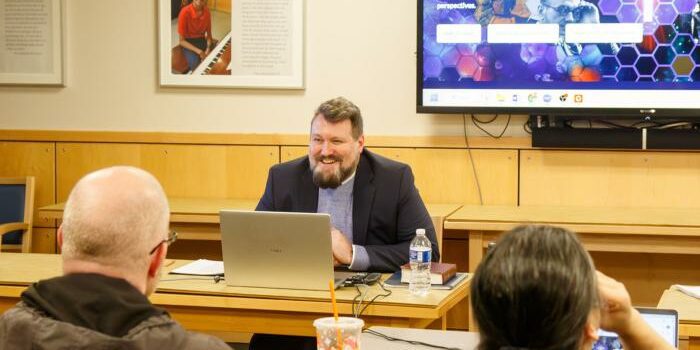
Such discussions are commonplace at Webb’s Critical Catholic Cosmology course, which meets in the Xaverian library every Tuesday. Webb’s course weaves together faith and science using the Bible, the catechism, moral theology, and references to “Star Wars,” “The Lord of the Rings,” and “Rick and Morty.” As a young man, Watson was a “science guy,” not focused on religion. Now, he sees no conflict between the two disciplines.
“It’s been a blurry line growing up for me, and I’ve never really given the religious side of everything a chance, because I was always grounded in the facts of science,” he said. “But this is giving me two hours a week to explore that intersection and what’s fact, fiction, what might have really happened, and given time to reflect on all that.”
The classes are a project of the Magis Center, a nonprofit whose founder, Jesuit Father Robert Spitzer, believes that science can prove Catholic teaching.
“His mission and the Magis Center’s mission is really trying to get that really powerful evidence into the hands of young people, and so my desire to share what I had learned made us really great partners in developing this course,” Webb said.
The course began with a first semester in spring 2025, and is currently concluding its second semester. The third will begin in February. It is offered and accredited through Pope St. John XXIII National Seminary in Weston. Several priests and seminarians there are interested in taking the course. The Magis Center has been in touch with the Archdiocese of Boston in hopes that more Catholic educators will attend classes. With the Magis Center’s involvement, the course may become a national project.
“I don’t know of any course that’s integrating science and faith the way this class is, and that’s using the cutting-edge new peer-reviewed science that’s being offered through this class,” Webb said.
About a dozen people attended the Jan. 6 class in-person or virtually, both current students and alumni. Many are faculty members at Xaverian, including Webb himself. The “Faith, Science, and Reason” course he teaches high schoolers inspired much of the content of Critical Catholic Cosmology. The course tackles the most common questions about God, and arguments against the Church.
On Jan. 6, Webb taught about “the problem of evil” — the age-old question of why an all-loving God allows bad things to happen to good people. There is an entire theological discipline, theodicy, dedicated to exploring this question.
“I think it’s a shame that sometimes we’ll shy away from strong atheist arguments as if we’re afraid of them, because I think there’s actually overwhelming evidence that helps us,” he said.
Student Edward Kozatek came from Pawtucket, Rhode Island, to attend the course. He comes from a family of various religions and ethnic backgrounds.
“Currently having conversations and being able to talk about things like this really helped me be able to better inform them and have better fruitful conversations with people in my own personal life that before I don’t think I was able to have,” he said. “Understanding different perspectives, as well as integrating the science with the faith, (is) something that’s unique compared to the other conversations that I’ve had in my personal life.”
Webb taught that the answer to the problem of evil comes “only through living the Christian life.”
He also spoke on the Catholic concept of redemptive suffering — the idea that suffering can strengthen the soul.
“It would be a fair accusation that sometimes Catholic folks can get a little too focused on the suffering,” he said. “Because ultimately, Catholicism, Christianity is our religion of joy and hope and triumph over suffering and triumph over pain.”
He then asked his students to think of all of the ways in which Christ suffered. He listed them on the whiteboard and went over them in great detail, particularly the type of whip that was used for the scourging and what the body goes through during crucifixion.
The course’s content is based on Webb’s own faith journey. He grew up devout, but studying theology and the history of the Church made him fall away. While Fordham is a Catholic university, many of his classmates rejected faith. He delved into academic study of the Bible. With his theology degree, he got a job at St. Patrick Parish in Natick, despite his doubts.
“God just kept nudging me, calling me back,” he said.
His job interview with the pastor felt more like a confession.
“You know, Joe,” the pastor told him, “A lot of people think about St. Thomas as the apostle who doubted, but I think of St. Thomas as the apostle, the first apostle to say ‘My Lord and my God’ after the resurrection.”
Webb went to the lower church to pray before the tabernacle. He said those words: “My Lord and My God.” He turned from the tabernacle to see a stained-glass window of St. Thomas. He took it as a sign.
“I built my faith up brick by brick, looking at science and looking at arguments in favor of God’s existence, arguments against God’s existence, and balancing them out until I found that it’s actually a really compelling case that God not only exists, but that the Gospels are true,” he said.