This post was originally published on here
From Copernicus to contemporary research, Catholics have long understood scientific inquiry as a partner with faith in the search for truth.
For more than a century, critics of Christianity have argued that modern science rendered religious belief obsolete. Father Dave Heney — a Catholic priest and archaeologist — says the opposite is true, contending that the Church has long understood scientific inquiry not as a threat to faith but as one of its natural allies.
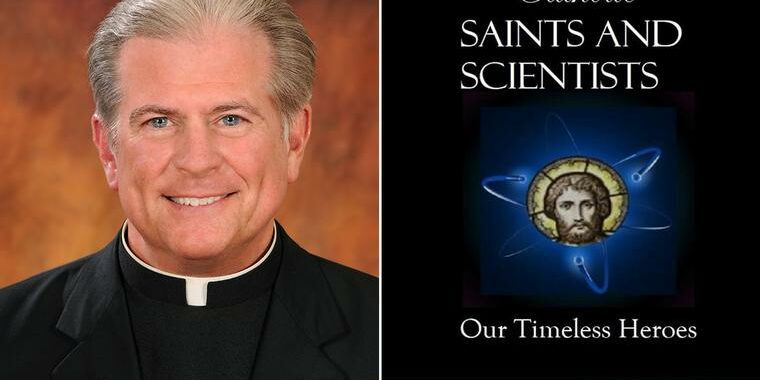
Father Heney, pastor of St. Bruno Church in Whittier, California, is the author or co-author of five books, most recently Catholic Saints and Scientists: Our Timeless Heroes (2025). Drawing on both scientific training and Catholic theology, he argues that the supposed conflict between faith and reason is a modern myth rather than a historical reality.
Your father was a scientist. How has this impacted you?
I grew up with science, reading many biographies of famous scientists. My father’s favorite phrase was, “Go where the data takes you.” Therefore, I learned to set my own ideas aside and follow what only observation reveals. I learned that truth is not just what I want, but what is objectively “out there.” This, fortunately, prevented me from accepting relativism, the belief that truth is subjective. This orientation to objective truth led me to the priesthood.
The New Atheists have characterized science as being at odds with faith. How would you respond?
As Pope St. John Paul II observed, God created the universe so the universe cannot contradict God. Even St. Paul chides the Romans for not seeing the universe correctly. “Ever since the creation of the world, his invisible attributes of eternal power and divinity have been able to be understood and perceived in what he has made …” (Romans 1:20). Our Catholic faith and science are never at odds but only affirm each other.
Many of the great scientists in history have been Catholic.
Yes, since Catholics believe God created the universe and our minds, both are open to discovery. Copernicus affirmed that the earth revolved around the sun, while serving as a canon at Poland’s Frombork Cathedral. Galileo was a faithful Catholic who accepted that his proof for heliocentrism was incorrect. Father Gregor Mendel discovered the laws of genetic inheritance. Louis Pasteur was the founder of bacteriology and the science of vaccines. Father Georges Lemaître discovered the math that affirmed the Big Bang.
A Catholic approaches science differently than a Protestant fundamentalist.
Catholics are not biblical fundamentalists. They accept the Bible as the “Word of God” in the historical cultural “Words of Men” [God used specific men and their talents to write the books of the Bible]. Catholics believe the Bible reveals the truth of what is necessary for our salvation. Therefore, Catholics are completely open and welcoming to scientific inquiry. We do not believe there is ever any conflict between science and faith; recent popes have affirmed there is no conflict with evolutionary theory. We only affirm that the soul is solely created by God.
Who are some of your favorite Catholic scientists?
Father Lemaître because his discovery is by far the most important in all of physics and the most verified to date. Einstein refused to accept his theory in 1927. In 1933, at CalTech, Lemaître convinced him. Einstein then said, “It was the most beautiful description of the origin of the universe!”
How do you blend in your knowledge of science with your teaching?
Annually I teach morality to our 8th grade. I affirm the two pillars of our Catholic faith: revelation, which is God’s direct communication in Scripture and Church teaching, and observation, which is his revelation through the observable universe (the natural law). There is never a conflict between revelation and observation.
What have you learned from your Holy Land archaeological pilgrimages?
Biblical archaeology is the happy union of science and religion. At each site we visit, we learn about its archaeological evidence. The most archaeological verified sites are the tomb of Jesus and his crucifixion site. This is the most amazing and fully verified event of all!
Bethlehem, Capernaum and Nazareth would follow in verification status. When our pilgrims realize some biblical event actually happened, they are profoundly moved. What is most amazing is that every single archaeological find has either been neutral or affirmed a biblical account.