This post was originally published on here
Hidden deep within the dry caves of northern Saudi Arabia, cheetahs lay undisturbed for centuries — their bodies slowly preserved by desert air, time and silence. Now, scientists have uncovered a rare natural phenomenon: the mummified remains of cheetahs that offer a striking glimpse into the Arabian Peninsula’s long-lost wildlife
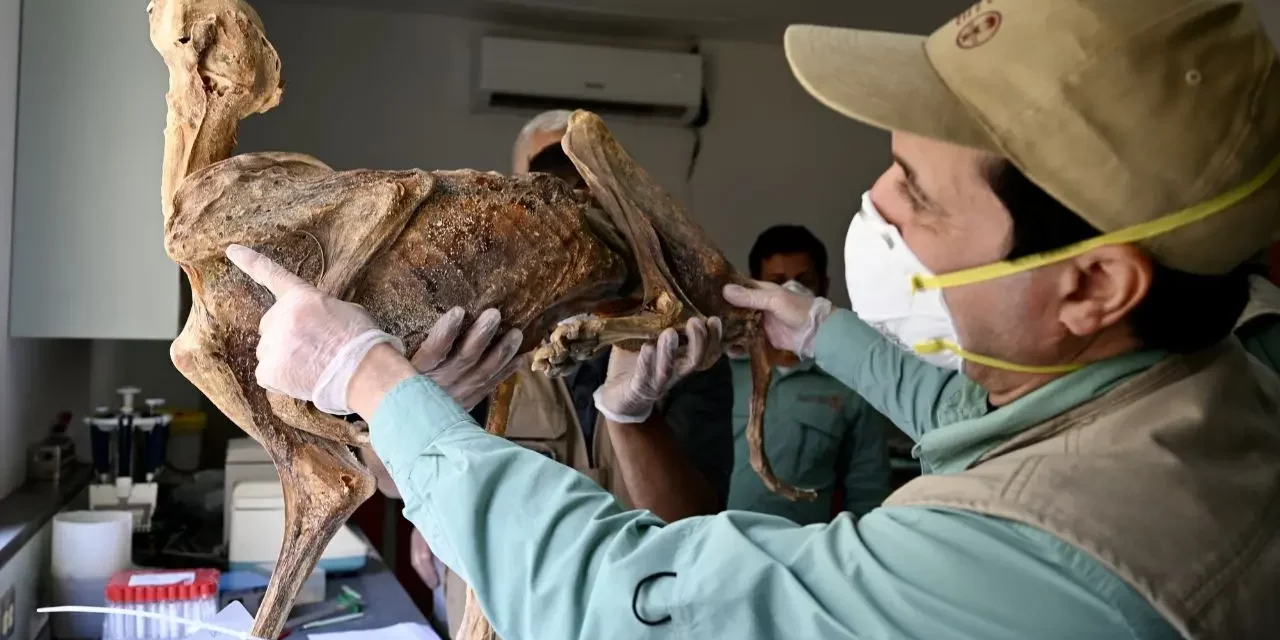
Scientists have uncovered a rare discovery in northern Saudi Arabia — the naturally mummified remains of cheetahs preserved inside desert caves for up to 2,000 years.
Researchers excavating caves near the city of Arar found seven mummified cheetahs along with skeletal remains of at least 54 others. Radiocarbon dating revealed that while some remains are about 130 years old, others date back more than 1,800 years, with some bones estimated to be nearly 4,000 years old.
Unlike the artificial mummification practices of ancient Egypt, the cheetahs were preserved naturally. Scientists believe the caves’ dry conditions, low humidity and stable temperatures slowed bacterial decay, allowing soft tissues to survive for centuries. The mummified cats were found with cloudy eyes and shriveled limbs, resembling dried husks.
“It’s something that I’ve never seen before,” said Joan Madurell-Malapeira of the University of Florence, who was not involved in the study.
The findings, published in the journal Communications Earth and Environment, represent the first known case of naturally mummified big cats suitable for ancient DNA analysis. While thousands of artificially mummified domestic cats have been discovered in Egypt, naturally preserved felids in cave systems had not been documented until now.
Researchers are still uncertain why so many cheetahs were present in the caves. One leading theory suggests the caves may have served as denning sites where mothers gave birth and raised their young. This is supported by the presence of cheetahs of different age groups and the relatively small number of prey remains found at the site. Modern cheetahs are not known to use caves, making the discovery particularly unusual.
Genomic analysis revealed that the ancient cheetahs were closely related to the Asiatic cheetah and the North-west African cheetah — both now absent from the Arabian Peninsula. The findings confirm that cheetahs once had a long-term presence in the region.
A New Tool for Conservation
Saudi Arabia’s extensive cave networks, especially along its northern border with Iraq, have previously yielded remains of wolves and hyenas, but evidence of cheetahs had not been documented until now. Beyond its archaeological significance, the discovery carries modern conservation value. Scientists also note that some caves may have acted as natural traps, while others created ideal conditions for preservation.
Beyond its archaeological significance, the discovery has important implications for conservation. The ancient DNA recovered from the remains provides rare insight into historical cheetah populations, genetic diversity and past ecosystems — data that could help guide future rewilding and restoration efforts in the Arabian Peninsula.
“The material opens a window to the past,” the researchers concluded, offering critical data that could shape evidence-based conservation strategies and future cheetah reintroduction plans.
With Inputs from AP